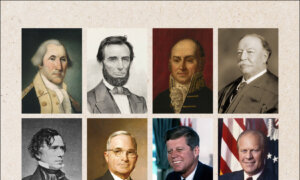

Of the 45 men who have served as U.S. presidents, four of them—Abraham Lincoln, James A. Garfield, William McKinley, and John F. Kennedy—died at the hands of an assassin. Others have escaped death or injury. In 1974, for example, an armed Samuel Byck boarded a Delta airliner in Baltimore and demanded that the pilots take him aloft with the intention of crashing the aircraft into the White House and killing Richard Nixon. When the pilots refused, he shot them, killing one, and then turned the gun on himself after being wounded by the police.
Three presidents were shot but survived their assassins’ bullets. Whatever we may think of Theodore Roosevelt, Ronald Reagan, and Donald Trump, the cool-headed courage and even humor that all three men demonstrated in the face of death makes an impression.
An Inch Away From the Grave
Most Americans are familiar with the now-iconic photograph of Trump surrounded by Secret Service agents after his attempted assassination at a political rally in Butler, Pennsylvania. Fist in the air, his right cheek streaked with blood from the wound to his ear, Trump shouted to the crowd and cameras, “Fight! Fight! Fight!”
Journalist and Trump acquaintance Salena Zito was seated four feet from the candidate, expecting to do an interview after his speech, when 20-year-old Thomas Crooks fired at the stage from a rooftop, clipping Trump’s ear, seriously wounding two other men, and killing another. Trump had turned toward a chart on the stage a split second before the assassin fired, just missing a kill shot.
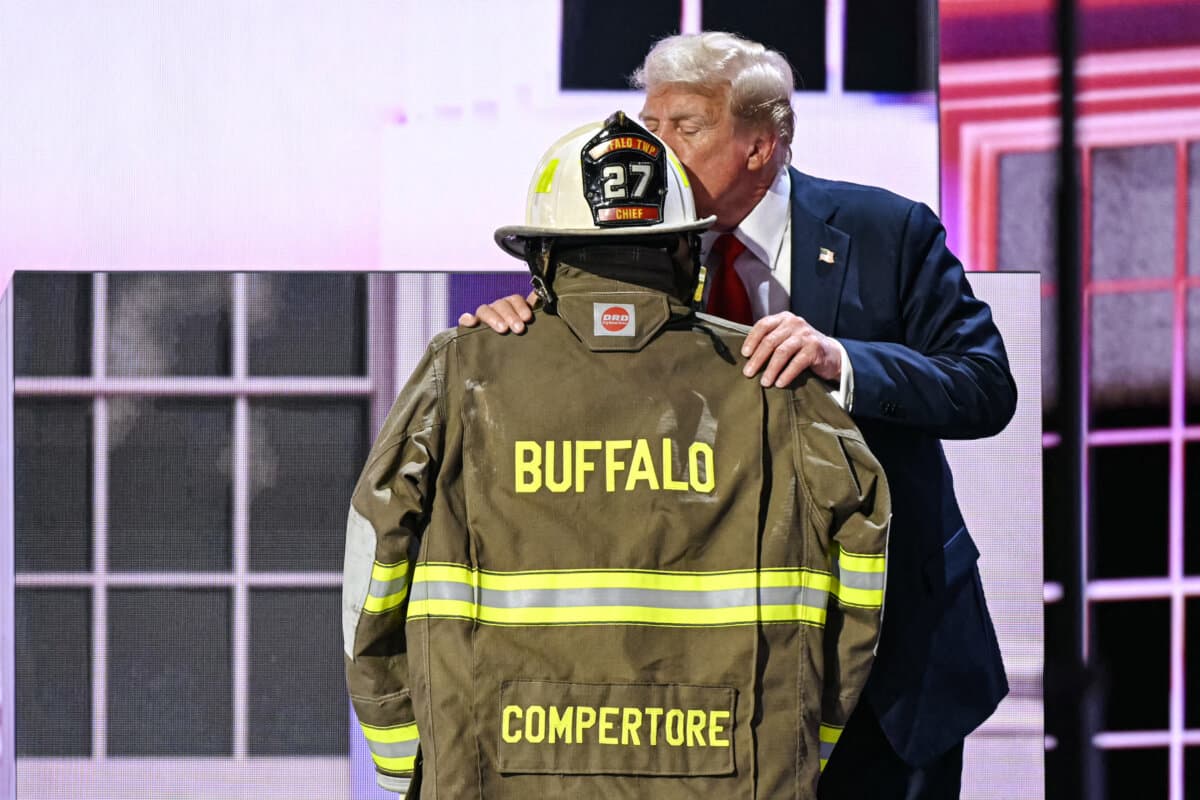
Then former President Donald Trump kisses a helmet and firefighter’s jacket that belonged to Corey Comperatore as he takes the stage to accept the Republican nomination at the Fiserv Forum on the final day of the 2024 Republican National Convention in Milwaukee on July 18, 2024. (Patrick T. Fallon/AFP via Getty Images)
Zito describes that moment in her book “Butler,” but what is equally revealing about Trump’s character was the grace he displayed in the aftermath of the shooting. Early the next day, he called Zito to make sure she was all right. After what he’d just gone through, Zito was shocked that he was calling to check on her status. She reassured him that she was fine.
Trump then telephoned her seven more times that day, with the calls totaling almost 90 minutes. He praised the treatment he had received in the local hospital, lamented the death of the man killed by the assassin, Corey Comperatore, asked several more times if Zito was all right, and praised those of his political enemies who had “reached out to make sure he was okay.”
In their last call of the day, Zito asked Trump outright what had made him turn to the chart at that exact moment. Like many people brushed by the cloak of death, Trump paused, then said: “God. The hand of God.”
Rawhide Down
“Rawhide” was the Secret Service code name for Ronald Reagan.
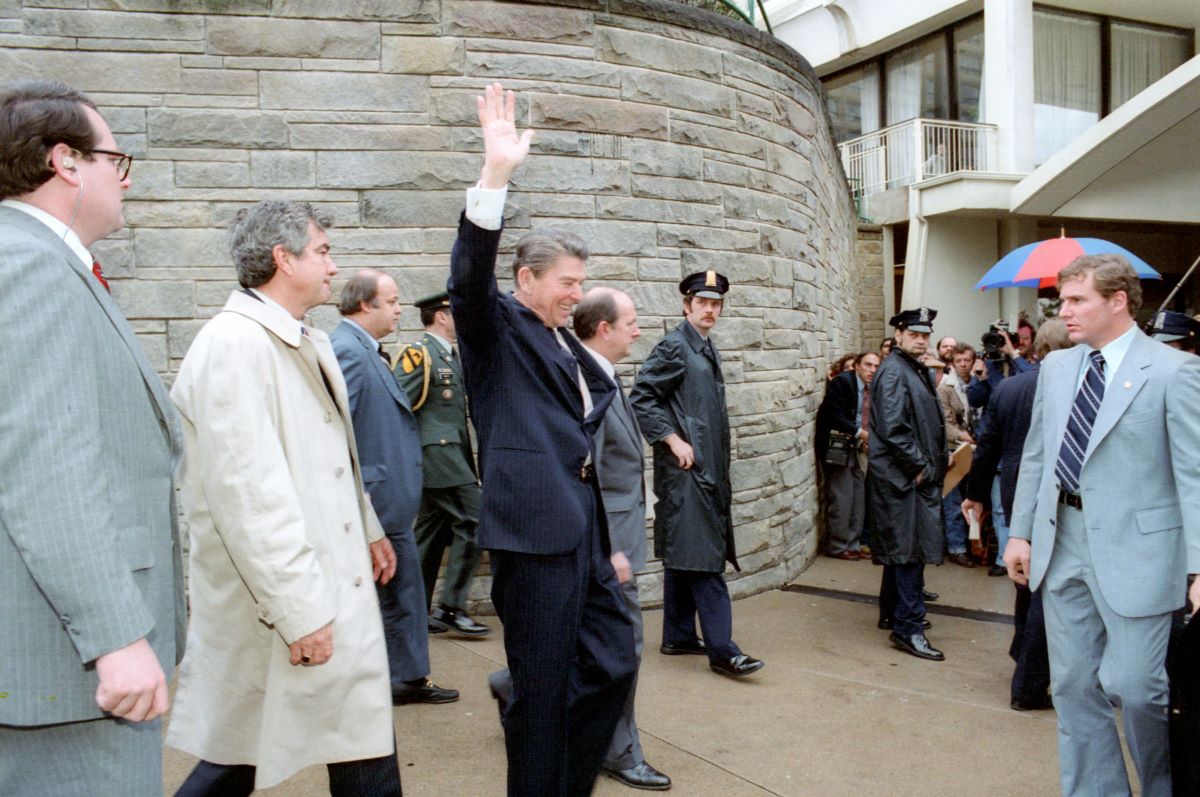
On March 30, 1981, just a little more than two months since taking the oath of office, Reagan and his entourage were leaving the Washington Hilton Hotel where he’d delivered a speech when a mentally troubled 25-year-old John Hinckley Jr. whipped out a pistol and fired six shots in less than two seconds, wounding Press Secretary James Brady, a policeman, and a Secret Service agent standing between Hinckley and the president.
The last shot ricocheted off the limousine, flattened out to the size of a dime, and struck Reagan in his left side. Once he realized the president had been wounded, agent Jerry Parr ordered the limo’s driver to head to George Washington University Hospital. On their arrival, Reagan insisted on walking inside, but then collapsed in the hallway.
The surgeons quickly determined that the wound was life-threatening and that surgery was needed to staunch the bleeding, with the bullet only an inch from Reagan’s heart. Before the bleeding was brought under control, Reagan lost more than half his blood volume that day.
Like Trump, Reagan was concerned with the welfare of those around him, particularly his wife, Nancy. As he lay on the gurney awaiting surgery, trying to calm her, he quoted a line by Jack Dempsey to his wife after losing a fight: “Honey, I forgot to duck.”
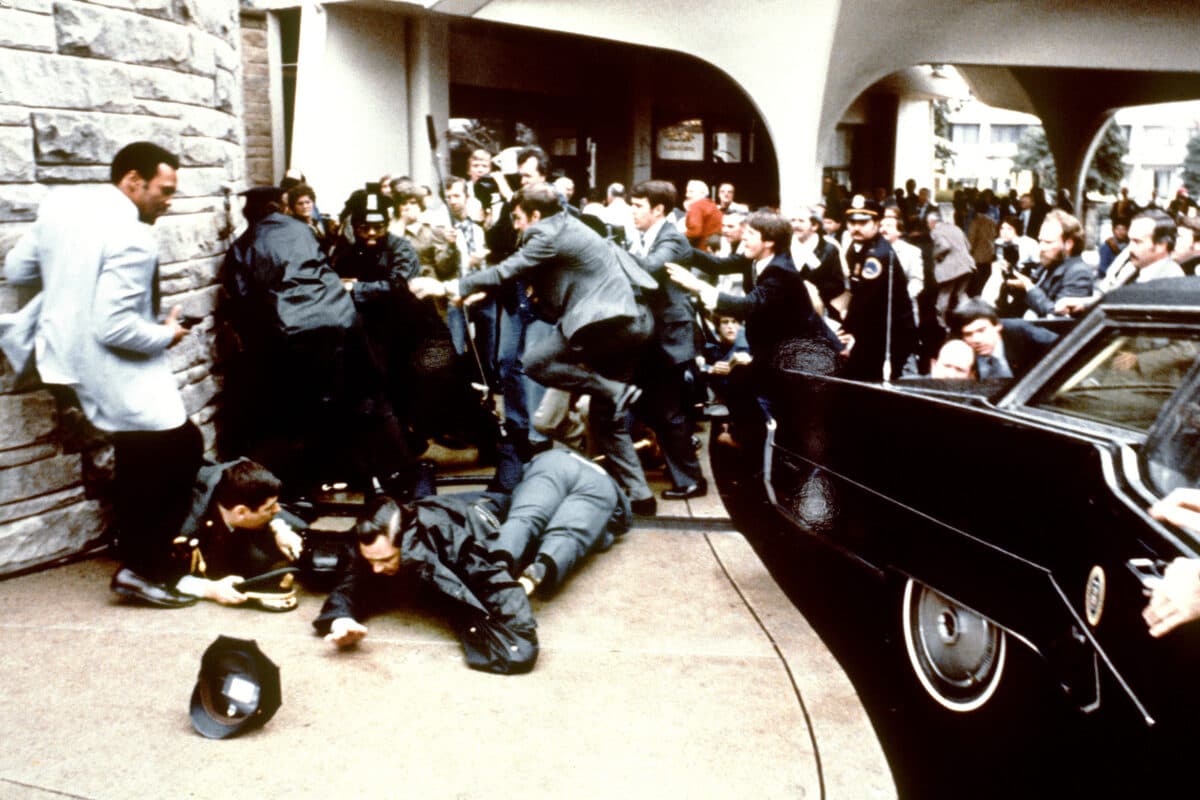
Police and Secret Service agents reacting during the assassination attempt on President Ronald Reagan in Washington on March 30, 1981. (Mike Evens/AFP via Getty Images)
He carried that humor into the operating suite, where he joked to the surgical team, “I hope you are all Republicans.” Liberal Democrat and surgeon Joseph Giordano gave a reply that soon made the news: “Today, Mr. President, we are all Republicans.” In recovery, he continued to bring smiles to his medical team. At one point, for instance, he wrote a note to the medical staff surrounding him: “If I had this much attention in Hollywood, I’d have stayed there.”
While still in the hospital, Reagan wrote in his diary: “Whatever happens now I owe my life to God and will try to serve him in every way I can.” This belief factored in his determination to reduce the threat posed by nuclear weapons and the Soviet Union.
The Bull Moose
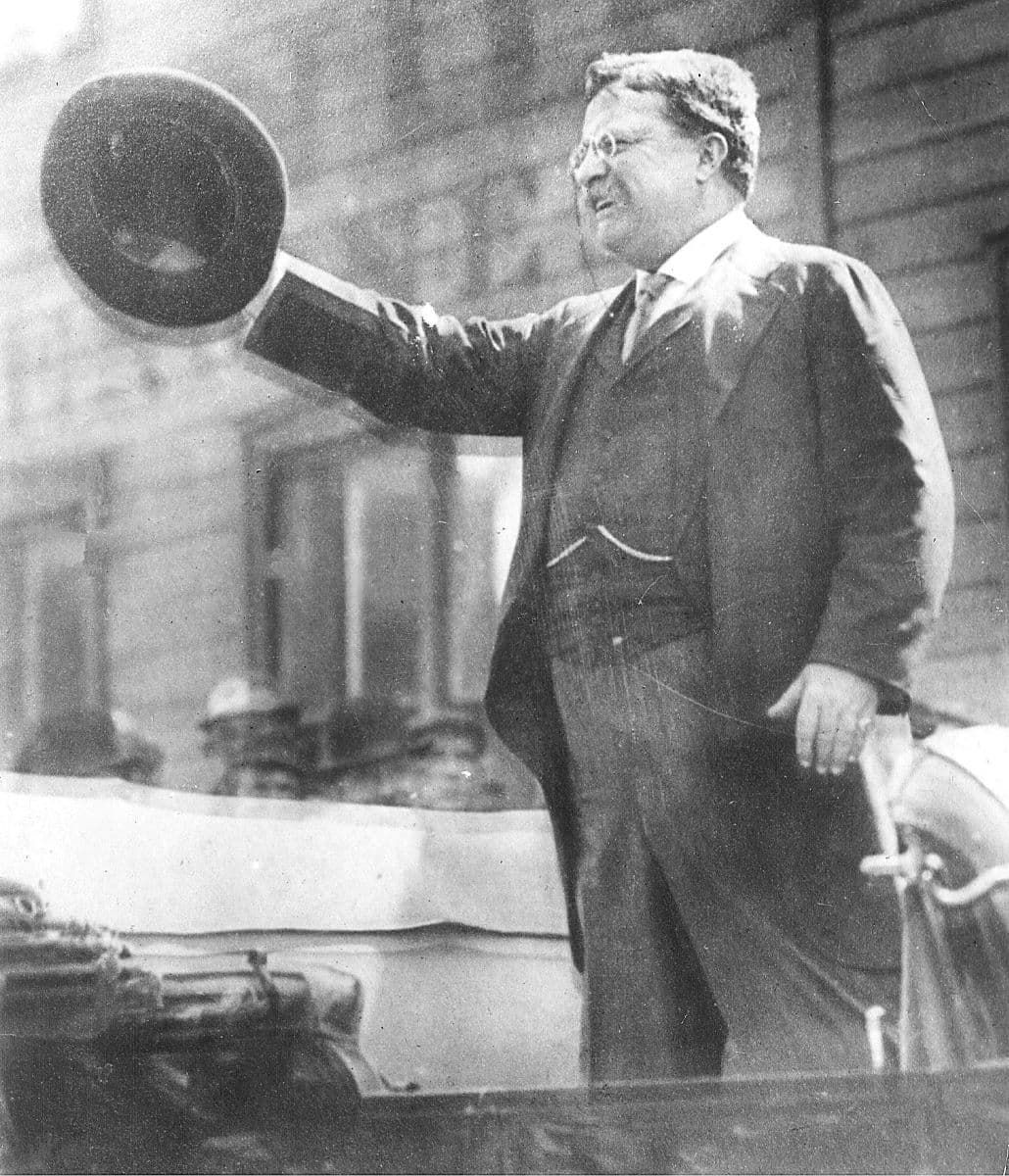
Theodore Roosevelt speaking from a car in Milwaukee on Oct. 14, 1912, shortly before being shot. (Public Domain)
On Oct. 14, 1912, John Schrank, later judged as insane by court psychiatrists, stepped out of a crowd in Milwaukee and shot Theodore Roosevelt in the chest from five feet away with a .38 special.
Like Trump, Roosevelt was a former president at the time he was shot, running once again for that office, in his case for the Progressives, also nicknamed the Bull Moose Party in honor of Roosevelt’s energy and fitness. And like both Trump and Reagan, Roosevelt brought his own brand of courage to his wound.
An eyeglass case and a folded copy of a speech he was scheduled to deliver partially stopped the bullet. That same bullet, however, failed altogether to stop Roosevelt, who insisted on delaying medical treatment until after he gave the speech. At the Milwaukee Auditorium, where several physicians examined him and urged an immediate trip to the hospital, Roosevelt waved them aside, stepped to the stage and the podium, and addressed the enthusiastic audience: “I shall ask you to be as quiet as possible. I do not know whether you fully understand that I have been shot—but it takes more than that to kill a Bull Moose.”
Speaking without notes for a few minutes about the shooting, Roosevelt then opened his coat and revealed his blood-soaked shirt. As he continued with his written speech, carefully watched by aides prepared to catch him at a moment’s notice if he should faint, some in the audience called out again and again for him to stop, to get help. Yet he remained onstage for 90 minutes, a monument of resilience and courage, and when he finished, “thousands cheered until they were hoarse.”
Taken immediately to the hospital, where doctors decided not to remove the bullet rather than risk further injury and infection, Roosevelt also brought some humor to his time spent in bed and under observation.
His wife, Edith, took such strict charge of his care that he cracked: “This thing about ours being a campaign against boss rule is a fake. I never was so boss-ruled in my life as I am now.”
Roosevelt lost his bid for another term in the White House but won the admiration of millions. At his next public appearance in Madison Square Garden, 17,000 party members gave him a 40-minute ovation of cheers and singing.
Courage Counts
Not everyone ballyhooed Roosevelt’s bravery. Some of his political enemies declared that “the whole thing had been staged, that Schrank had been hired by Roosevelt and would soon be released, and that the bullet had been made out of wax.” Trump detractors made similar charges, with some arguing that he’d been hit by a BB gun and others that he faked the bleeding from his ear with a “blood pill.”
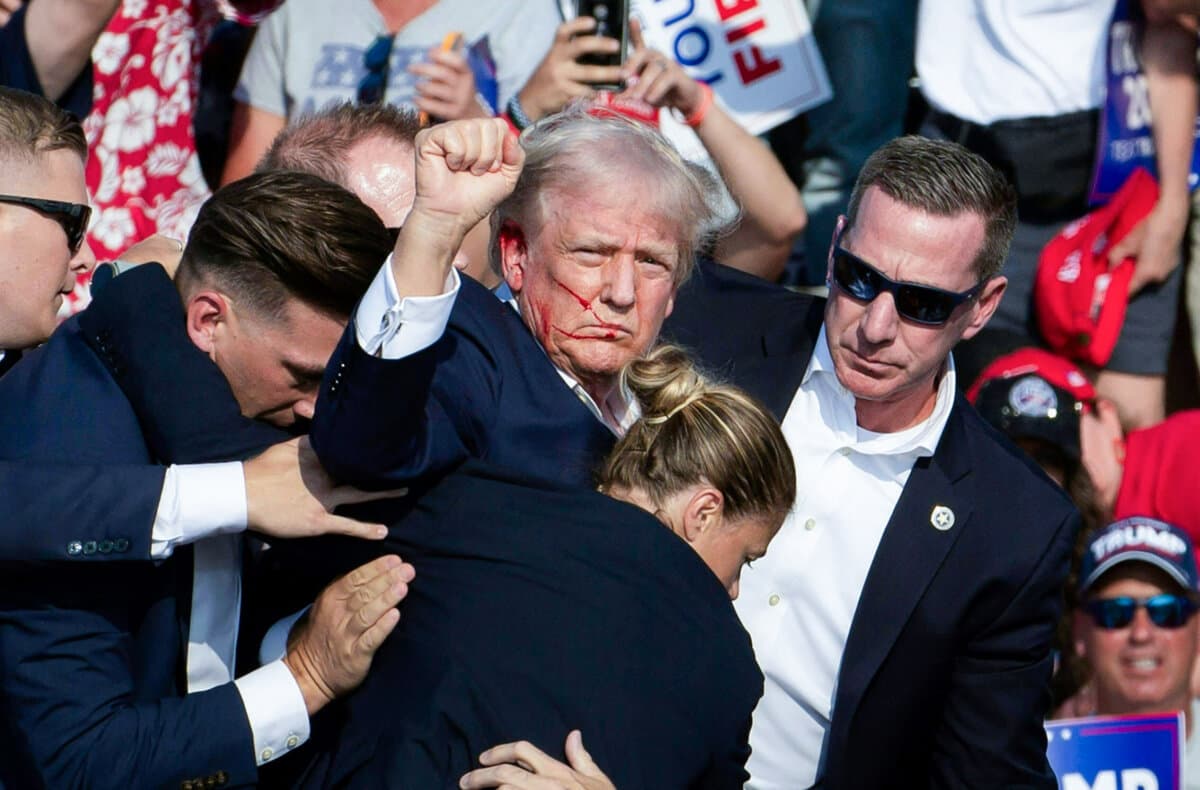
Then former President Donald Trump, with blood on his face, is surrounded by Secret Service agents after being shot by would-be assassin Thomas Crooks at Butler Farm Show Inc. in Butler, Pa., on July 13, 2024. (Rebecca Droke/AFP via Getty Images)
Not only were all of these accusations proved false, but the measure of all three of these men rose in the eyes of the public. It’s easy to understand why this was so. We’ve all witnessed or heard secondhand of similar heroics on the fields of sports and battle, where injured men pushed bravely forward despite shock and physical pain to do their duty and fulfill their mission, often using stoicism for an anesthetic and humor for a crutch. The same holds true with these wounded presidents.
Del Quentin Wilber, author of “Rawhide Down: The Near Assassination of Ronald Reagan,” wrote:
“The shooting generated massive sympathy from the American public for Reagan, who spent 13 days in the hospital before returning to the White House. But it did something else—it built a bond between the president and the public. They had seen a president who acted with grace and courage. They would hear that he had cracked jokes with his doctors and nurses as they fought to save his life and sought to ease the anxiety of loved ones.”
As was the case with Reagan, the attempted murders of Roosevelt and Trump and their bravery and resilience in the aftermath burnished their reputations among voters. Perhaps it is fitting to conclude with a few words from Roosevelt’s now-famous 1910 speech at the Sorbonne:
“It is not the critic who counts; not the man who points out how the strong man stumbles, or where the doer of deeds could have done them better. The credit belongs to the man who is actually in the arena, whose face is marred by dust and sweat and blood.”
Whatever else anyone thinks of them, history will remember Roosevelt, Reagan, and Trump as men of the arena.
What arts and culture topics would you like us to cover? Please email ideas or feedback to features@epochtimes.nyc