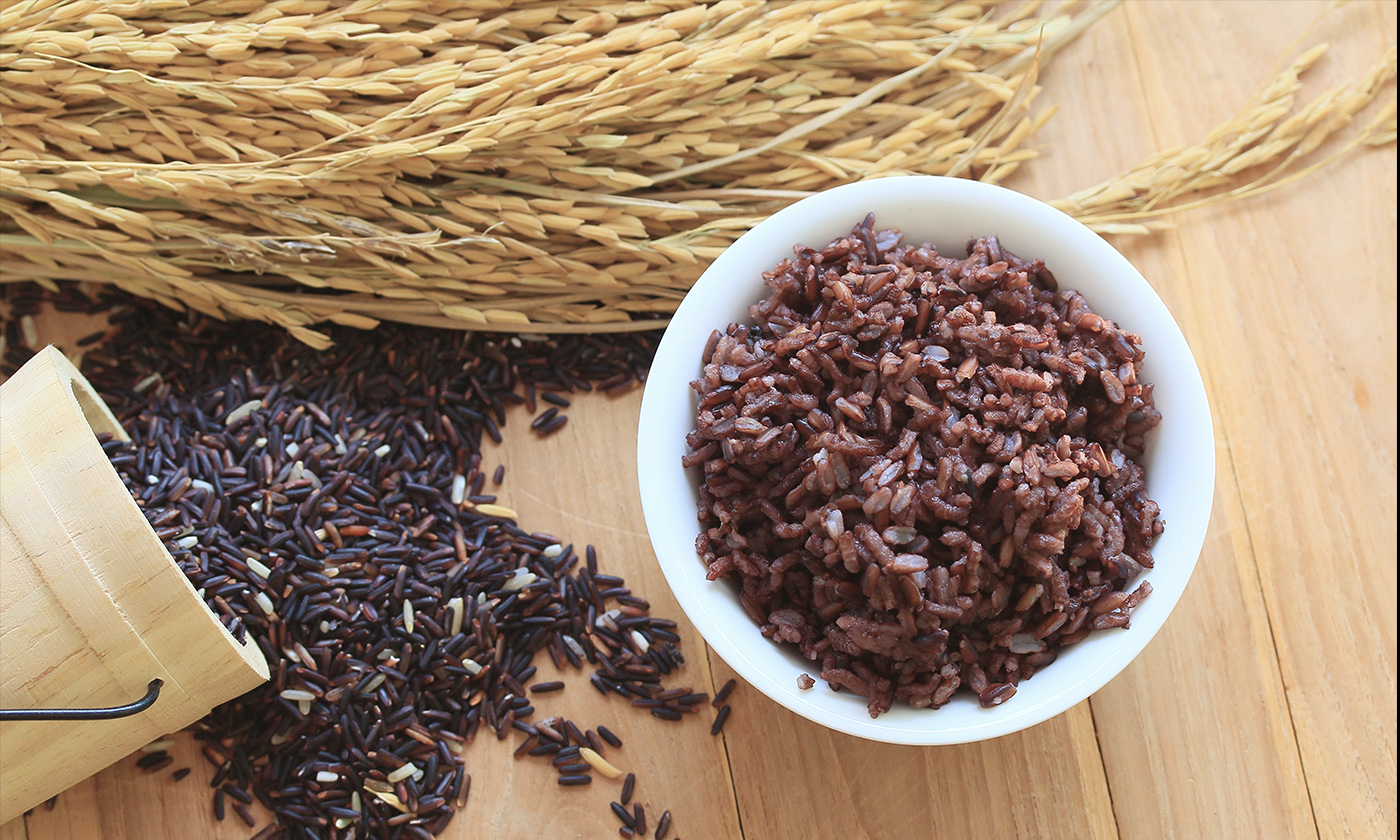
Rice varieties can be divided into white, glutinous, purple, and black. Among them, black rice has the most nutritional and medicinal value. In ancient China, black rice was reputed to cure disease, contribute to longevity, and was used as a tribute to the Emperor—so powerful and rare it was.
According to the Chinese medical classic “Compendium of Materia Medica,” black rice can “nourish yin and tonify the kidneys, keep the body fit, warm the stomach, improve eyesight, and promote blood circulation.” Studies have also confirmed that black rice contains anthocyanins (a group of deep red, purple and blue pigments found in plants), which can effectively improve diabetic nephropathy (kidney disease) and vision, as well as prevent cardiovascular disease and cancer.
5 Colored Foods Nourish 5 Internal Organs
Traditional Chinese medicine (TCM) theory is based on the five elements or five phases theory—that all things in the universe are composed of five basic qualities or substances: wood, fire, earth, metal, and water. The development and changes of various things and phenomena in nature are the results of the continuous movement and interaction among these five substances. For instance, earth nourishes wood, and wood nourishes fire, like how soil creates food that our body “burns” as it extracts calories from that food.
According to the theory of TCM, the five elements also correspond to the five internal organs of the human body: “liver, heart, spleen, lung, and kidney,” which in turn correspond to the five colors “blue (green), red, yellow, white, and black (purple).”
The Chinese medicine classic “Huang Di Nei Jing” (The Yellow Emperor’s Classic of Medicine) describes the theory of “five colors nourish the five internal organs,” essentially meaning that foods of different colors have different health benefits, and eating more of the five-colored foods can impact the corresponding five internal organs.
In that respect, it’s said that white moisturizes the lungs, yellow is for the spleen, red for the heart, blue for the liver, and black for the kidneys.
Beets provide a particularly vivid example of how color reveals a food’s biological effect.
“Beets are unique for their cardiovascular and heart health benefits,” registered dietitian Sarah Thomsen Ferreira tells Health Essentials, a publication from the Cleveland Clinic. “Due to a combination of compounds found in beets, they are able to enhance blood flow, improve the health of arteries, support lower homocysteine levels and reduce LDL cholesterol.”
According to TCM, eating more black food, such as black rice, will bring direct nourishment to the kidneys. While it may sound unusual to think of foods having medicinal properties according to their colors, research has found that the pigments that color plants are actually potent phytochemicals.
The Surprising Benefits of Anthocyanins
Modern studies have also
found that black rice can effectively improve diabetic nephropathy. A
study published in 2020 in the academic journal, Journal of Functional Foods, confirmed that cyanidin-3-glucoside in black rice can inhibit the accumulation of extracellular matrix (ECM) in the kidneys of rats with diabetic nephropathy. It’s also been found to alleviate oxidative stress and inflammatory cytokines and inhibit renal interstitial fibrosis and glomerulosclerosis in rats with diabetic nephropathy.
Black rice contains an abundance of anthocyanins, comparable to blueberries. Anthocyanins are plant pigments that give plants their black, blue, and dark purple colors. In November 2022, a study published in the journal Translational Medicine also pointed out that anthocyanins can improve kidney function in patients with diabetes. Through experiments on mice, it was found that anthocyanins play a significant role in improving hyperglycemia and insulin sensitivity.
In 2017, the medical journal Food & Nutrition Research published a research paper stating that anthocyanins have a multitude of beneficial effects such as prevention of cardiovascular disease, and being anti-cancer, anti-diabetes, improved vision, anti-obesity, antibacterial, and neuroprotective. In addition, black rice is also rich in various trace elements, vitamins, carotene, and more. At the same time, it also has the characteristics of brown rice, which is rich in dietary fiber and can promote intestinal peristalsis.
Black Rice Sushi—Delicious and Nutritious
Recently, the Health Promotion Administration of Taiwan shared an
article about how to make sushi with black rice. Here is the recipe:
Ingredients
- 100 g (3.5 oz) black rice
- 50 g (1.8 oz) Taiwanese quinoa
- 200 g (7 oz) white rice
- 100 g (3.5 oz) raw bean buns (a steamed bun made of sweetened adzuki bean filling and soft, leavened dough).
- 100 g (3.5 oz) chicken breast
- 100 g (3.5 oz) cucumbers
- 100 g (3.5 oz) carrot
- 4 pieces (10 g-0.4 oz each) nori seaweed slices
- 350 ml (11.8 fl oz) water
Preparation
1. Wash and drain dry the black rice, Taiwan quinoa, and white rice. Add 350 ml (11.8 fl oz) of water, and steam in a 1.5-meter jar.
2. Wash in sequence the cucumbers, carrots, bean buns, and chicken breasts.
3. Cut the cucumbers lengthwise into long strips, peel the carrot and cut into strips.
4. Boil a pot of boiling water, blanch the carrots, bean buns, and chicken breasts in it. Cut the bean buns and chicken breasts into strips and set aside to cool and ready for further processing.
5. After the black rice is steamed and well cooked, stir it loose with a rice spoon, and let it cool.
6. Spread a layer of plastic wrap, put nori seaweed on top, spread the black rice flat, add the ingredients, roll it up, slice, and serve.
Black rice can also be made into Chinese pastries, sweet soup, or cooked into cereal porridge. All are healthy and delicious dishes.