
Lawmakers had a busy week in Washington, but plenty of news was made outside the halls of Congress.
The Supreme Court released a slew of rulings on June 27, one involving two hot topics for President Donald Trump’s second term: birthright citizenship and nationwide judicial injunctions.
Silicon Valley giant Intel announced a huge layoff on July 1. Tech layoffs are common enough. But this announcement from the beneficiary of billions in federal subsidies raised questions about the value of government investment in private industry.
Also, astronomers made an exciting discovery in deep space, a new planet appearing similar to one in our own solar system, Saturn.
Should one federal judge be able to block the president from taking action?
Do federal subsidies really help American companies succeed?
Is there life on other planets?
Here’s what Epoch readers think.
Universal Injunctions and Birthright Citizenship
The Supreme Court on June 27 ruled that Congress had not granted judges authority to issue broad relief to individuals not before the court.
Several states and an organization called Casa had sued to challenge Trump’s executive order restricting birthright citizenship for children of illegal immigrants. A Massachusetts federal judge issued a universal injunction against the order, preventing its enforcement anywhere in the country, pending completion of the lawsuit.
Rulings by federal courts usually apply only within their territory, called a circuit, of which there are 13.
These universal injunctions were unheard of for most of the first 200 years of American history, according to Justice Amy Coney Barrett.
But they have increasingly been used as presidents have increased their use of executive orders.
The Supreme Court decision means that rulings generally apply only to people who are plaintiffs in the lawsuit under consideration. That means it’s possible that Trump’s order could be enforced in some states.
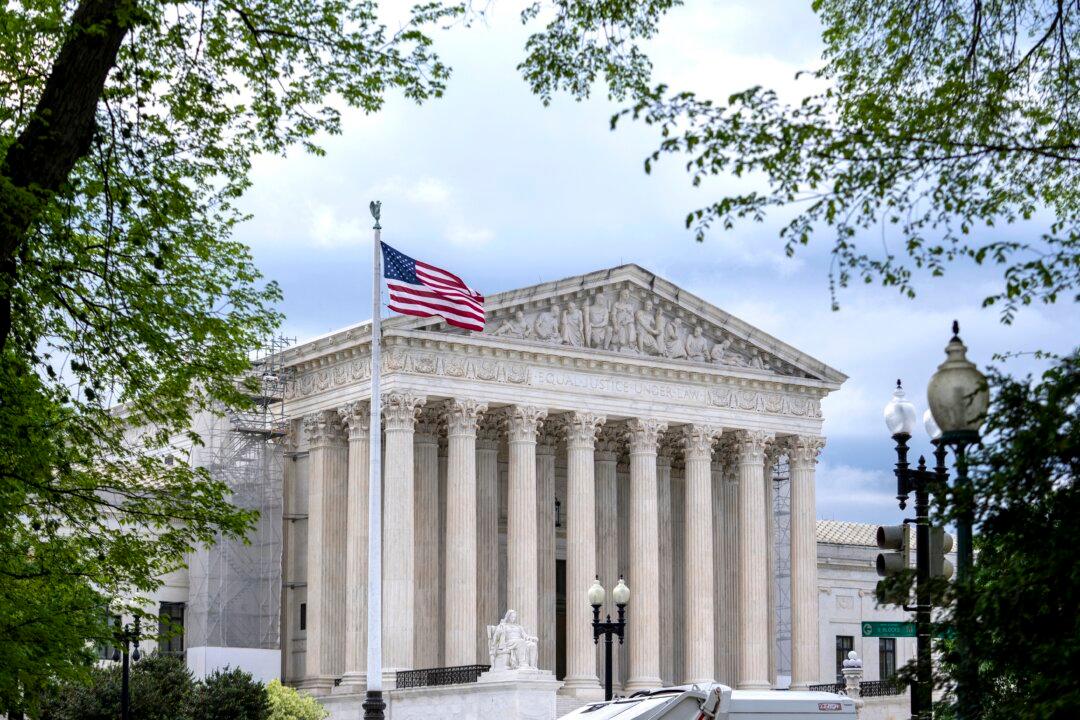
Supreme Court is seen on Capitol Hill in Washington on April 25, 2024. (J. Scott Applewhite/AP Photo)
Yet the court did allow some circumstances where a universal injunction could be issued.
We asked readers of The Epoch Times what they thought about the use of universal injunctions and about the underlying question of birthright citizenship.
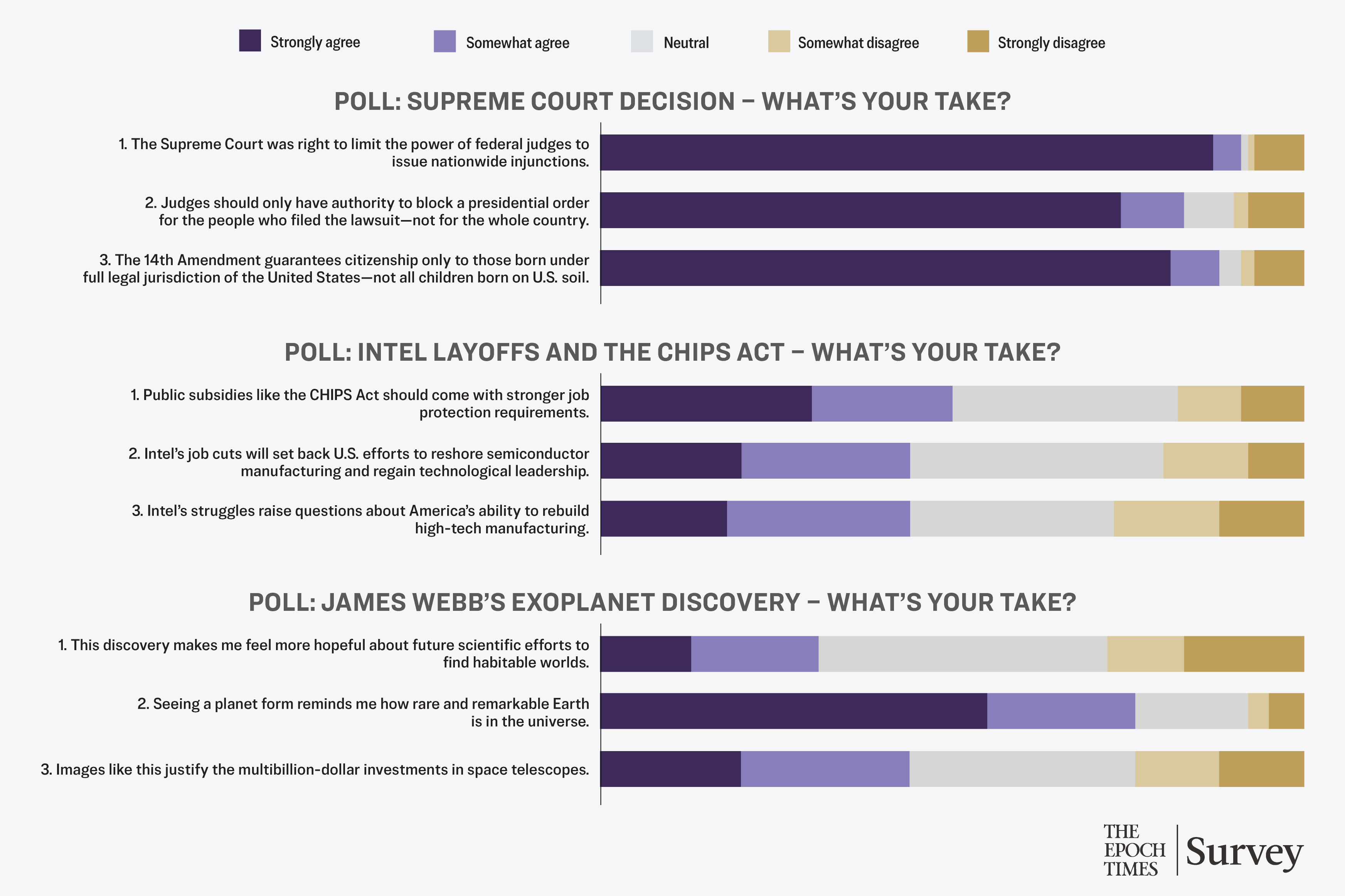
The vast majority of respondents agreed with the court’s decision in this case, though 7 percent strongly disagreed.
About the same number said that district court judges should not be able to issue universal injunctions, and a similar number disagreed.
Though the Supreme Court didn’t rule on the question of birthright citizenship, that issue may have colored our respondents’ answers on universal injunctions. Nearly the same split was seen on that issue among respondents.
Intel Layoffs and the CHIPS Act
The bipartisan CHIPS and Science Act in 2022 was intended to bolster U.S. innovation for and production of semiconductors.
It provided $52.7 billion for research, development, manufacturing, and workforce development. It also provides a 25 percent tax credit for capital investments in this field.
The bill was supposed to break U.S. dependence on China for tech components and provide tens of thousands of jobs.
Yet Intel—which received $7.9 billion in federal subsidies from the CHIPS Act, announced late last year—has decided to lay off 15 percent of its workforce, cutting 15,000 jobs.
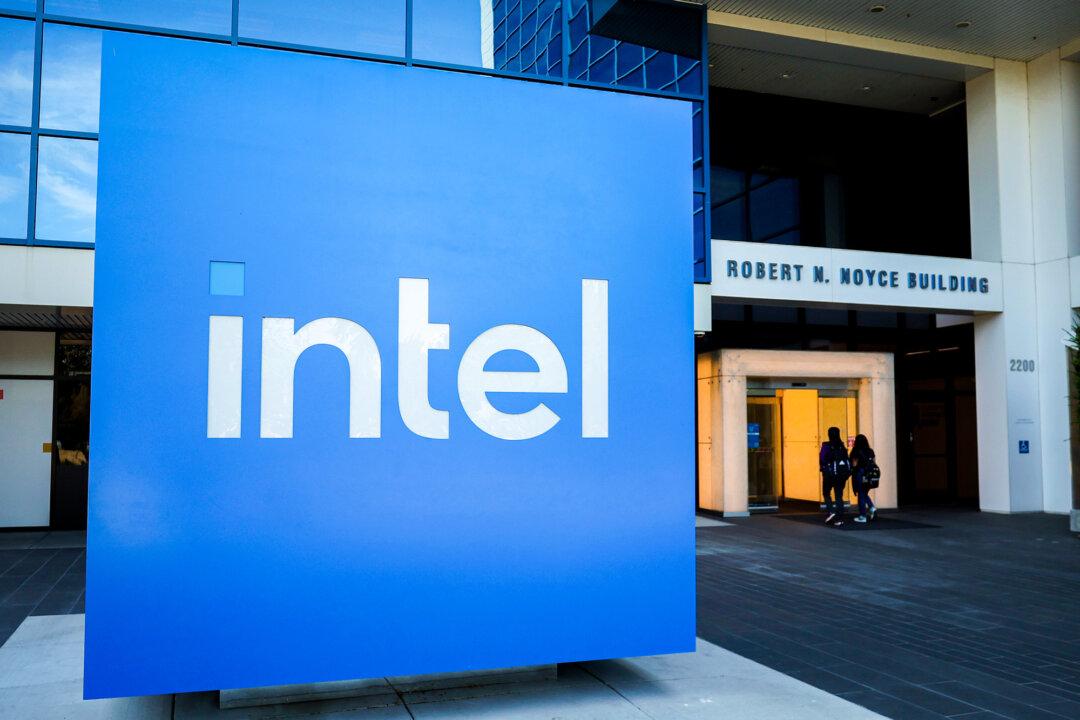
A sign is posted in front of Intel headquarters on August 01, 2024 in Santa Clara, California. Chipmaker Intel is set to lay off thousands of workers as the company tries to recover from an eroding market share. Intel will report second quarter earnings today after the closing bell. (Photo by Justin Sullivan/Getty Images)
We asked our readers to weigh in on the bigger picture of federal giveaways in exchange for promised industrial investments.
Opinions were more mixed here than on many of our poll questions.
Just 30 percent of respondents agreed that federal subsidies should have stronger job protections attached. About 32 percent were neutral on the question.
The largest share of respondents, 36 percent, were unsure whether Intel’s problems spelled trouble for the U.S. semiconductor industry.
Does the Intel announcement mean America may not be able to rebuild its high-tech capacity? Again, the largest share of respondents, 29 percent, were neutral.
Space Exploration
Using NASA’s James Webb Space Telescope, researchers on June 25 captured an image of a planet about the size of Saturn, which they named TWA 7 b.
The planet appears to be in the process of formation and is about 110 light-years away from Earth.
Saturn is about 9 times wider than Earth. For comparison, that’s the difference between a nickel and a volleyball, according to NASA.
The Webb Space Telescope was launched into space in 2021 at a cost of $10 billion.
Scientists were excited about this first discovery of a developing planet, but how do our readers feel?
The short answer was, Meh.
Only a third said this development made them more hopeful about finding habitable worlds elsewhere. A minority of respondents, 44 percent, thought such discoveries justified the expense.
The real value of the discovery appears to have been inspirational, as 76 percent strongly or somewhat agreed that the images caused them to reflect on the value of planet Earth.
This Epoch Reader Poll was conducted on July 2–3, 2025, via email and social media, and received 18,131 responses.
Sam Dorman contributed to this report.
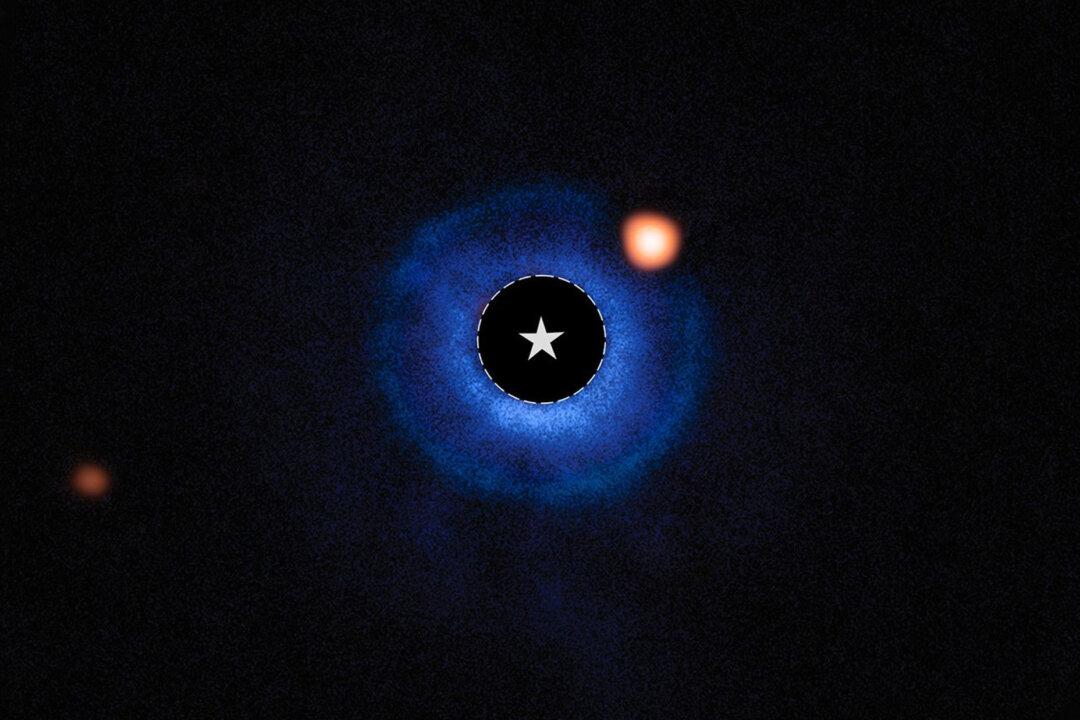
Astronomers using NASA’s James Webb Space Telescope have captured compelling evidence of a planet with a mass similar to Saturn orbiting the young nearby star TWA 7. In this image combining ground-based data from ESO’s Very Large Telescope (VLT) and data from Webb’s MIRI (Mid-Infrared Instrument), light from the star TWA 7 has been subtracted. The location of the star is marked with a circle and a star symbol at the center of the image. The blue color represents data from the VLT’s SPHERE instrument, which showcases the location of the disk surrounding the host star. MIRI data is shown in orange. The bright orange spot to the upper right of the star is the source identified as TWA 7 b, within the debris disk. The more distant orange spot visible in the left of the image is an unrelated background star. (NASA, ESA, CSA, Anne-Marie Lagrange (CNRS, UGA), Mahdi Zamani (ESA/Webb))