
When federal prosecutors accused then-Arcadia, California, Mayor Eileen Wang of acting as an illegal agent of China, one detail stood out in the court filings: the alleged influence operation network built through a Chinese-language news site, WeChat coordination, repost chains, civic relationships, and community trust.
At the center of the case is the U.S. News Center, a Chinese-language media outlet operated by Wang and her former fiancé, Yaoning “Mike” Sun, according to the Department of Justice (DOJ). Federal authorities allege that the site presented itself as a local news platform serving Southern California’s Chinese American community while publishing content directed by Chinese Communist Party (CCP) officials.
According to Wang’s plea agreement, Chinese officials sent prewritten articles to Wang and others through WeChat, including a 2021 article denying allegations of genocide and forced labor in the Xinjiang region. The filing alleges that Wang reposted the article within minutes to the U.S. News Center, then sent the publication link back to the Chinese official.
In another exchange cited by the DOJ, Wang edited an article at a Chinese official’s request and later sent a screenshot showing that the article had received more than 15,000 views. After receiving praise from the official, Wang replied, “Thank you, leader.”
Beyond a Website
For federal investigators, the significance of the case appears to extend beyond the content of a single website.
The DOJ filings describe a broader ecosystem in which messaging moved through WeChat conversations, community-linked websites, reposting networks, and local civic relationships rather than through overt state media branding alone.
Unlike traditional state broadcasting, the distribution model described in the case relied heavily on peer-to-peer circulation inside trusted social circles, including business associations, community groups, and private WeChat networks.
That ecosystem matters because influence within diaspora communities often depends less on formal authority than on familiarity, identity, and social trust. These nuances are common across all diaspora networks, as detailed in research by Aleksandr V. Gevorkyan, a macroeconomist specializing in economic history, labor migration, and diaspora economics.
In his 2022 paper “Diaspora Networks?” Gevorkyan showed that diaspora networks operate through mechanisms of bounded solidarity, reciprocal obligations, and enforceable trust rooted in shared identity and interpersonal familiarity, rather than through reliance on formal institutions.
The U.S. News Center allegedly appeared local and community-oriented. Prosecutors said the platform targeted Chinese Americans in Southern California rather than audiences inside mainland China.
Because the platform appeared culturally familiar and community-based, the messaging could carry a level of social legitimacy distinct from overt state propaganda.
Former BBC Hong Kong Bureau Chief Vivian Wu wrote on X on May 12 that the case was striking because Wang allegedly handled the operational details herself—receiving articles from the CCP officials, posting them online, distributing links, and reporting traffic data back to officials.
“The most unbelievable detail is that a local elected American official was personally helping Chinese officials distribute propaganda articles and then reporting back after publishing them,” Wu wrote.
The DOJ alleged that multiple participants in the same WeChat group reposted identical articles across different websites shortly after receiving instructions from Chinese officials.
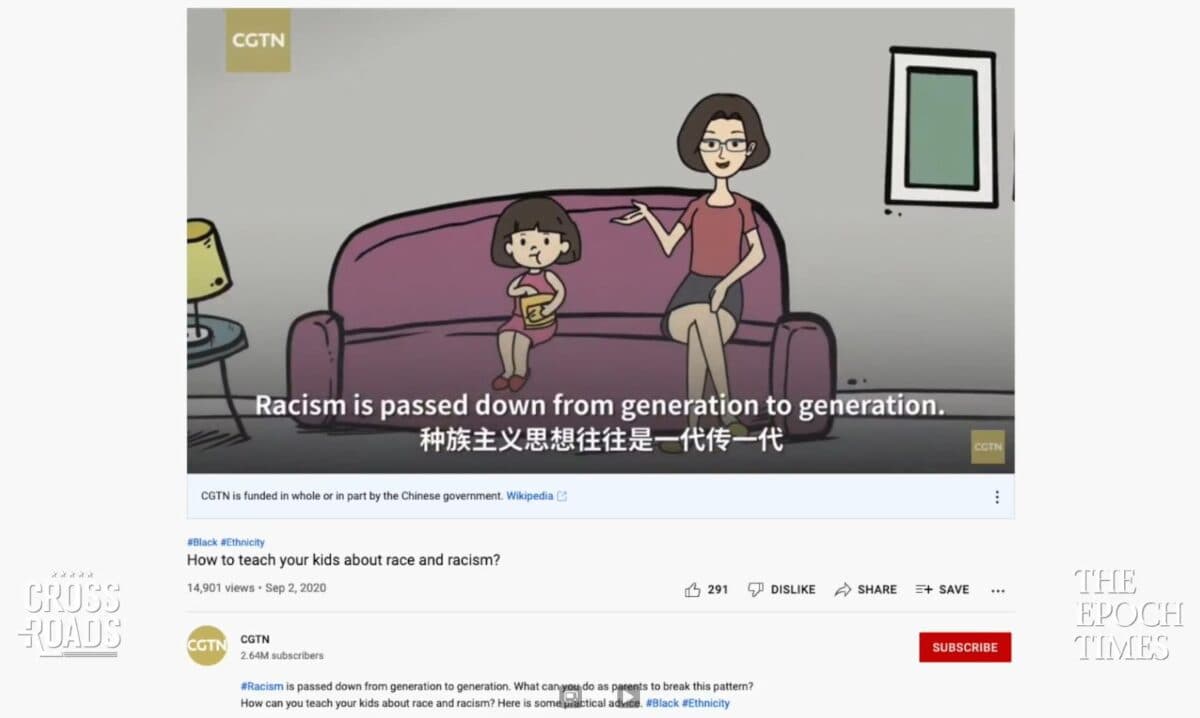
China Global Television Network, a Chinese state-run media outlet, promotes critical race theory in the United States through its programs. (YouTube/Screenshot via The Epoch Times)
Sheng Xue, vice president of the Federation for a Democratic China, told the Chinese-language edition of The Epoch Times that such coordination showed how Beijing-linked influence activity could move through community-based networks rather than through overt state channels.
The Role of WeChat
The Arcadia case also highlights the central role WeChat plays in many overseas Chinese-speaking communities.
For many Chinese-speaking users worldwide, WeChat functions less as a single social media platform than as an integrated communications infrastructure that combines messaging, payments, media distribution, business networking, event coordination, and civic communication.
In mainland China, WeChat Pay has largely replaced cash transactions in many sectors of daily life. Overseas Chinese communities also use WeChat extensively for social communication, business activity, community announcements, political discussion, and media sharing.
That integration gives information circulated through WeChat an unusual speed and reach within tightly connected social communities.
In the Wang case, court filings allege that CCP officials used WeChat group chats to distribute content directives and coordinate publication activity among participants operating Chinese-language websites in the United States.
In a 2020 executive order, the Trump administration said WeChat collected large amounts of user information and warned that the data could give China access to Americans’ personal and proprietary information.
The University of Toronto’s Citizen Lab reported the same year that WeChat monitored files shared by international users and used that material to train censorship systems inside China.

A screenshot of an article promoting Xixi Li, city councilor for Brossard, Canada, in the 2021 municipal election. The article was posted on a WeChat account shared by the Centre Sino-Québec de la Rive-Sud in Brossard and the Service à la Famille Chinoise du Grand Montréal, which are both headed by Li and are being investigated as possible secret Chinese police stations. (Screenshot via The Epoch Times)
The FBI has warned that the CCP seeks to influence public opinion and political activity abroad through both formal and informal channels inside diaspora communities.
Community Influence and Political Access
Federal prosecutors also tied the alleged media activity to broader community and political organizing efforts.
Sun, who was sentenced in February to four years in federal prison after pleading guilty to acting as an illegal agent of a foreign government, allegedly described Wang in a report to Chinese officials as “a new political star.”
According to DOJ court filings, Sun wrote that he had “orchestrated and organized” a team to help Wang win election to the Arcadia City Council in 2022.
The DOJ also said Sun monitored then-Taiwanese President Tsai Ing-wen’s April 2023 visit to Southern California and sent real-time updates to a CCP consular official in Los Angeles.
Sheng told The Epoch Times that getting pro-Beijing channels to “access U.S. political figures, government policies, and data [is] very important to the CCP.”
Tang Hao, host of Crossroads of the World, said on May 12 on NTD, a sister media outlet of The Epoch Times, that the case reflected what he described as a broader Chinese strategy to cultivate foreign political figures through seemingly legitimate social and civic channels.
Diaspora Media Are Not Monolithic
The Wang case has also exposed tensions inside overseas Chinese-language media ecosystems, in which outlets often hold sharply different political positions toward Beijing.
Chinese-language media outside mainland China are politically diverse and often deeply divided. Although many outlets have come under varying degrees of influence from the CCP through its united front work, content-sharing agreements, ownership changes, advertising leverage, and direct pressure, a minority maintain independent or explicitly critical stances, according to a 2018 Hoover Institution report titled “China’s Influence and American Interests.”
The Hoover report documents how the CCP has significantly narrowed the space for independent Chinese-language media in the United States through cooperation among existing outlets, the establishment of new pro-Beijing outlets, and coordinated efforts by entities such as the China News Service. The report states that truly independent voices have shrunk to a small number of outlets, including The Epoch Times and NTD.
According to a 2020 survey of Chinese-language media by the Australian Strategic Policy Institute, such divisions are not unique to the United States. Similar patterns of CCP influence in overseas Chinese-language media have been observed in Australia, Canada, and Europe, where united front efforts target both traditional newspapers and digital platforms, especially WeChat public accounts.