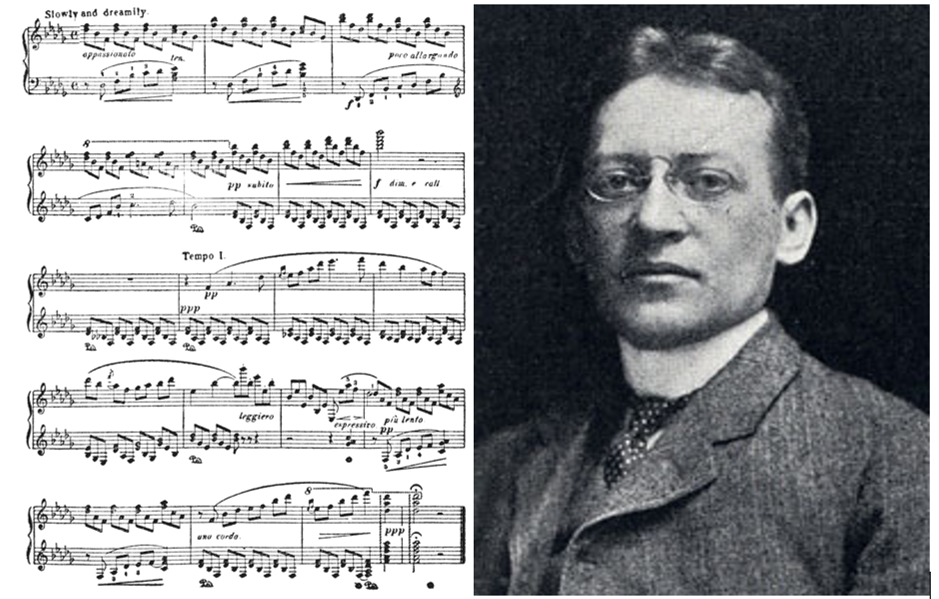

Six musicians and composers, known as the Second New England School of Music, shaped the late 19th- and early 20th-century world of American classical music. These composers, known as the Boston Six, advocated homegrown classical music—John Knowles Paine, Arthur Foote, George Whitefield Chadwick, Edward MacDowell, Horatio Parker, and Amy Beach.
Other musicians from the same time period are considered honorary members of the Boston Six, including George Whiting and his nephew, Arthur Batelle Whiting (1861–1936).
Nephew and Student
Arthur Batelle Whiting was born on June 20, 1861, in Cambridge, Massachusetts. He came from a multigenerational musical family. His paternal grandmother was a singer. His father, Charles Edward Whiting, was a music educator in public schools and a composer.
His mother, Emma Reeves Leland Whiting, was also a musician; she became his first music teacher by giving him piano lessons at age 8. Several uncles were also musicians. His uncle George, an organist and composer, taught him organ. Arthur made his public debut on the piano at age 13 in a concert in Worcester, Massachusetts.
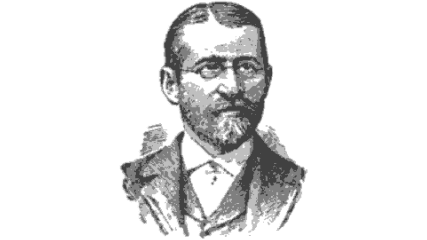
A portrait of George Elbridge Whiting. The National Cyclopaedia of American Biography, Volume VIII, 1924. (Public Domain)
By the time Whiting reached maturity, fine music schools were being established in New England, largely due to the work of the Boston Six. Thus, Arthur decided to pursue music seriously by attending the New England Conservatory. There, he learned piano from William Hall Sherwood, harmony from J.C.D. Parker, and composition from George Whitefield Chadwick, a member of the Boston Six who had studied with his uncle George.
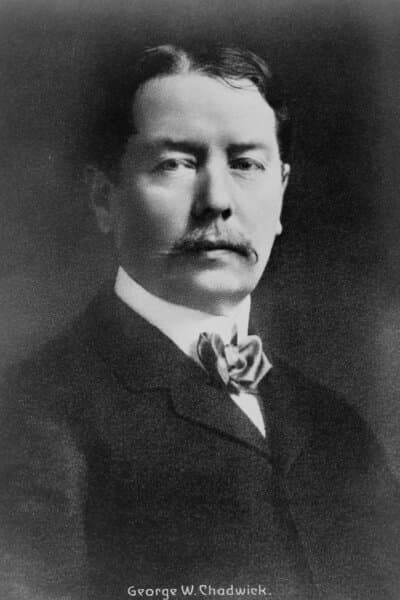
George Whitefield Chadwick, circa 1890–1910. (Public Domain)
After graduating from the New England Conservatory, Whiting decided to supplement his Yankee music education with further studies in Germany. Although there were more music programs in the United States by this point than in previous generations, most people thought it was necessary to travel to Europe, particularly Germany, to obtain a serious music education. In 1883, Whiting traveled to Munich, where he studied composition at the Munich Conservatory with Josef Gabriel Rheinberger.
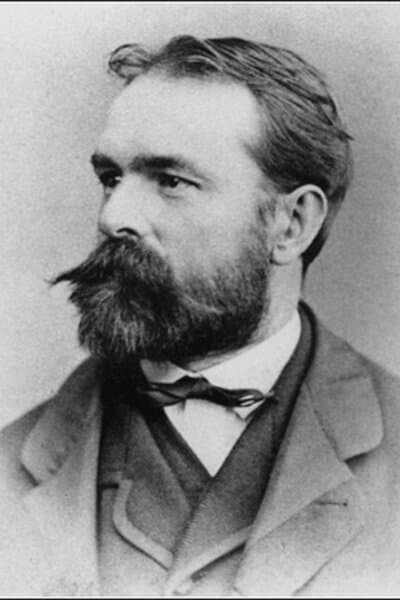
Josef Gabriel Rheinberger. (Public Domain)
While studying at the Munich Conservatory, Whiting joined an American band formed by Rheinberger, of which Chadwick had been an earlier member. Rheinberger influenced his taste in music of the German masters, shaping his compositional style as well as his future teaching technique.
Whiting also studied conducting with Ludwig Abel. While in Munich, Whiting performed as a concert pianist and developed his budding compositional talent.
Back to the US
In 1885, Whiting returned to Boston, where he lived for the next decade. He married into one of the foremost New England families when he wed Grace Kneeland Gorham in 1889. In Boston, he focused on composing.
In 1895, he and his wife moved to New York City, where he began performing on the piano more frequently, teaching privately, and writing articles in addition to composing. He often performed with chamber groups, like the Kneisel String Quartet.
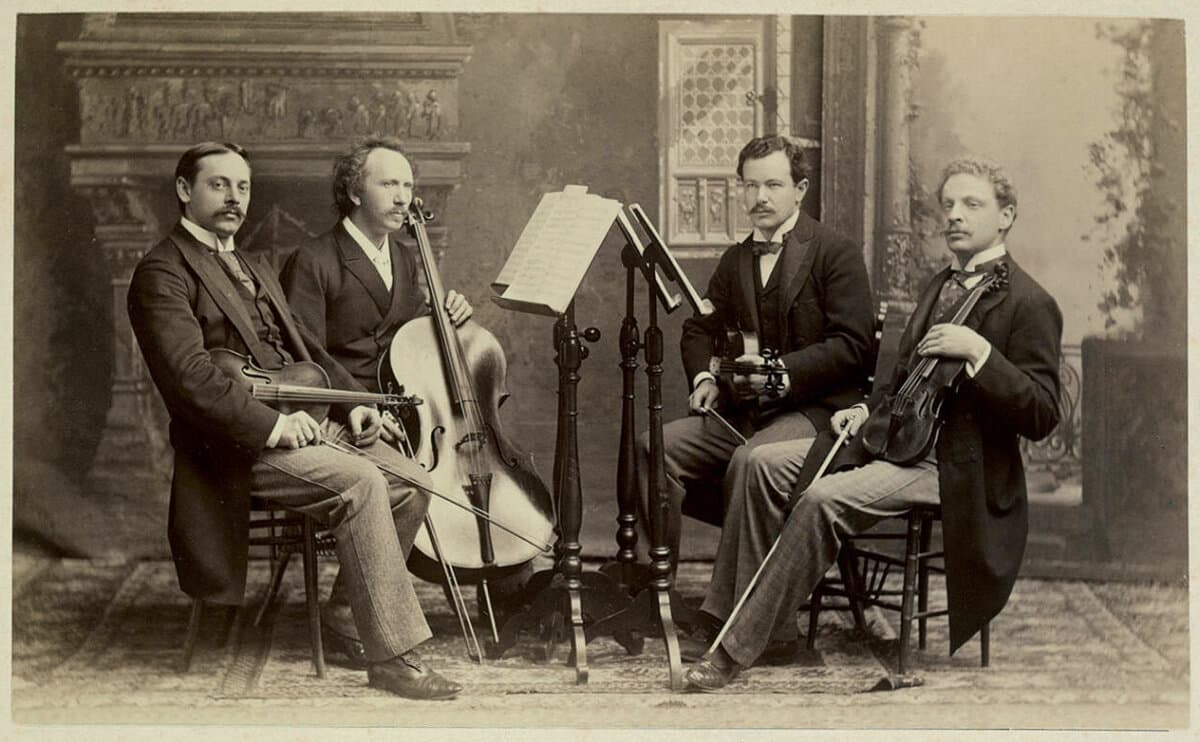
The Kneisel Quartet between 1891 and 1899. (Public Domain)
In 1907, Whiting began the endeavor which would become his greatest legacy: his series of “University Concerts.” These were five lecture recitals on chamber music per year that he gave at the big Eastern colleges with music programs—Yale, Harvard, Princeton, and Columbia. He performed these educational concerts until 1930. As a result, several of these schools conferred on him honorary degrees.
Whiting pioneered a movement to rediscover early classical music, advocating for historically informed performances. He was an early proponent of using clavichords and harpsichords for early keyboard music instead of automatically switching everything to the piano.
Starting in 1911, he performed several recitals on the harpsichord. He also wrote two volumes on the use of piano pedals, “Pianoforte Pedal Studies,” the second of which explored using the pedals for musical colorization.
Whiting was by all accounts a brilliant man who was torn between two sides of his own nature, one highly creative and the other rigidly rule-bound. His sense of inferiority to the master composers also kept him from writing as much music as he wanted or perhaps could have. As he neared the end of his life, he wistfully quipped to a friend that his tombstone should read, “Here lies one who did not compose enough.”
Nevertheless, Whiting did compose, and his compositions reflect the neo-classical style. His Piano Concerto in D Minor and Fantasia for Piano and Orchestra were both performed by multiple American orchestras.
One of his earliest successes was his choral setting of Oliver Herford’s poetry cycle, “Floriana,” which was first performed in New York in 1902. He also wrote several assorted works for smaller chamber groups, including a piano trio, a suite for strings, and a horn quartet.
An excellent keyboardist, Whiting wrote a variety of songs for piano and organ music. He wrote sacred music as traditional hymns of the day. For voice, he wrote sacred and secular songs for solo voice and piano, and settings of poems for mixed chorus. He also wrote motets and anthems of choruses.
Throughout his life, Whiting wrote larger pieces for orchestra, which turned out to be his most important compositions. These include his Concert Overture of 1885, which came very early in his career, and “The Golden Cage,” a dance pageant which was arranged to poems by William Blake from his collection “Songs of Innocence.”
A widower with no children, Whiting died in 1936 at the age of 75. His music had faded from the public consciousness by this point.
Whiting dedicated his life to studying, promoting, and preserving the work of great classical composers. He prized the music of geniuses like Johann Sebastian Bach, George Frideric Handel, and Johannes Brahms.
He published his own transcriptions of their compositions. He performed their music as historically accurately as possible. He also helped new generations of musicians appreciate their brilliance through his teaching.
For these contributions, Whiting deserves to be remembered as a great American music legend.
What arts and culture topics would you like us to cover? Please email ideas or feedback to features@epochtimes.nyc