
HOUSTON—Humanity’s first adventure to the moon in more than 50 years is complete.
Artemis II, NASA’s 10-day test flight around the moon, concluded just after 5 p.m. PT, 8 p.m. ET, on April 10. After flying more than 700,000 miles, and faster than 24,000 mph, the Orion spacecraft gently parachuted into the Pacific Ocean off San Diego, within less than a mile of its target.
Inside that spacecraft, named Integrity, were NASA’s Reid Wiseman, Victor Glover, and Christina Koch, as well as Jeremy Hansen of the Canadian Space Agency. In the course of 13 minutes, they discovered, as Apollo 17 astronaut Gene Cernan described it, “what it’s like to be that comet.”
Floating in the calm seas, as divers and medical personnel circled around their capsule, they were once again embraced by Earth’s gravity after pushing farther from her surface than any other astronauts, and seeing things no human eye had seen.
All four crew members were reported to be in great health by medical staff as divers secured an inflatable “front porch” in front of the capsule.
Assisted by recovery team members, they began stepping out of their capsule and back into the sun one by one at 6:31 p.m. PT, taking a seat on the porch. The last to leave was Wiseman, the mission commander, at 6:34 p.m PT.
The crew started hoisting up to the Navy helicopters one by one at 6:49 p.m. PT, and all four were aboard the recovery ship, the USS John P. Murtha, by 6:58 p.m.PT.
They were greeted by NASA Administrator Jared Isaacman, and were then moved to a medical bay for further assessment while Integrity is prepared to be towed aboard. All four crew members were able to walk under their own power despite being in zero gravity for more than a week.
Integrity began to take the form of that comet at approximately 4:53 p.m. PT as it began penetrating the atmosphere 400,000 feet up and 1,957 miles downrange from its targeted landing site.
It separated from its European-made service module, which provided propulsion, power, and life support during the historic journey, 20 minutes earlier. It then made a final burn to roll itself over and solidify its course.
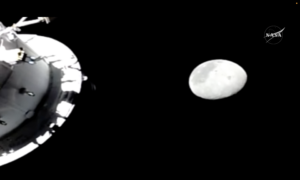
“We have a great view of the moon out of window two,” Wiseman said in the final minutes before reentry. “Looks a little smaller than yesterday.”
The astronauts inside were already back in the orange pressure suits they wore during liftoff and strapped into their seats, falling backward and upside down to ensure the heat shield was in front, and they could see the horizon out the windows.
Integrity became enveloped in a ball of fire and plasma as the friction with the planet’s layers of gas built up. It was expected to reach a max speed of 24,661 miles per hour, approximately 130 mph short of the record speed set by Apollo 10 in 1969.
NASA initially said Integrity hit the atmosphere moving 35 times the speed of sound, which is 26,854 mph. But Flight Director Rick Henfling said at the post-mission press conference that the peak velocity was 24,664 miles per hour.
Its heat shield reached temperatures of 5,000 degrees Fahrenheit, and this entry path was designed to be much shorter than the one for Artemis I to limit the heat shield’s exposure to those maximum temperatures as much as possible.
The capsule entered a communication blackout less than 30 seconds into re-entry, due to interference from the plasma buildup. That loss of signal lasted six minutes.
While the crew was trained to take manual control, Integrity’s computer completed the maneuver that needed to hit the atmosphere at a precise angle and perform multiple roll reversals to both slow down and offload energy from the heatshield.
The astronauts rode their man-made comet in comfortable temperatures inside their pressure suits and were subject to 3.9 Gs of force. That is 3.9 times the gravitational force a person normally feels on Earth at sea level.
When Integrity regained communication with Mission Control, it was already down to 150,000 feet and slowing down. Three minutes later, it was moving slower than the speed of sound.
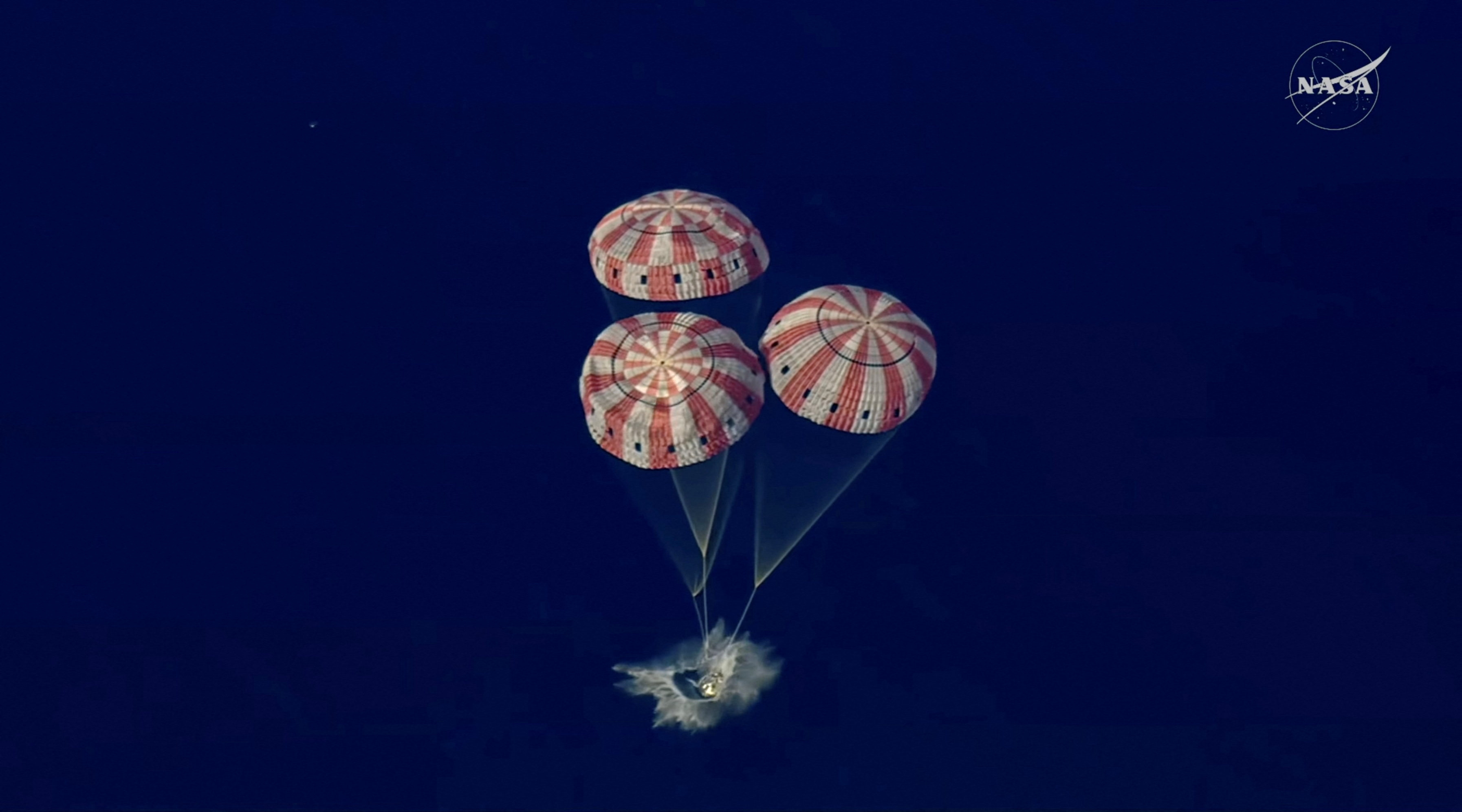
Eruptions of applause could be heard when the drogue parachutes deployed, then the pilot parachutes, then as the three giant main parachutes deployed and gracefully dropped Integrity into the water. The moonship that at one point pushed 25,000 mph, dropped into the sea at only 20 mph.
The celebration in mission control built as staff watched the updates from the recovery teams on site.
The recovery ship USS John P. Murtha was already in position, and immediately deployed fastboats to get out to the floating capsule.
Stabilization airbags deployed, and Integrity was powered down at 5:30 p.m. PT. Mission authority was transferred from Mission Control in Houston to the recovery team on site.
The side hatch was opened for the first time since before launch at 5:55 p.m. PT.
Four recovery personnel went in, each assessing their own astronaut. All four crew members were reported to be in excellent health. They were out of the capsule less than an hour later, and then safely aboard the recovery ship before 7 p.m. PT.
Wiseman, Glover, Koch, and Hansen return home not just as lunar pioneers, but as deliverers of a wealth of scientific information, from more photographs of the moon to biological experiments aimed at understanding how deep space affects the human body, as well as the data and condition of the Orion spacecraft itself. While the crew is assessed further back aboard the USS John P. Murtha, Integrity is towed aboard.
NASA officials and mission leaders have said that all of this information was crucial to ensuring the success of Artemis III, Artemis IV, and all future missions.