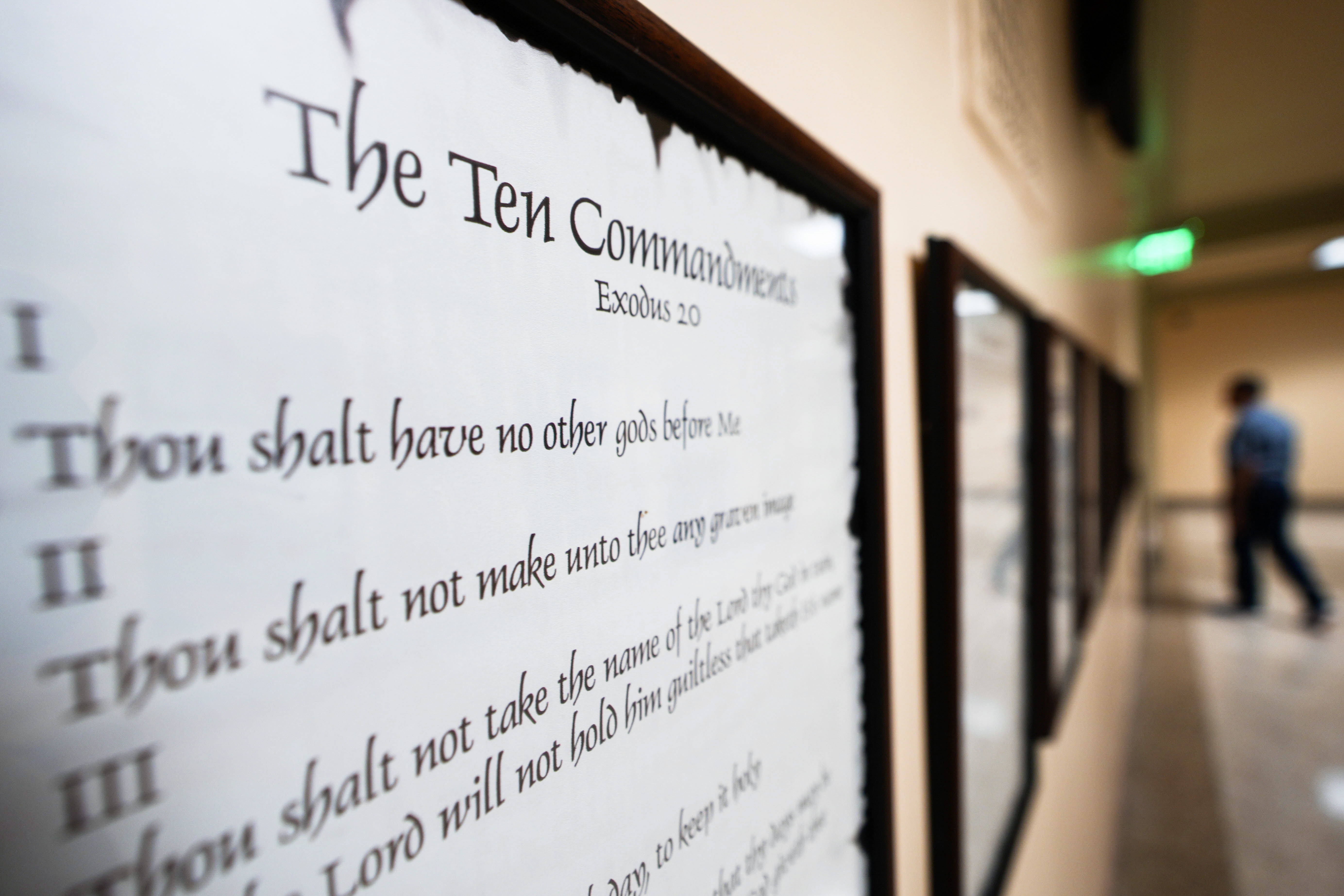

An appeals court on Feb. 20 overturned previous rulings that struck down Louisiana’s law requiring that the Ten Commandments be displayed in classrooms.
That law was passed in 2024, prompting a lawsuit by a group of parents who said it violated the First Amendment’s Free Exercise and Establishment Clauses. Among other objections, the plaintiffs said the law “unconstitutionally pressures students into religious observance.”
A federal court blocked the law, and a three-judge panel in the U.S. Court of Appeals for the Fifth Circuit upheld that ruling in June 2025. The Fifth Circuit then agreed to rehear the case en banc, with all the judges of the court.
The majority in the 18-judge en banc panel did not directly address the First Amendment issue, but instead ruled that the suit was not “ripe,” or ready to be litigated yet. In a per curiam—unsigned—opinion, the panel said there were still too many unknown factors about how the law would be implemented.
“We do not know, for example, how prominently the displays will appear, what other materials might accompany them, or how—if at all—teachers will reference them during instruction,” the panel wrote.
They added that the plaintiffs suffered no definite harm by a mere posting of the display, and that the court would have to speculate about any future harms that might arise.
“That exercise exceeds the judicial function. It is not judging; it is guessing,” the panel wrote.
However, the panel noted that plaintiffs could bring a future challenge once the law is implemented.
Appeals Court Judge James Ho agreed with the panel majority, but added that he would also uphold the law on its merits because, at the time of the country’s founding, religion was used more freely in educational settings.
“Given the centrality of religion in our Founders’ conception of good citizenship, it’s not surprising that religion was a cornerstone of American education from the beginning,” he wrote.
“And one of the most popular textbooks used in that education was the New England Primer, which features extensive religious material including poems, prayers, and lessons, including the Ten Commandments.”
Four judges on the panel dissented, writing that the law violates a 1980 Supreme Court decision in Stone v. Graham, which struck down a similar Ten Commandments law in Kentucky.
“By placing that text on permanent display in public school classrooms, not in a way that is curricular or pedagogical, the State elevates words meant for devotion into objects of reverence, exposing children to government‑endorsed religion in a setting of compulsory attendance,” Appeals Court Judge James Dennis wrote.
“That is precisely the kind of establishment the Framers anticipated and sought to prevent.”
The majority brushed aside that precedent, saying it was based on principles overturned in 2022 by the Kennedy v. Bremerton School District decision. There, the Supreme Court ruled that a football coach was wrongly fired for quietly praying midfield after games, because he had not coerced his students into praying with him.