In the late 19th and early 20th centuries, the United States was staking its claim as a major player in classical music. New England, in particular, became a hub of classical music because of the performance, writing, and teaching of a group of composers and musicians known as the Second New England School of Music.
Called the Boston Six, most played the organ as children and went to Germany for further studies, eventually taking positions as America’s first college music professors.
The youngest member of the Boston Six followed a different path. As the only woman in the group, Amy Beach (1867–1944) proved herself as one of the first distinctly American composers.
America’s Greatest Prodigy
Amy Marcy Cheney was born on Sept. 5, 1867, in Henniker, New Hampshire. Before age 2, she could improvise an alto harmony to the lullabies her mother sang while rocking her to sleep.
She started playing the piano at 4, demonstrating perfect pitch and totally accurate musical memory. She could recall four-part harmony of church hymns and sing 40 tunes by memory in their original keys.
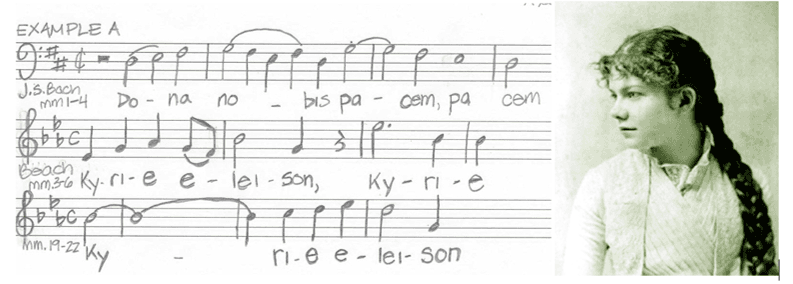
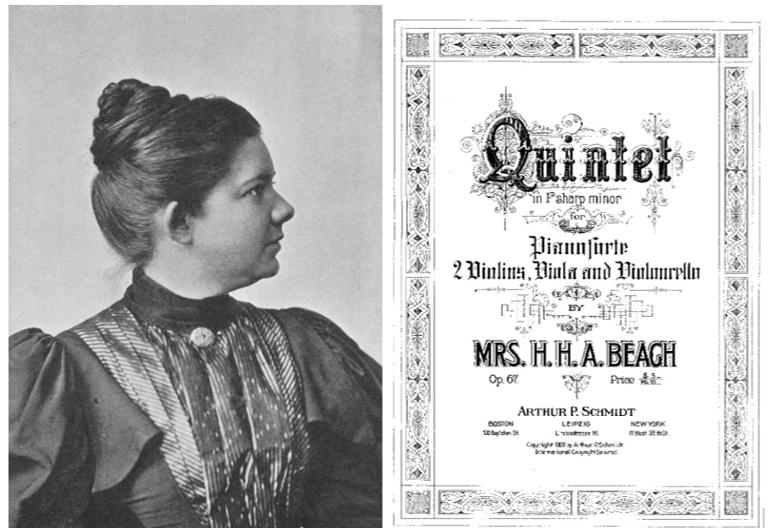
(Left) Section of Beach's Mass in E Flat, 1902. (Public Domain) (Right) Amy Beach, circa 1890. (Public Domain)
Also when she was 4, little Amy composed her first music, writing three waltzes in her head. Her mother, an amateur pianist and singer, began giving her formal piano instruction when she was 6. She played piano concerts at age 7 and introduced her own compositions as encores to the works by the old masters.
In 1875, the Cheney family moved to Boston, where music experts noted that Amy would be admitted to any of the finest conservatories in Europe. However, her parents decided that she should continue her musical studies at home for a while, and she enrolled in a private school run by W.L. Whittemore.
For the next few years, she studied piano with Johann Ernst Perabo, then Carl Baermann, a student of Franz Liszt.
In 1883, Amy made her first public performance in Boston, playing the piano at a concert with an orchestra conducted by Adolf Nuendorff. In the next few years, she concertized extensively, gaining a reputation as one of the finest young pianists.
In 1885, she performed with the Boston Symphony for the first time. Critics noted her incredibly sensitive and expressive playing, in addition to her perfect technique. As a teenager, she was considered America’s greatest prodigy. Her success was remarkable because she was the first New England pianist to achieve such proficiency without European training.
A Prolific Composer
Having demonstrated compositional talent for 10 years, Amy studied the principles of composition and harmony with Wellesley College professor Junius Welch Hill for just one year, 1881 to 1882. By this point, Amy’s ear was so refined that she could transpose fugues from J.S. Bach’s “Well-Tempered Clavichord,” which she studied religiously, into any key on the spot. In 1883, when she was just 16, her first piece was published, a song entitled “The Rainy Day.”
In 1884, her parents consulted with the Boston Symphony’s conductor, Wilhelm Gericke, about what further compositional training Amy should receive. He encouraged the gifted girl to teach herself composition and orchestra theory by studying the masters’ works.
Gericke’s advice proved to be a valuable gift to Beach because it encouraged her to develop her own distinct compositional style. She later wrote many articles of advice to young composers, such as her “Music’s Ten Commandments as Given for Young Composers.”
This shows how she studied the music of the greatest composers, especially Bach, to learn their style and then make it her own.
Mrs. H.H.A. Beach
In 1885, Amy married Boston surgeon Dr. H.H.A. Beach, who was 24 years older. Amy described him as “old-fashioned,” as Dr. Beach encouraged his wife to curtail her career as a professional concert pianist to one performance per year. He believed a husband should support his wife, so she donated any money she made from occasional performances to charity.
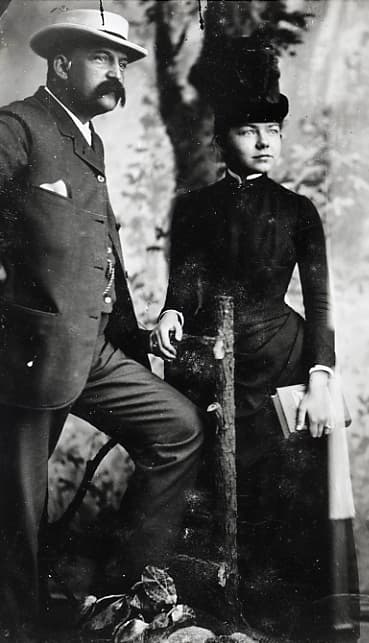
Amy Beach and her husband, 1886. (CC0)
As an amateur music lover and poet himself, Beach appreciated Amy’s talent. Because she was limited in performing, she turned to composing music instead. She composed beyond the parlor songs for voice and piano that 19th-century women were expected to write. Amy wrote serious orchestral works.
Her first major work, the Mass in E flat, was debuted by the Handel and Haydn Society. The Boston Symphony premiered her Gaelic Symphony to great acclaim in 1896. She was the soloist at the premiere of her Piano Concerto in 1900.
Dr. Beach used his influence to promote his wife’s work. Unusual for any composer, most of her work was published and performed very shortly after its composition. During her husband’s lifetime, her work was frequently published under the name Mrs. H.H.A. Beach.
After Dr. Beach died in 1910, Amy went to Europe. After a year of grieving, she resumed composing and performing, using the name Amy Beach for the first time. Her talent was greatly appreciated in Europe and in the United States.
Amy gained many admirers through women’s clubs and Amy Beach Clubs founded by young women and girls. She continued her work until heart disease forced her to slow down in the 1930s. She died in 1944 at 77.
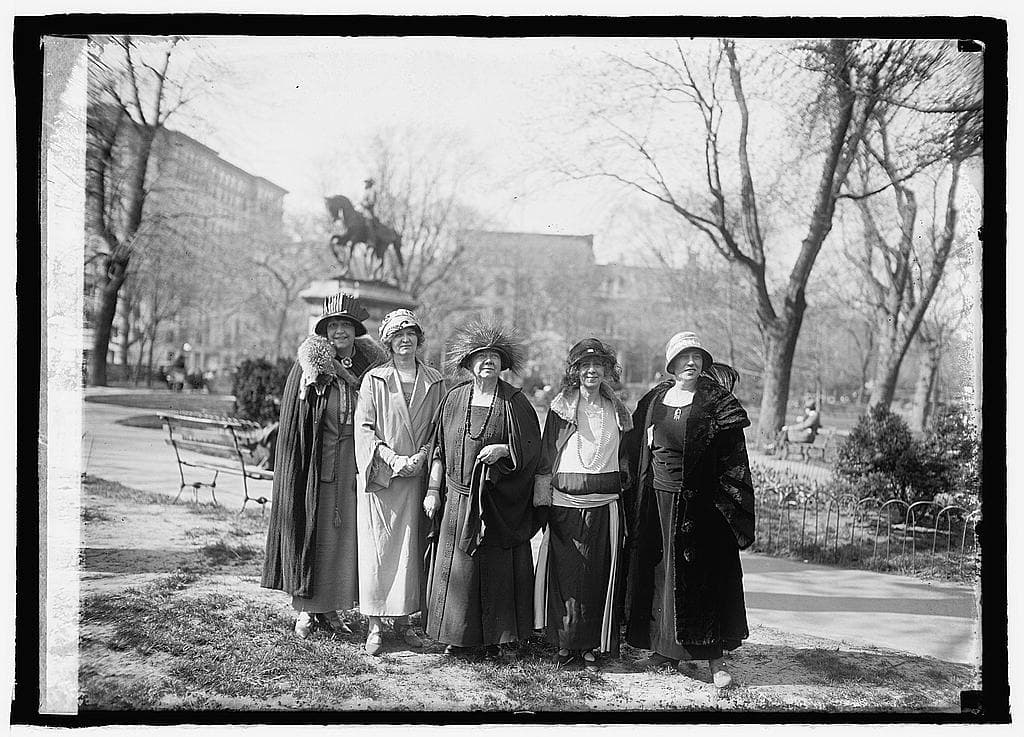
Amy Beach (center) with friends in McPherson Square, Washington. (Public Domain)
A Composer’s Legacy
Amy proved an incredibly prolific composer; she wrote in a variety of genres, including for orchestra, chamber ensemble, solo piano, solo voice and piano, and chorus. She wrote one opera, “Cabildo.” She wrote for pianists of all levels, from beginners to virtuosic technicians like herself. She composed extensively for the human voice, writing dozens of choral pieces in both sacred and secular settings.
Amy is best remembered for her art songs, many set to classic poems by William Shakespeare and Robert Browning.
From 1928 onward, Beach spent every summer at the MacDowell Colony, an artists’ retreat started by fellow Boston Six composer Edward MacDowell and spearheaded by his widow, Marian. She wrote some of her best work there. She also enjoyed the company of other composers and musicians, mostly fellow female artists.
Out of gratitude for the inspiration she enjoyed at MacDowell, Beach willed the earnings from her compositions to the MacDowell Colony, which became her chief executor, since she was childless.
Amy outlasted her fellow Second New England School members in earthly lifespan and posthumous legacy. Her music deserves recognition and appreciation for its range and beauty.
Check out the other members of the Boston Six: John Knowles Paine, Arthur Foote, George Whitfield Chadwick, Horatio Parker, and Edward MacDowell.
What arts and culture topics would you like us to cover? Please email ideas or feedback to features@epochtimes.nyc.