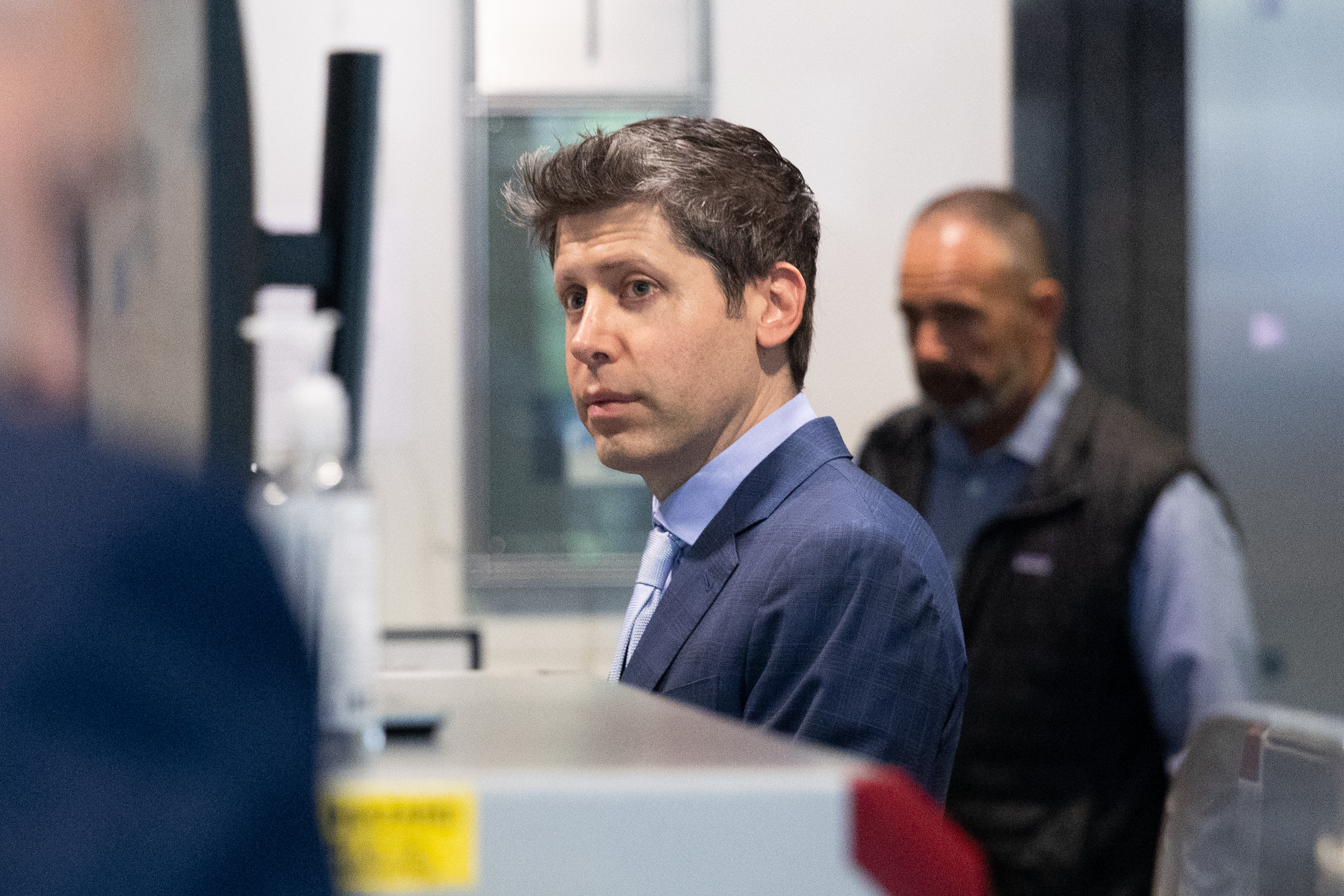
OAKLAND—In the third week of a high-stakes federal trial that could have a profound impact on the artificial intelligence (AI) race, OpenAI CEO Sam Altman on Tuesday told an Oakland jury that he remains committed to his company’s original mission of ensuring AI benefits humanity.
“I think it’s wonderful that through the hard work of thousands of people … we’ve been able to create one of largest nonprofits in the world, [and] that it has this role to protect the technology and the impact on the world,” Altman told the court.
Tesla CEO Elon Musk is accusing Altman and OpenAI President Greg Brockman of bilking him out of $38 million in donations, then restructuring the nonprofit lab they cofounded by exclusively licensing its flagship product to Microsoft—betraying a founding mission to operate an open-source charity that would counter the existential risks of profit-driven AI.
During his own testimony, Musk often told the court, “You can’t just steal a charity.”
When his time on the stand came, Altman clapped back, “No, you can’t steal it, but Mr. Musk did try to kill it.”
Altman said Musk abandoned the company in 2018 to start his own for-profit competitor, xAI, when other founders rejected his bid to take full control of the operation.
“I thought incredibly highly of Elon, and felt like he had abandoned us, not come through on his promises,” Altman said, suggesting Elon’s withdrawal of support jeopardized the mission. “We were left for dead.”
He acknowledged Musk was a critical contributor but added, “I also wish he would stop doing what he is doing here, which in my opinion is jealousy as we get more and more successful.”
In the bitter feud between the former friends and cofounders, which in recent years has unfurled on social media, both volley accusations of betrayal, double-dealing and hypocrisy.
Altman on Tuesday described his tumultuous tenure at OpenAI’s helm as painful and difficult, its successes unimaginable just a decade prior.
The once-embattled and underfunded nonprofit startup, founded in 2015, was recently valued at $852 billion following a 2025 restructuring as a public benefit corporation, in which the nonprofit arm received a 26 percent stake in the for-profit, based on a transfer of intellectual property. Microsoft, following $13 billion in investments since 2019, currently owns a 27 percent stake in the company.
‘Hurt and Angry’
Of the circumstances surrounding his chaotic 2023 ouster by former nonprofit board members, who at the time cited his “consistent pattern of lying” and concerns over safety protocol issues, Altman said it was one of the most painful moments in his life.
“I had poured the last years of my life into this. I was watching it about to be destroyed. … I was very angry and hurt and upset. It felt like an incredible betrayal,” he said, noting he could have made a lot of money and had a “much easier life” if he had gone to work for Microsoft.
Microsoft CEO Satya Nadella testified Monday that at the time, he offered to create an AI project for Altman, Brockman and any potentially departing employees, in an effort to prevent the wholesale implosion of OpenAI—and along with it his company’s formidable investments.
Musk alleges Microsoft “methodically entrenched itself” into OpenAI, helping to engineer the 2023 “coup” and seize the company’s board of directors.
Altman returned to OpenAI just days later, at the board’s invitation, he said, because he “cared about the mission and the people,” and thought it would be the last chance to create an AI lab with OpenAI’s unique mission and structure.
“I was not trying to deceive the board,” Altman said. “I was certainly not trying to do anything other than make safe AI and distribute it to humanity. I feel badly for the misunderstandings … but that was never my intent.”
In court Tuesday, Steven Molo, an attorney for Musk, pressed Altman about his conditions for return, which included firing the original board—and vetting a new one with Nadella’s approval.
Musk is suing Microsoft for aiding and abetting OpenAI’s breach of a charitable trust, allegations Nadella disputed when he testified May 11 about his involvement in the messy 2023 shakeup and a landmark financial agreement between the two companies the same year.
Power Struggle
Following a 2017 milestone demonstration of OpenAI technology at a gaming event, the founders realized they had a chance at becoming competitive but would need significantly more capital and computing power to take on Google, at the time an undisputed leader in the field.
Each floated various ideas for profit and nonprofit configurations; Musk at one point suggested rolling OpenAI into Tesla. Throughout late 2017 and early 2018, discussions became more contentious as the power struggle between Musk and Altman intensified.
At one point, Altman said, Musk suggested giving himself a 90 percent equity stake in a for-profit entity; Musk meanwhile, pointed out that he proposed taking an initial majority stake that would be diluted with additional investment over time.
Altman said Tuesday that Musk contributed only 28 percent of the nonprofit’s funding from 2015 to 2020, and failed to come through on a $1 billion pledge, leaving the startup with few options.
Molo pressed Altman, suggesting he had a “fixation” with being CEO. The attorney referenced an email from Brockman and fellow cofounder Ilya Sutskever during the period of intense negotiations over the future funding and structure of OpenAI.
“We don’t understand why the CEO title is so important to you. Your stated reasons have changed, and it’s hard to really understand what’s driving it,” the two wrote. “Is AGI your primary motivation? How does it connect to your political goals?”
Artificial General Intelligence (AGI) generally refers to the theoretical point at which machine “intelligence” meets or surpasses human cognitive abilities and can operate autonomously, which many experts view as an existential threat to humanity. Musk cites the risks of runaway AGI as the express motivation for founding OpenAI.
Altman on Tuesday said, by way of explanation, “I was thinking about running for governor at the time.”
Molo challenged OpenAI’s contention that its nonprofit board has control of OpenAI’s for-profit ventures and governance.
In a poignant moment, the plaintiff’s attorney played a brief clip of Altman’s 2024 appearance on a popular podcast, in which he appears to acknowledge former board members’ contentions that he maintained de-facto control over the nonprofit’s board of directors, and impeded their ability to carry out their duties.
Asked on the podcast if he trusted himself with the kind of power that will come with being first to develop AGI, Altman paused and said he was going to offer a standard response about how no one person should have total control over AGI.
“I think you want a robust governance system,” he said, noting a number of issues related to “our board drama.”
“But as many people have observed, although the board had the legal ability to fire me, in practice it didn’t quite work. And that is its own kind of governance failure,” he said.
Under re-direct by OpenAI attorney William Savitt, Altman clarified the outgoing board technically fired him, rehired him, and appointed a new board.
Toxic Management Style
Altman said he was “annoyed” when Musk resigned from the OpenAI board in 2018 to pursue his own AI venture.
“He really had lost confidence in the organization and did not believe we were going to be successful. … And he didn’t want to be associated with something he couldn’t control,” Altman said.
That left questions about funding gaps, competition and, Altman said, whether Musk would “take revenge” on his former cofounders.
“I don’t think Mr. Musk understood how to fund a good research lab,” Altman said, noting he had “demoralized” some of the company’s most key researchers, including by suggesting they be ranked by accomplishments.
Musk’s management style, he said, may work in other industries, but upset the culture in a fledgling, frontier lab where people needed “psychological safety” and long periods of time to develop their work.
Reaction to his departure, Altman said, was mixed. It introduced instability but also provided a “morale boost.”
Altman’s Character on Trial
Molo, Musk’s attorney, peppered the witness with a litany of questions about statements others have made about Altman’s character, both in the media and in internal communications revealed during the trial.
“I believe I’m a truthful person,” Altman said, appearing to waver under relentless examples of former colleagues and Silicon Valley insiders who have questioned his integrity.
“You’ve been repeatedly called deceptive and a liar by people with whom you’ve done business, haven’t you?” Molo asked, referencing accusations by former board members that Altman created a “toxic culture of lying.”
Speaking to the press after trial, OpenAI attorney William Savitt told reporters that the plaintiff’s case amounted to “character assassination.”
“I don’t think it’s easy to sit there and have someone barking at you like a dog, saying things that aren’t true, having no real opportunity to defend oneself,” Savitt said of Molo’s cross-examination. “I think it’s an intense amount of pressure and he answered the questions honestly.”
Savitt said the evidence has made clear that “far from stealing a charity, OpenAI and its leaders have created one of the largest charities in history, with an extraordinary mandate, and an extraordinary reservoir of resources it’s putting to hard work, as well as governance over the technology that has so well impacted so many people.”
Marc Toberoff, an attorney for Musk, reiterated a point made throughout the trial—that the nonprofit’s transfer of all assets to the for-profit amounted to a looting of the OpenAI charity.
“From 2018 to 2024 the nonprofit Musk cofounded and invested all the original money in has been an illusion. It had no employees, it didn’t develop any AGI, and it did absolutely nothing to further the mission that its executives keep touting in this case,” Toberoff said.