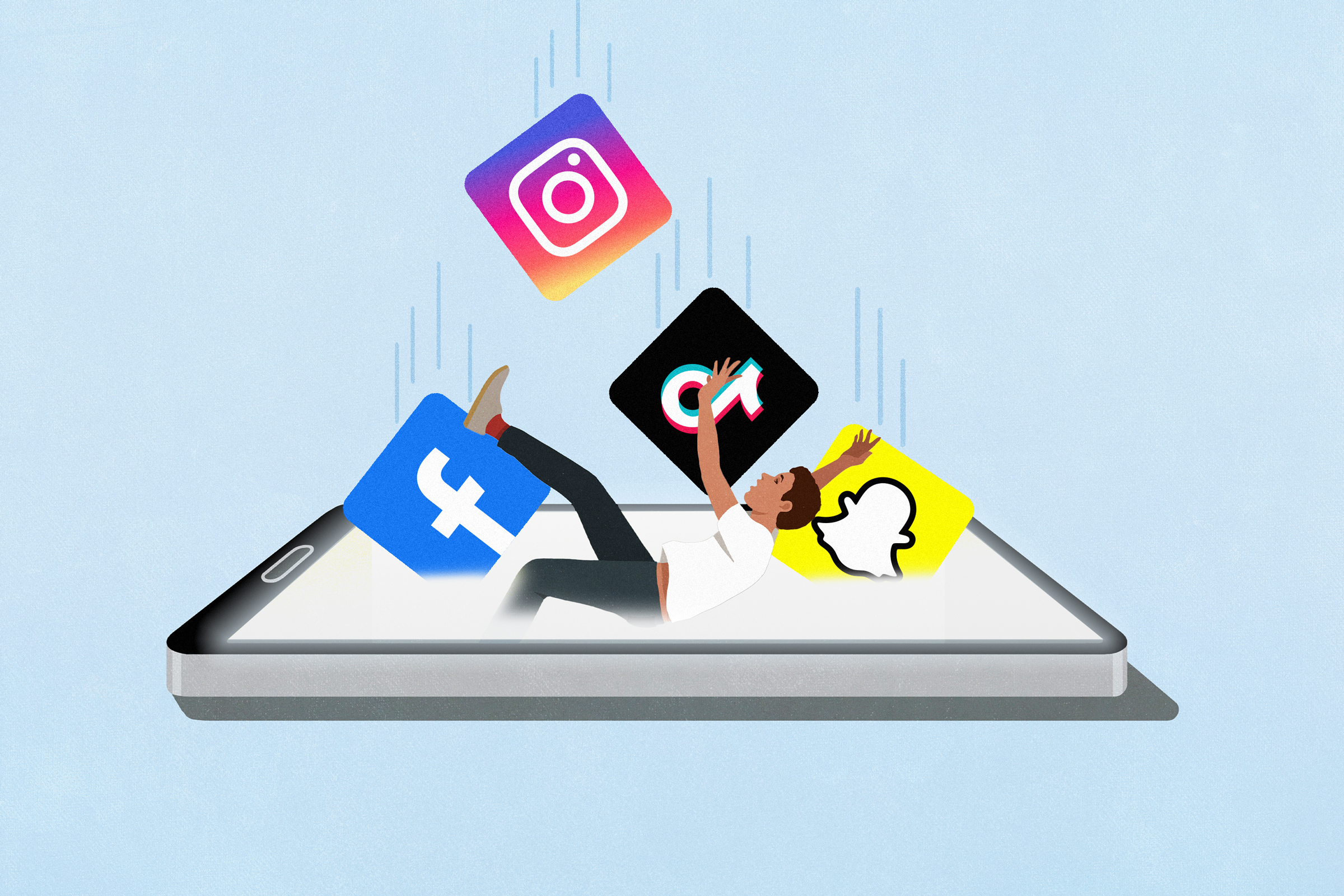

LOS ANGELES—Following a landmark $6 million personal injury verdict in March against Meta and Google, the next bellwether case in California state court considering whether tech giants can be liable for harms caused by their platforms’ addictive features will highlight familiar claims.
Like the 20-year-old California woman identified in court documents as “Kaley G.M.” or “K.G.M.,” who sued Instagram, YouTube, TikTok, Snapchat, and their parent companies, “R.K.C.,” the plaintiff in the second case, claims that he suffered anxiety, depression, and body dysmorphia after becoming addicted to their platforms. He is suing the same four companies.
Both lawsuits allege that the companies engineered their products to hook vulnerable young people and trap them in a vicious cycle of problematic use, despite known harms.
But notably, plaintiffs’ attorneys say, R.K.C. is a 17-year-old black American boy from Panama City, Florida. He offers a different but parallel perspective to that of the young white woman who testified about her deepening psychological turmoil as she came of age in an era already saturated by social media.
“He has a similar but different story,“ Josh Autry, an attorney with Morgan & Morgan who represents R.K.C., told The Epoch Times. ”He’s still a child. He’s a teenager, and he still struggles with social media addiction.
“He’s from across the country. He’s a Floridian, and he doesn’t travel much. I think the trial might be his first trip to California. He is a member of a minority group. I think that’s all significant.”
Autry said that in the bellwether process, during which a handful of test cases create a blueprint for how thousands more will be argued and settled, it will be important for juries to see cases with both male and female plaintiffs—as well as examples of young adults and teenagers who have grown up with social media and who come from diverse backgrounds.
Although much research and attention has focused on negative impacts of social media use for girls, the male adolescent perspective adds a new dimension to the evolving discourse in what some observers call Big Tech’s “Big Tobacco moment”—in which a high-stakes debate over the future of the industry is playing out both in groundbreaking trials and in the court of public opinion.
The plaintiff’s 2023 complaint alleges that “prompted by the addictive design of Defendants’ platforms” and “constant notifications,” R.K.C. became a compulsive user, to the near exclusion of all other activities. Sleep deprivation, depression, eating disorders, and suicidal ideation followed.

Attorney Mark Lanier, representing plaintiff K.G.M., speaks to reporters outside Los Angeles Superior Court in Los Angeles on March 25, 2026. Following a landmark verdict finding Meta and Google liable for designing addictive platforms that harmed a young woman’s mental health, a California court is set to hear a similar case involving a 17-year-old boy from Panama City, Fla. (Justin Sullivan/Getty Images)
Defendants failed to warn R.K.C. and his father of the dangers of compulsive use, and misrepresented “safety, utility and non-addictive properties of their products,” according to the lawsuit.
These civil cases narrowly focus on the design and operation of the defendants’ platforms—including features such as infinite scroll, beauty filters, and artificial intelligence-powered proprietary algorithms—rather than user content they may host. Both the First Amendment and Section 230, added to the Communications Decency Act three decades ago, protect platforms from liability for third-party content.
The cases are part of a wave of thousands of civil cases, including those brought by school districts and attorneys general across the country, that are just now beginning to go before juries, after years in the making. One day before the verdict was delivered in K.G.M.’s case, a jury in New Mexico found Meta liable for misleading consumers about the safety of its products and endangering children, awarding $375 million in civil penalties.
Meta and Google executives, including Meta CEO Mark Zuckerberg, testified during K.G.M.’s trial that their products are not designed to be addictive, that they do not believe that clinical social media addiction exists, and that the companies have taken an over-cautious approach to safety. Google is YouTube’s parent company.

Meta CEO Mark Zuckerberg arrives at Los Angeles Superior Court ahead of the social media trial in Los Angeles on Feb. 18, 2026. Meta and Google executives testified that their platforms are not designed to be addictive, disputed the existence of clinical social media addiction, and said the companies have taken an over-cautious approach to safety. (Patrick T. Fallon/AFP via Getty Images)
Some expert witnesses in K.G.M.’s trial reported that social media addiction has skyrocketed among young people and is virtually indistinguishable from substance abuse in the brain, while others noted a lack of institutional consensus around diagnosis, treatment, and the true scope of the phenomenon.
Attorneys for Meta aggressively picked apart K.G.M.’s sensitive medical records and troubling family history, arguing that her mental health struggles more likely resulted from factors such as genetic disposition and abusive or neglectful parents than from compulsive social media use.
This did not appear to convince jurors, who found Meta liable for 70 percent of K.G.M.’s compensatory and punitive damages. YouTube, which denied that it was negligent and argued that it is not in fact a social media app but a video streaming platform like Netflix, was ordered to pay 30 percent. Both companies issued statements saying that they disagreed with the verdict and planned to appeal.
Autry said he does not expect defendants’ legal strategy to change in future cases.
“I think that’s going to be the lead defense in every trial,” he said. “They are going to say these kids would’ve had messed up lives anyway, [that] they would’ve had anxiety, depression, suicidal ideation anyway.”
In R.K.C.’s case, the battle over parental control of teens’ social media use will be a live issue.

Young boys look at a phone on a subway in New York City on March 26, 2026. Expert witnesses in K.G.M.’s trial said social media addiction has surged among young people and is virtually indistinguishable from substance abuse in the brain, a focus expected to continue in a second case. (Samira Bouaou/The Epoch Times)
“I think it will be important for us to get a bellwether verdict in a case where the parents are going to be faulted for giving the child a phone, not taking the phone away, not doing more restrictions. ... He’s still under his dad’s supervision,“ Autry said. ”And to have his dad testify about his struggles with social media, and his own struggles as a parent with how to handle his son’s social media use ... all of that will be important.”
Like K.G.M., R.K.C. struggled with weight issues and related feelings of self-worth, as well as bullying, and, like her, he kept returning to the apps even though being on them made him feel worse about himself, Autry said.
“We use that as evidence of how significant their addiction is—even when they hate it, they can’t stop coming back,” Autry said.
But where K.G.M.’s use of beauty filters on Instagram was a central focus of her case—at one point her lawyers unrolled a 30-foot mosaic of filtered selfies she had posted on the platform—for R.K.C. they played a lesser role.
“The filters for him were puppy ears or a Superman sign on the chest,“ Autry said. ”It wasn’t really a contributor to his injuries other than potentially just being one more dopamine hit—an additional feature that would pull him back to the platform, but not in the same way as Kaley’s case, where the filters made her dislike herself more.”
Like the first trial, the second will focus heavily on expert testimony about the science of addiction—including research about how problematic use can affect developing adolescent brains—and on what internal documents reveal about what the defendants knew and when.

Teenagers pose for a photo while holding smartphones in front of a Meta logo in this illustration taken on Sept. 11, 2025. Part of what the second trial will focus on is thousands of pages of unsealed internal documents that reveal what Meta and Google leaders knew about underage users and potential harms. (Dado Ruvic/Reuters)
Thousands of pages of unsealed internal company documents gave the jury—and the public—insight into what leaders at Meta and Google understood about their underage users and potential harms.
Representatives for both companies have argued that the plaintiff cherry-picked and misconstrued these documents in service of an incomplete and inaccurate narrative.
Snapchat and TikTok settled shortly before K.G.M.’s trial, but they are still named in thousands of related cases.
In the upcoming trial, Autry said, yet more internal documents will show that defendants knowingly engineered their products to be addictive to children.
“The Meta and YouTube documents are not unique,” he said. “We still have not had a Snap or TikTok trial, but [those] documents are just as damning. TikTok and Snap, just like Meta and YouTube, designed their platform to maximize time spent, and to addict.”
In particular, internal TikTok documents will show that the company knew “a safe way to operate,” Autry said, referring to the version of its app rolled out in China with additional safety mechanisms.
“They made a business decision to prioritize growth over safety, whereas in China, they were more protective of children,” he said.

An instructor prepares to livestream on TikTok in Guangzhou, Guangdong Province, China, on April 2, 2024. Attorney Josh Autry said internal TikTok documents will show that the company knew how to operate in a safer way, citing a version of its app used in China that has additional safety mechanisms. (Jade Gao/AFP via Getty Images)
Representatives of Snap Inc., Meta, ByteDance, and Google did not respond to requests for comment from The Epoch Times.
Judge Carolyn Kuhl of the Superior Court of California for the County of Los Angeles in 2023 ruled that California does not allow “strict liability” claims, meaning that K.G.M.’s attorneys had to prove that the companies knew that their product was defective and were negligent.
Attorneys for the plaintiff are arguing that Florida allows strict liability, which would mean that they would still have to prove that the platforms are defective and dangerous by design, but they would not have to prove that the companies knew of the defect.
Plaintiff’s attorneys said they are hoping to schedule the trial during Kuhl’s first availability this summer, but some defendants are opposing a summer trial.
A decision from Kuhl on both issues is expected later this month.