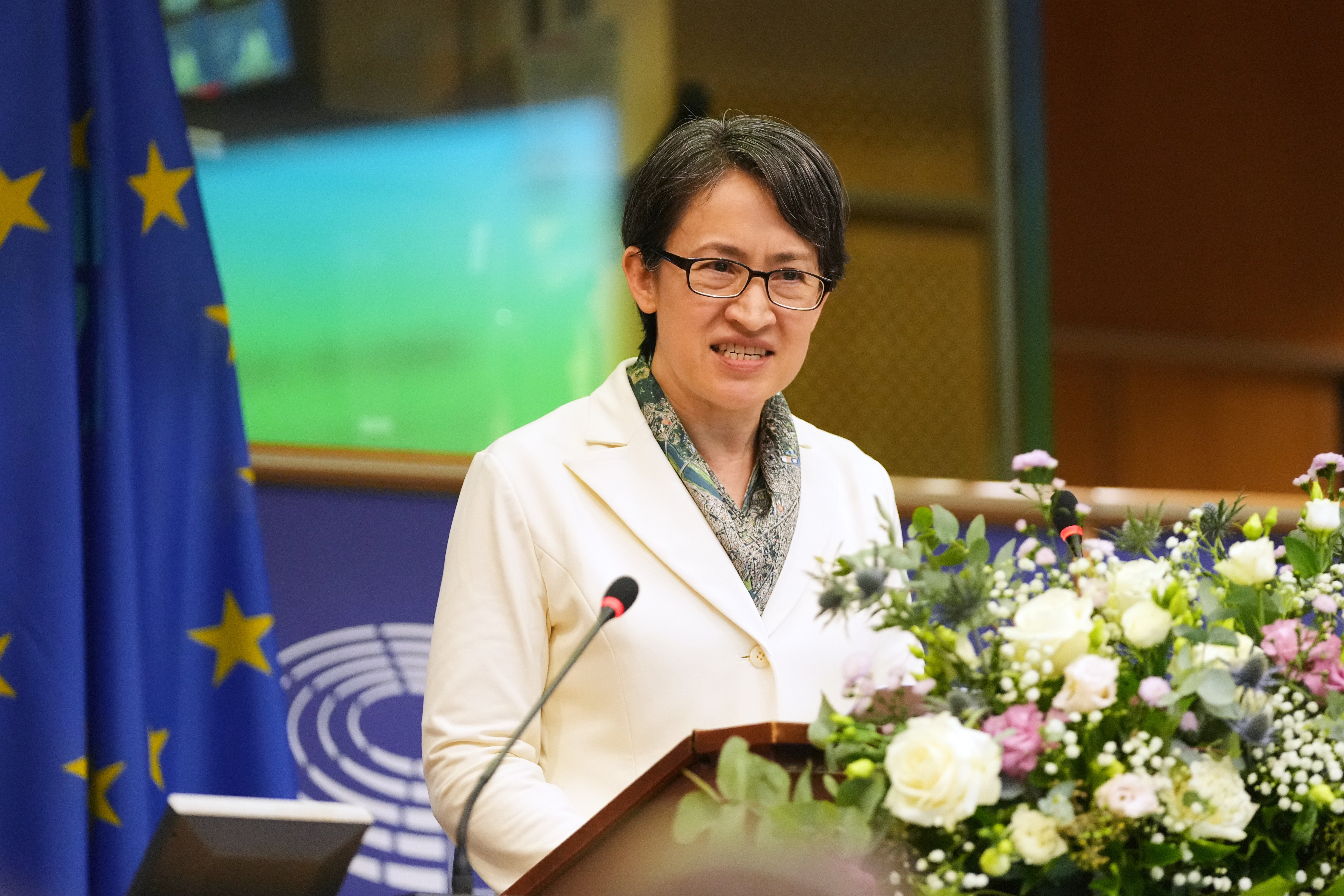

Taiwan’s Vice President Hsiao Bi-khim said a free Taiwan is key to global security during an unannounced appearance on Friday at the European Parliament in Brussels, where she addressed lawmakers at the Inter-Parliamentary Alliance on China summit.
Hsiao was the first Taiwanese vice president to visit the European Parliament.
“Taiwan matters—not because we are a victim of coercion, but because the integrity of the international system and global prosperity depend on a strong and free Taiwan,” said Hsiao.
Her speech, which centered on Taiwan’s importance to global prosperity, underscores Taipei’s expanding outreach to Europe and the continent’s growing willingness to engage with Taiwan despite Beijing’s objections.
While acknowledging that Taiwan and Europe differ in culture and history, Hsiao said their partnership “is rooted in common ground that runs deep.” She noted shared democratic values and the potential for deeper cooperation in trade, technology, and supply chain resilience.
“Europe has defended freedom under fire. Taiwan has built democracy under pressure,” she said. “These different histories lead to a shared commitment: in peace, dignity, and resilience.”
Building on these shared foundations, Hsiao said free political and economic systems are the engines of prosperity and growth.
“Our democracies are not perfect, but they are open,” she said. “They do not silence criticism—they allow it to guide reform. They do not fear transparency—they demand it. And they do not require loyalty to a strongman, but allegiance to the law and the people.”
Hsiao noted that Taiwan and EU nations share a commitment to open societies and a readiness to confront common challenges. Yet Taiwan’s democracy, she said, continues to face intensifying military and security threats from Beijing.
When the Chinese Civil War ended in 1949, the Nationalist government retreated to Taiwan. Although the Chinese Communist Party has never ruled the island, it continues to claim Taiwan as a “renegade province” and has repeatedly threatened to bring it under its control by force.
In recent years, China has ramped up military activity around the island, conducting increasingly frequent and large-scale air and naval drills.
Hsiao concluded her address by describing Taiwan as a vibrant, pluralistic democracy that values open dialogue, accountable governance, free elections, and freedom of belief and expression.
“We don’t just want to survive—we want democracies to thrive,” she said. “A stronger Taiwan means a more stable Indo-Pacific. And a stable Indo-Pacific will bring about a safer world.”