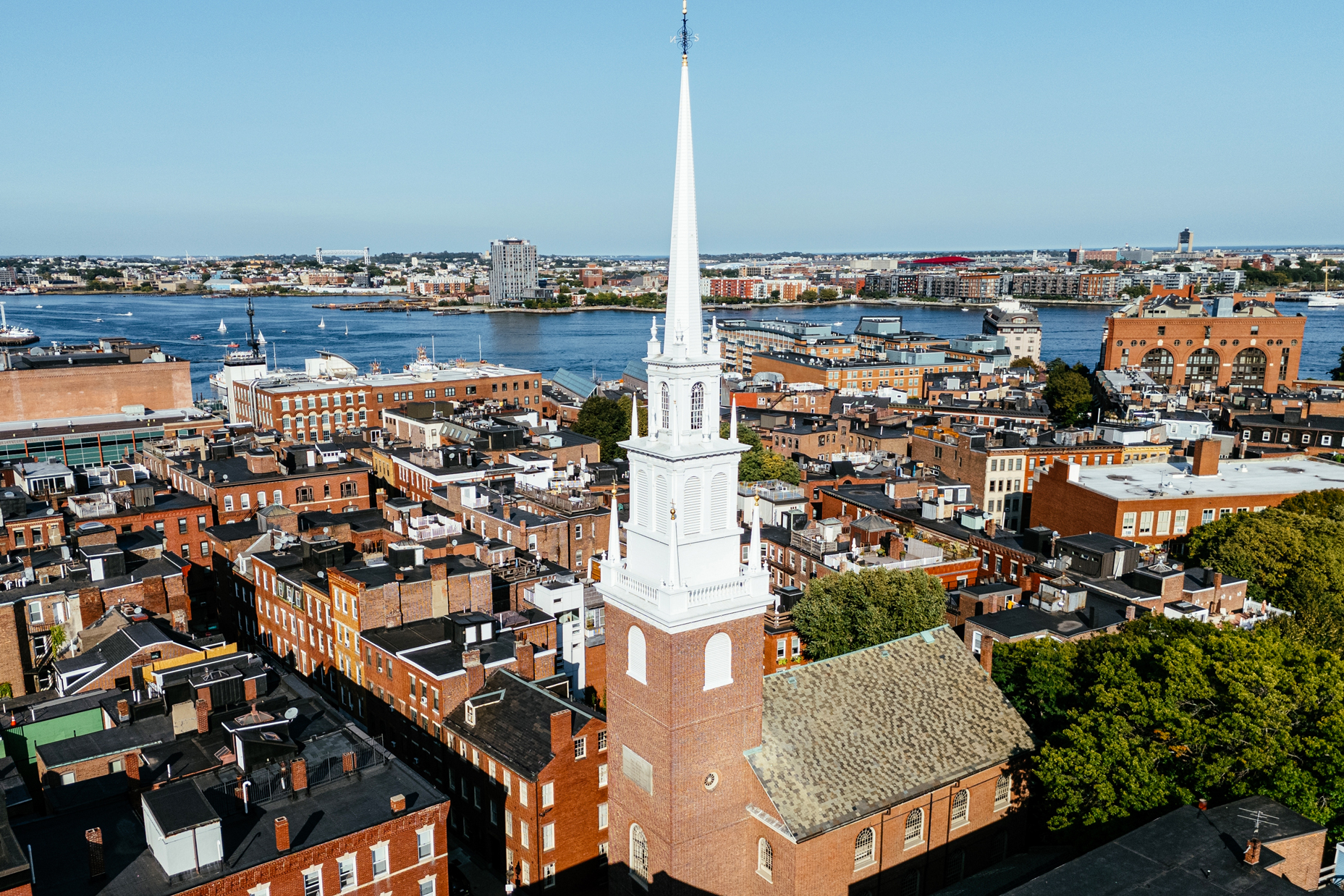


The American Revolution started in a church.
Two lanterns in the steeple of Boston’s Old North Church signaled the movement of British troops on April 18, 1775, providing early warning for the Patriots.
Our celebration of America’s 250th anniversary would be incomplete without some mention of this historic house of worship, which now welcomes more than half a million visitors each year as a National Historical Landmark.
But Old North Church is not merely a museum. It’s a living, breathing Christian congregation and the oldest Episcopal church in the city.
Its story did not begin or end with the exploits of its Patriot members. This is a generational saga of perseverance in the face of challenge, adaptation to continual change, and, above all, unwavering fidelity to the vision of its founders.
It is a story of faith and a story of liberty. The story of Old North Church is the story of America.
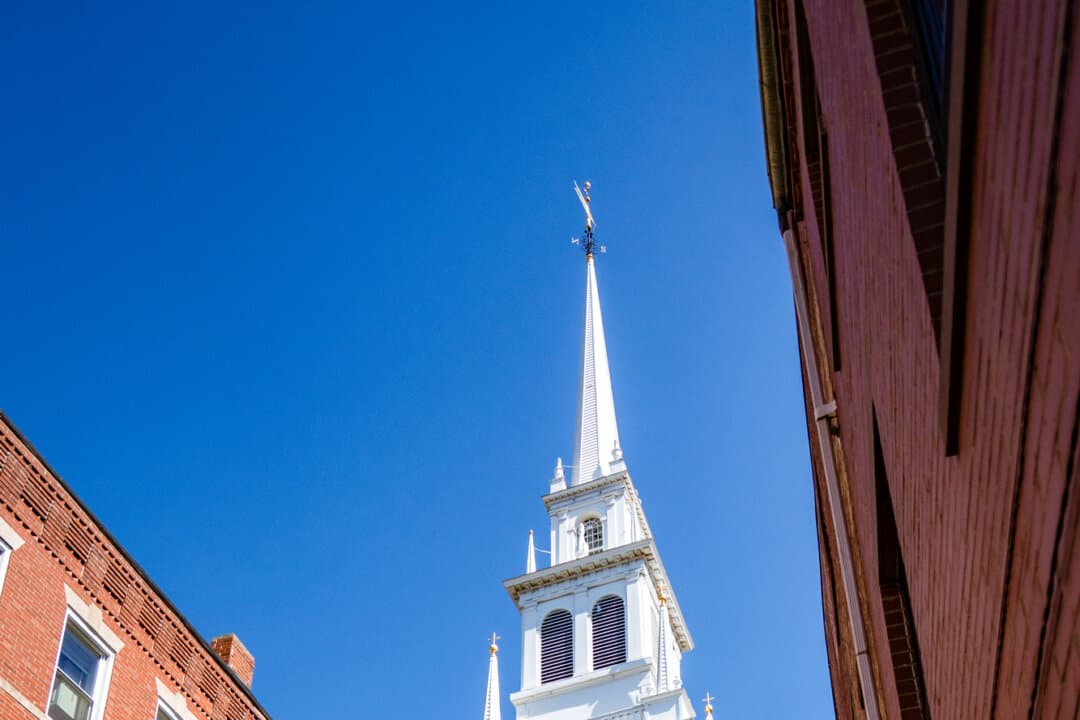
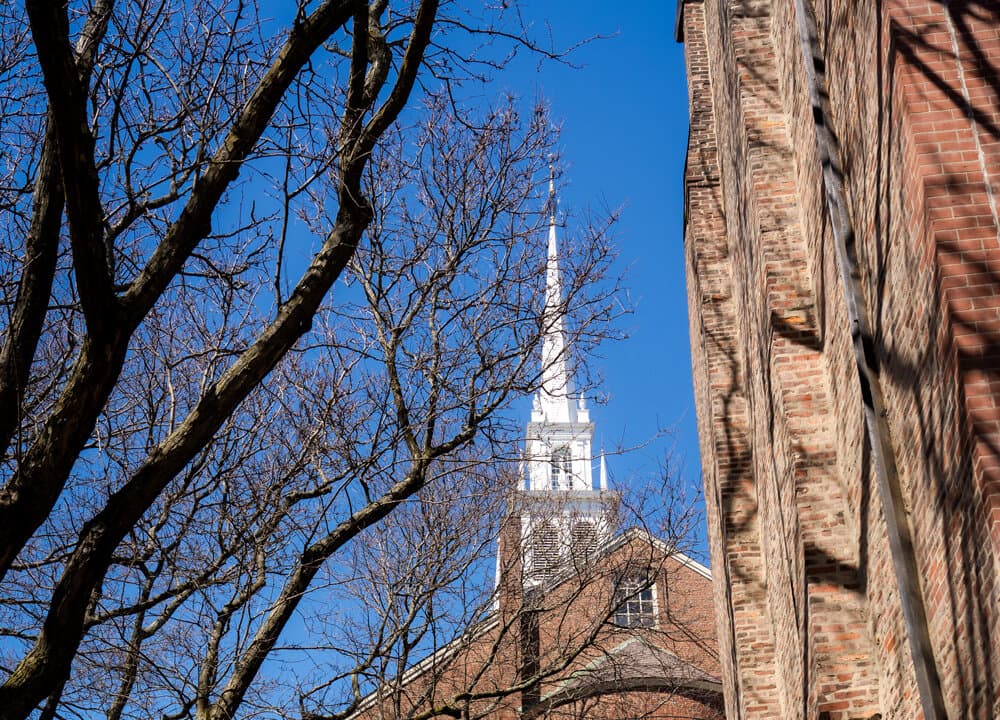
Old North Church, formally known as Christ Church, is seen in Boston on April 8, 2026. The church was established as Boston grew within the British Province of Massachusetts Bay. (Samira Bouaou/The Epoch Times)
Prosperous Colonies, Flourishing Faith
Old North Church, formally known as Christ Church, was created by growth in the British Province of Massachusetts Bay and its principal city, Boston.
By 1723, when the church was founded, the region had been inhabited by colonists for more than 100 years. King’s Chapel, the first Anglican church in Boston, was bursting at the seams.
Christ Church was established to accommodate the expansion of the city and its body of Anglican worshipers. The Rev. Timothy Cutler dedicated the church with the biblical vision to be “a House of Prayer for all people.”
The church continued to grow along with the country, which was in the midst of a religious revival that came to be known as the Great Awakening.
English minister Charles Wesley, who had founded Methodism in Britain along with his brother John Wesley, preached at Christ Church multiple times in 1736 during a speaking tour of the colonies.
Christ Church is located in Boston’s well-to-do North End and drew wealthy merchants and sea captains as well as farmers and sailors. Some freedmen and some enslaved blacks worshiped at Christ Church, too, as slavery was still legal in the British colonies.
While people of color were welcome to attend services, they were relegated to the second-level gallery. Wealthier members, some of whom were slaveholders, purchased reserved pews on the main level.
The congregation added a steeple in 1740, making Christ Church the tallest structure in Boston at the time. Ten years later, a 15-year-old Paul Revere became a bell ringer at the church.
Loyalists and Patriots
The late 1700s were marked by political tension in the increasingly prosperous British colonies. Patriots agitated for independence. Tories were loyal to the crown.
Christ Church contained both.
Robert Newman, the church sexton, was a Patriot. He sat in a pew on the east side of one aisle. Gen. Thomas Gage, commander of the British forces in Boston, sat on the west side.
The political tensions reached a breaking point when British forces prepared to move on a colonial arsenal in the town of Concord.
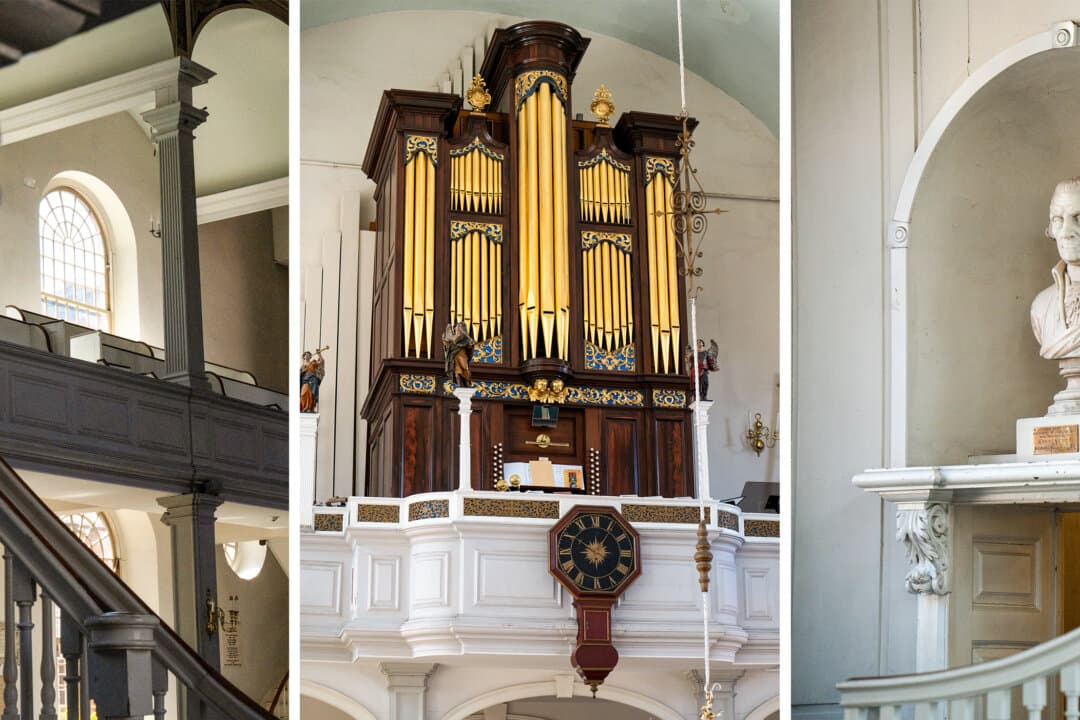
(Left, Center) Old North Church in Boston on April 8, 2026. (Right) A bust of George Washington in Old North Church in Boston on April 8, 2026. (Samira Bouaou/The Epoch Times)
Mather Byles, the loyalist pastor, resigned on April 18, 1775.
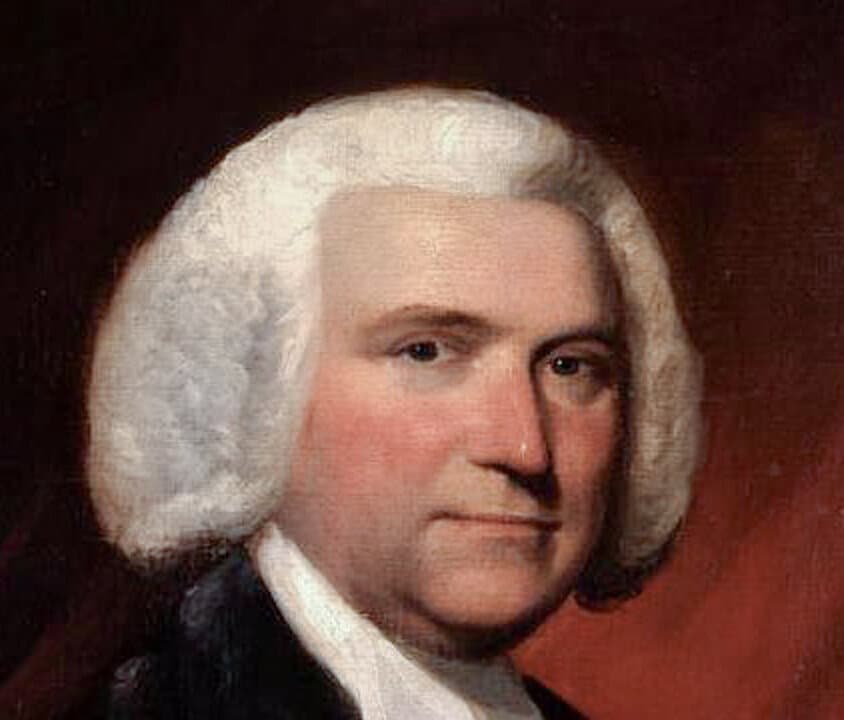
A portrait of Loyalist pastor Mather Byles, in 1784. (Mather Brown/Public Domain)
That night, Newman and John Pulling Jr., another church leader, lit the famous lanterns in the church steeple.
That was just the beginning of the church’s role in the war.
Two months later, Gage watched the Battle of Bunker Hill from the church steeple. His trusted subordinate, Maj. John Pitcairn, was fatally wounded in the fighting. Pitcairn, also a member of Christ Church, was buried in the church crypt.
The building served as a British military hospital during the hostilities, according to local lore.
Byles left for Nova Scotia in 1776. Others moved away, too, leaving only a handful of Christ Church families in Boston.
The church closed on the day that the lanterns were lit and remained closed for three years.
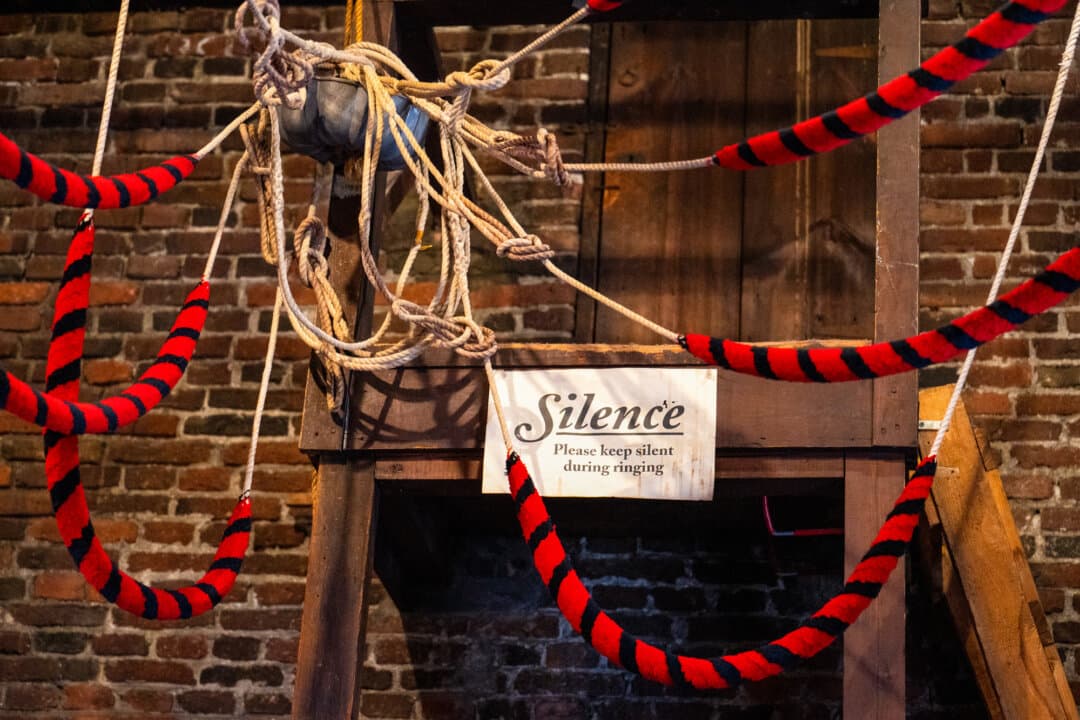
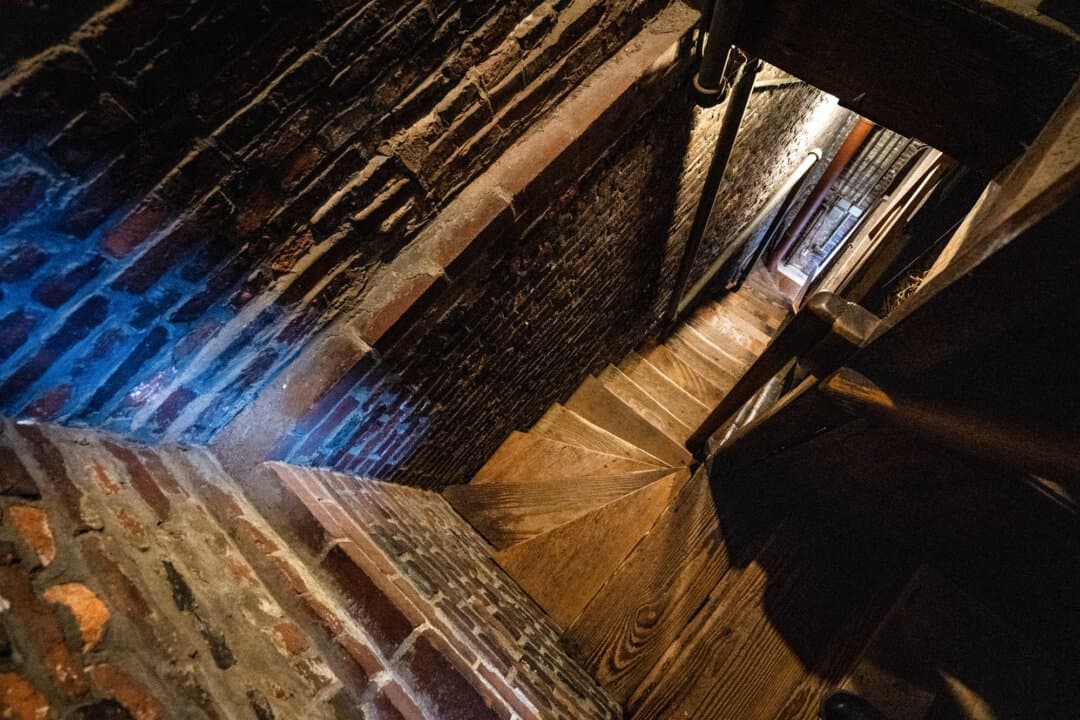
(Top) The bell ringing chamber in Old North Church in Boston on April 8, 2026. (Bottom) The stairs from the bell ringing chamber in Old North Church in Boston on April 8, 2026. (Samira Bouaou/The Epoch Times)
New Country, New Church
Christ Church reopened in August 1778 after a former chaplain in the British army switched sides and swore allegiance to the United States. Prayers for the Continental Congress soon replaced prayers for the king in the church’s prayer book.
Yet when the war ended, little returned to normal for either the church or the fledgling nation.
The former colonies disagreed on how to form a government. Christ Church grappled with divisions, too.
Huguenots—Protestants who fled persecution in France—had settled heavily in New England over the past century.
After the war, an influx of Huguenots nearly overwhelmed the weakened congregation, threatening a shift away from its historic expression of the Christian faith. But former members were returning in numbers great enough to maintain their Anglican traditions.
In 1789, Christ Church became part of the newly formed Protestant Episcopal Church in the United States, formalizing its break with the official church of England but maintaining its beliefs and worship practices.
Boston itself was changed by the war.
The North End had become home to many of the thousands of immigrants arriving in the country. Wealthier families relocated to Beacon Hill, leaving their old neighborhood one of the poorest in the city.
By 1803, Christ Church was in “a state of feebleness and depression,” a pastor later reported.
Urban Renewal
Fortunes changed for the church with the arrival of a new pastor in 1805.
The Rev. Asa Eaton led the church through a period of expansion—not among wealthy merchants but among the immigrants who provided labor for America’s growing industrialization.
Eaton started a Sunday school, which was open to young people of all denominations, including black students. In those days, Sunday schools were the only education available to many working people and focused on reading, writing, and arithmetic.
The church embraced the new ministry. The congregation formed the Fragment Society to provide suitable clothing for poor students. Children would pick up the clothing to wear on Sunday and return it on Monday.
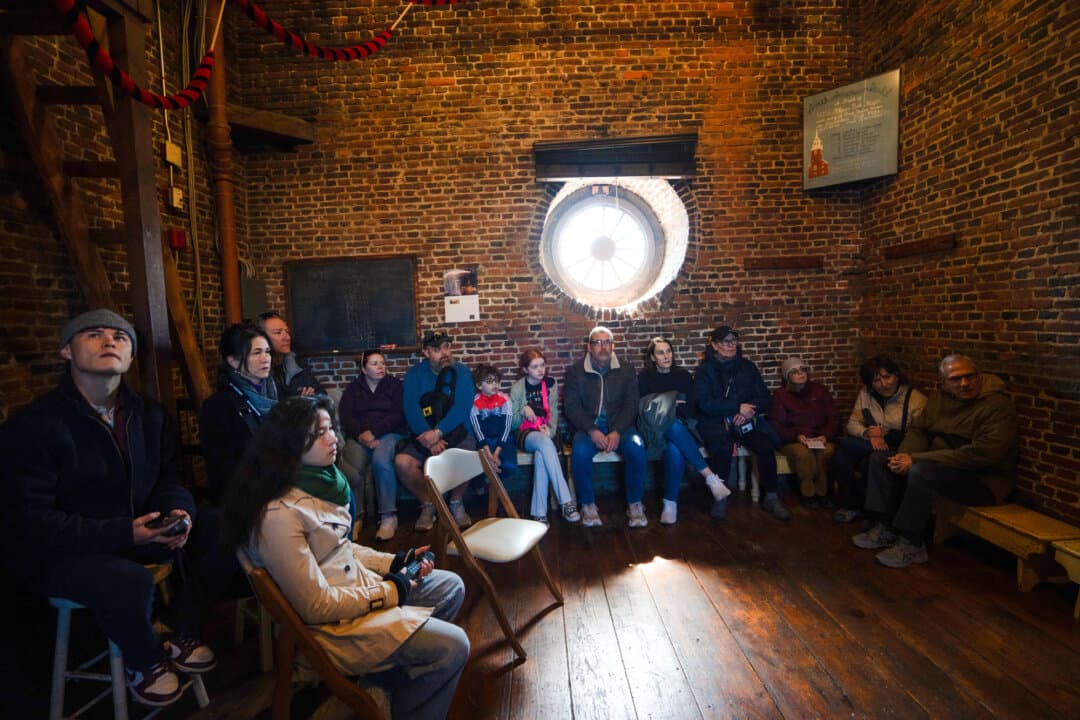
Visitors tour the bell ringing chamber in Old North Church in Boston on April 8, 2026. (Samira Bouaou/The Epoch Times)
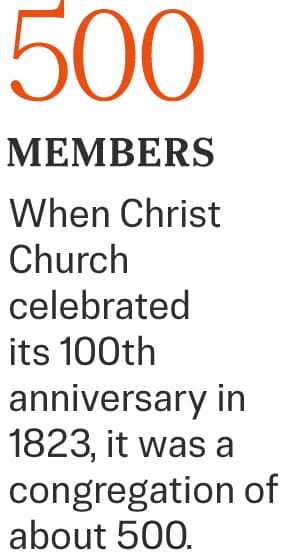
When Christ Church celebrated its 100th anniversary in 1823, it was a congregation of about 500.
Eaton recorded more than 650 people baptized and 240 couples married between 1805 and 1823. More than 1,000 children attended the Sunday school in its first nine years, and more than 3,000 books were distributed.
“That same period has been marked by a corresponding growth in its members in the virtues and graces of the divine life,” Eaton told the congregation in his centennial sermon.
Ten years later, the once financially strapped congregation had enough funding to undertake an extensive renovation of its historic building.
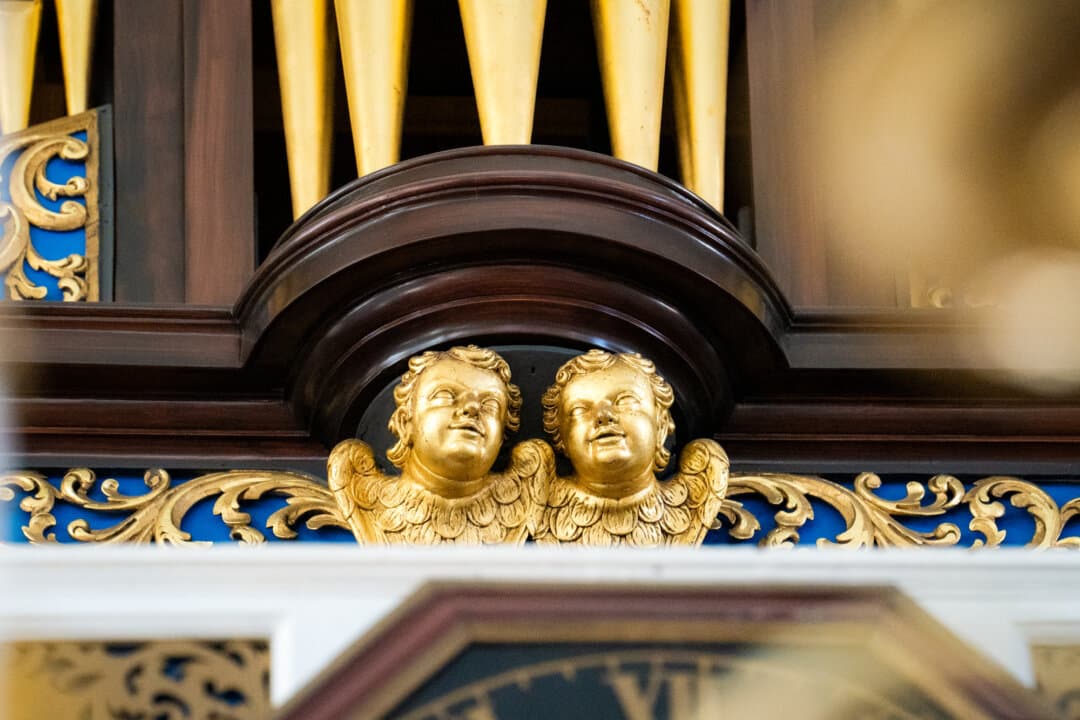
Details of a restored 1759 organ are seen at Old North Church in Boston on April 8, 2026. (Samira Bouaou/The Epoch Times)
Conflict and Attrition
Twenty-nine states were added to the Union during the 19th century. But the rapid expansion intensified the debate over slavery, which erupted into civil war in 1861.
The trajectory of Christ Church was similar.
Although the church had regained its footing, it, like the nation, had not come to grips with the issues of race and slavery.
In 1833, the church hosted Rev. William Levington, a black Episcopal minister from Baltimore. Levington was raising money for his church, which was also used as a school for black children.
Yet historians note that Levington may have been permitted to speak at Christ Church only on the strong recommendation of Eaton, the beloved pastor who had by then moved to another parish.
A newspaper announcement of the event noted that people of color would still be required to sit in the gallery.
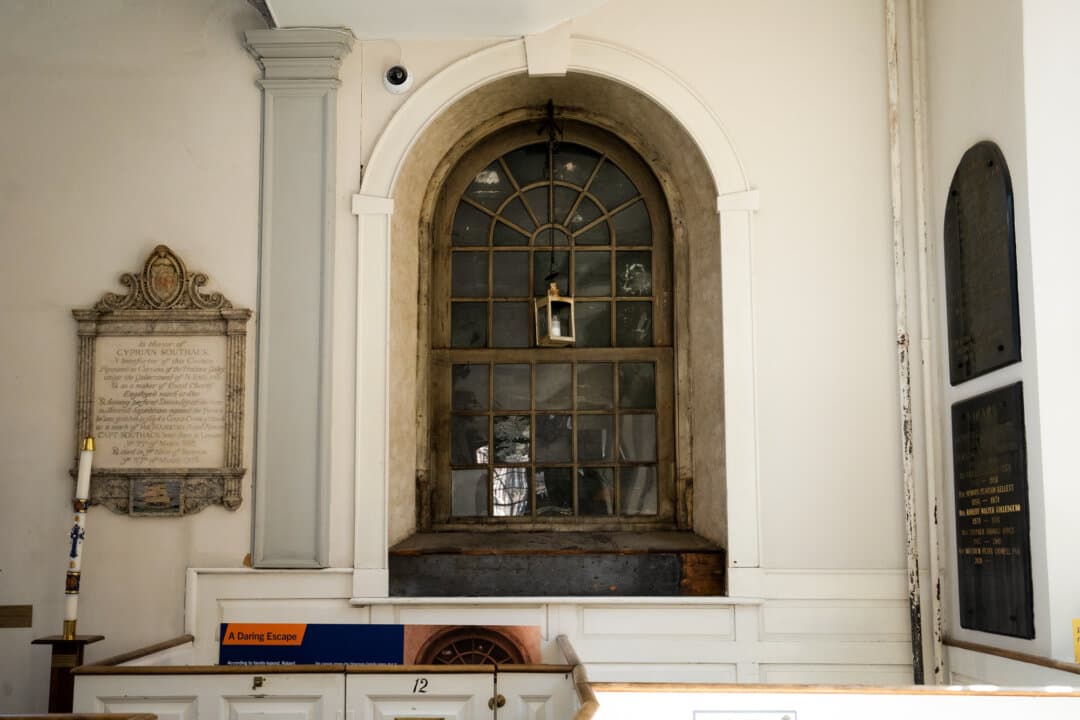
Old North Church in Boston on April 8, 2026. (Samira Bouaou/The Epoch Times)
When the Massachusetts Anti-Slavery Society sought meeting space in Boston churches in 1837, the leader of the Episcopal mission responded that Episcopal churches were to be used for religious purposes only.
He stated that although the antislavery cause was benevolent, it was political.
“The 19th-century Episcopal Church never took a firm stance on slavery,” historian Jaimie D. Crumley said in a Feb. 24 video. “Perhaps the ministers believed that abolition was not a spiritual cause.”
The church sank into a period of decline. By 1843, Sunday attendance had slipped to 381. Factions within the church quarreled with one another, leading to a series of lawsuits in the 1850s.
Meanwhile, Henry Wadsworth Longfellow’s poem “Paul Revere’s Ride” was published in 1860, and Old North Church gained national attention for its role in the Revolution as a result.
As the 20th century opened, the church’s condition mirrored that of 100 years prior—dwindling in congregation numbers, financially challenged, and struggling to maintain an aging facility.
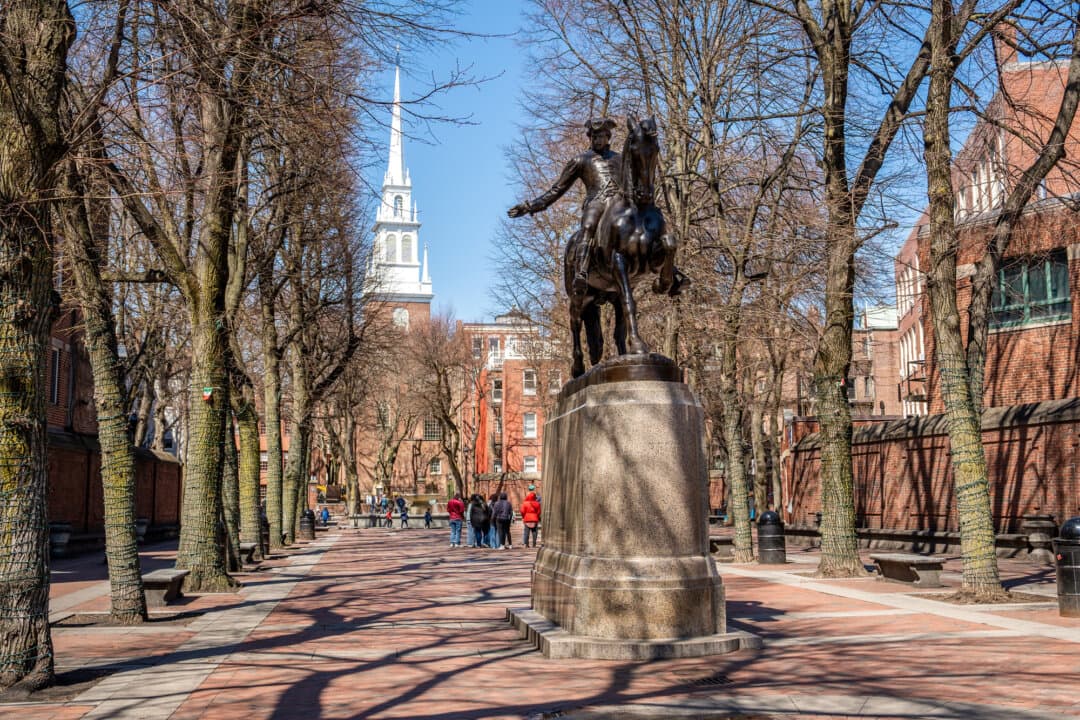
A statue of Paul Revere stands near Old North Church in Boston on April 8, 2026. The church gained national attention for its role in the Revolution after the 1860 publication of Henry Wadsworth Longfellow’s poem, “Paul Revere’s Ride.” (Samira Bouaou/The Epoch Times)
The church’s Sunday school closed in 1907, and its pastor, who found himself preaching to nearly empty pews, resigned. Some argued that the church should be closed and the building used exclusively as a historic site.
However, in 1912, an Episcopal bishop stepped in to organize a renovation, raising more than $25,000 for the purpose.
Once again, the church found a way to carry on, organizing a hospitality society to provide entertainment and accommodations for soldiers and sailors.
Visitors and Worshipers
At the close of World War II, the presiding bishop faced a dilemma. Under the bylaws, the church was owned by the pew holders, of whom there were fewer than 40—and most attended other churches.
So in 1946, the bishop reorganized the congregation under a new constitution and bylaws. The bishop also made improvements to the building. The church could be toured by the public but would still be the congregation’s place of worship.
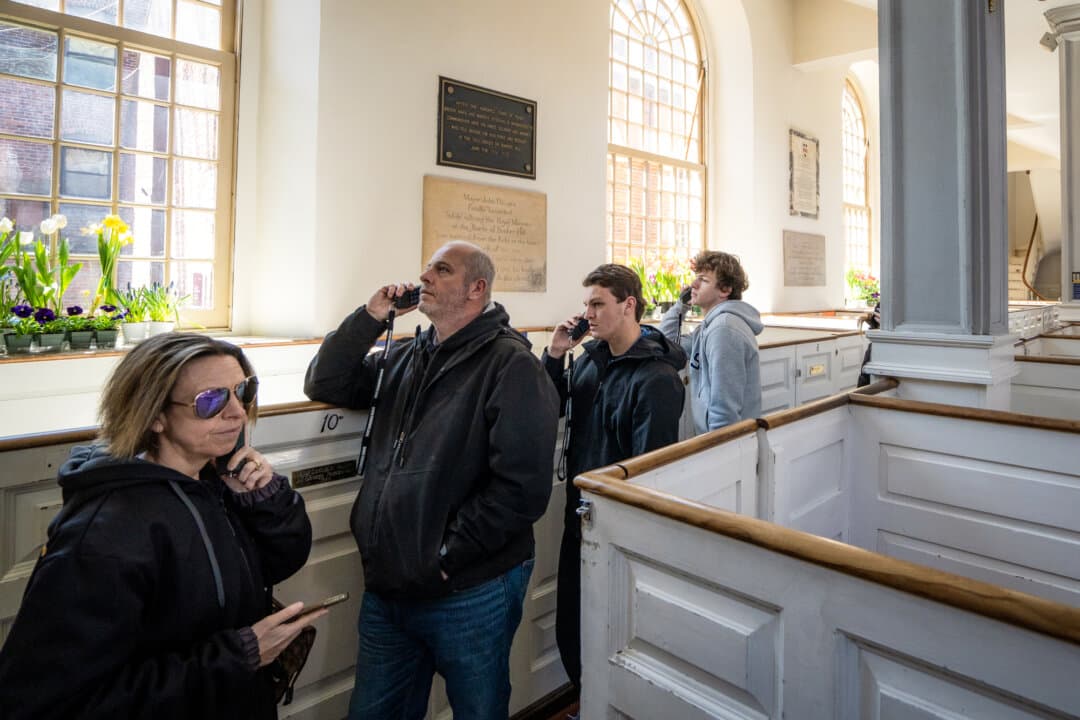
Visitors listen to handheld audio devices for self-guided tours, at Old North Church in Boston on April 8, 2026. (Samira Bouaou/The Epoch Times)
The federal government added Christ Church to the list of National Historical Landmarks in 1961.
President Gerald Ford visited the church on the 200th anniversary of Revere’s ride—April 18, 1975. The president spoke of America as a great experiment.
“Over the decades, there were challenges to that experiment,” Ford said, speaking of the nation and, perhaps unknowingly, describing the church as well.
“Could a nation half-slave and half-free survive? Could a society with such a mixture of peoples and races and religions succeed? Would the new Nation be swallowed up in the materialism of its own well-being?”
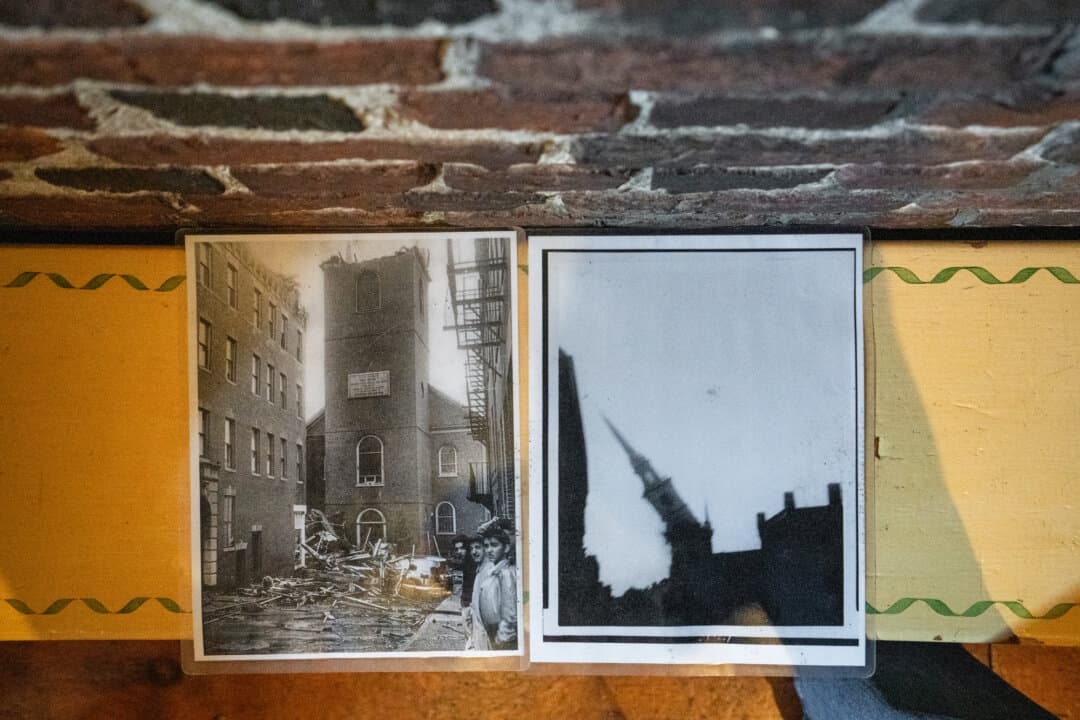
Photographs of Old North Church’s steeple collapse during Hurricane Carol on Aug. 31, 1954, are displayed in Boston on April 8, 2026. (Samira Bouaou/The Epoch Times)
The congregation of Christ Church grappled with those questions around the time of its 300th anniversary in 2023.
Longtime member Ann Sheets commented on the congregation’s journey, Vicar Matthew Caldwell reported at the time.
“Adaptation to changing times is a principle of our history, alongside our contribution to the nation and its development,” Sheets said.
Caldwell said, “We have wrestled with what it means to be a symbol of freedom, knowing that many of our earliest members were far from free.”
Today, the congregation is like many others, despite its fame as a historic site. On a Sunday, the pews may be filled, with perhaps half of the attendees being visitors.
In addition to Sunday worship, Christ Church conducts young adult and children’s ministries, holds Bible studies, and provides financial support and volunteers to charitable organizations.
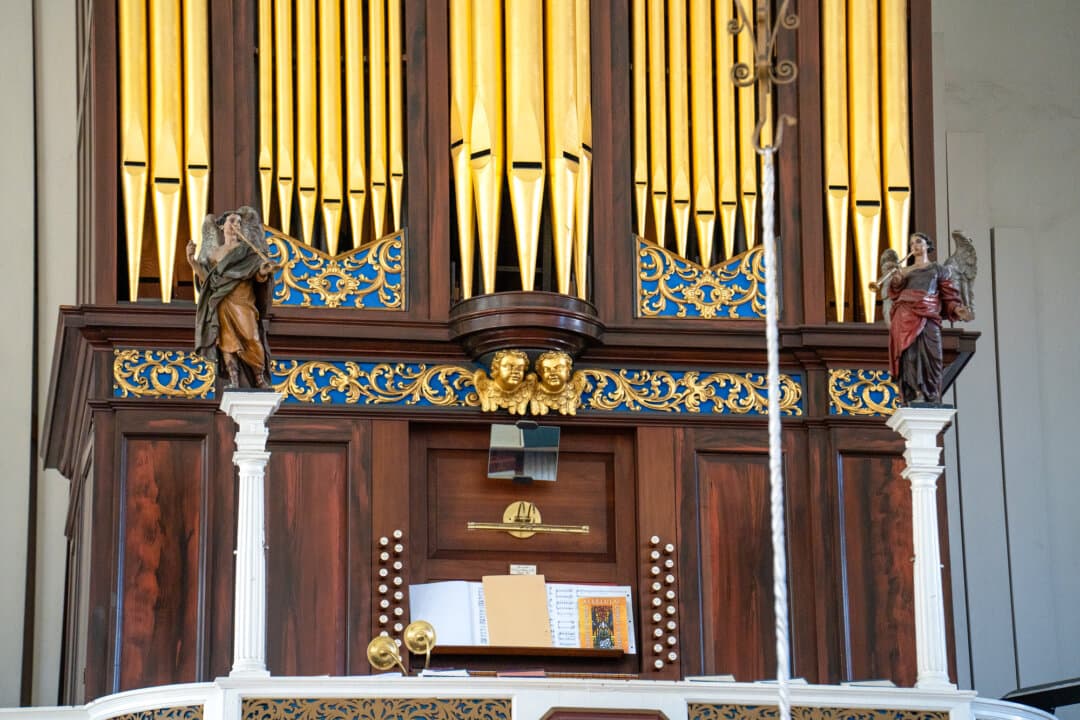
Old North Church in Boston on April 8, 2026. The church celebrated its 300th anniversary in 2023. (Samira Bouaou/The Epoch Times)
“Through these ministries we grow in our understanding and practice of the Christian faith, deepen our worship experience and appreciation of the sacred, strengthen and support each other, and serve our neighbors nearby and across the world,” the church website states.
“Many find themselves and their story somewhere in our story,” Caldwell said.
“This majestic church has witnessed 300 years of history, of triumphs and struggles, of division and reconciliation, the evil of slavery, the lights of freedom and abundant, amazing grace.
“Through it all, we have endeavored to be a house of prayer for all people shining ever brighter as beacons of justice and light.”
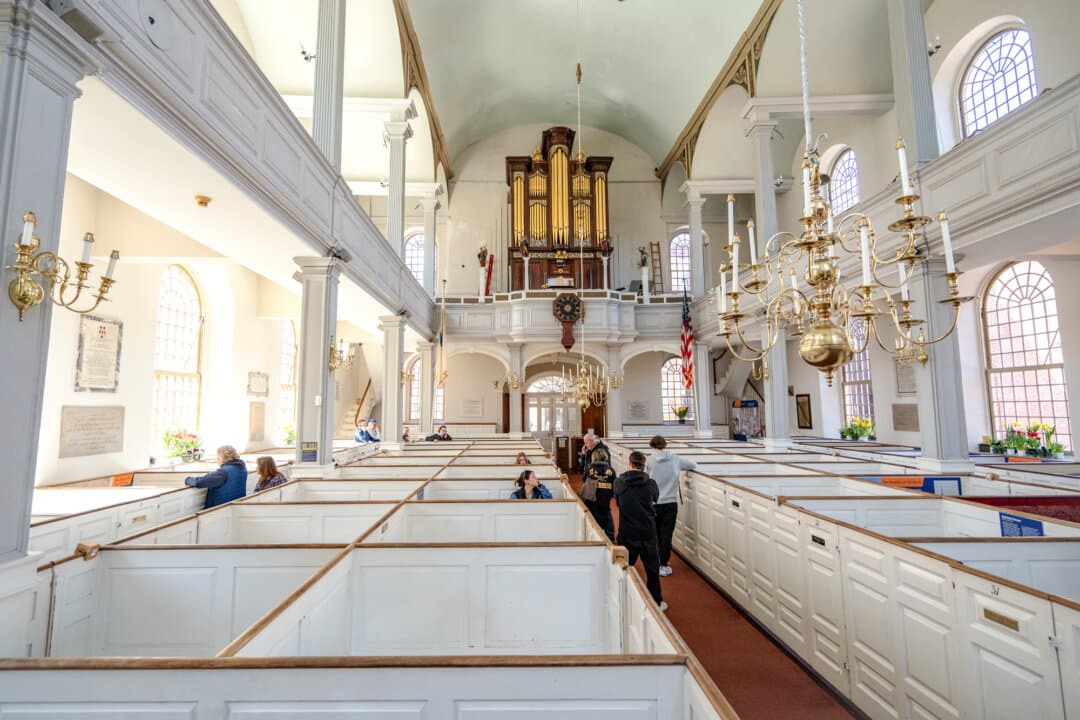
Old North Church in Boston on April 8, 2026. Today, the congregation resembles many others—despite its fame as a historic site—with pews often filled on Sundays and about half of attendees being visitors. (Samira Bouaou/The Epoch Times)
A previous version of this article misstated the number of U.S. states admitted to the Union during the 19th century and the date the Christ Church hosted Rev. William Levington. The Epoch Times regrets the errors.