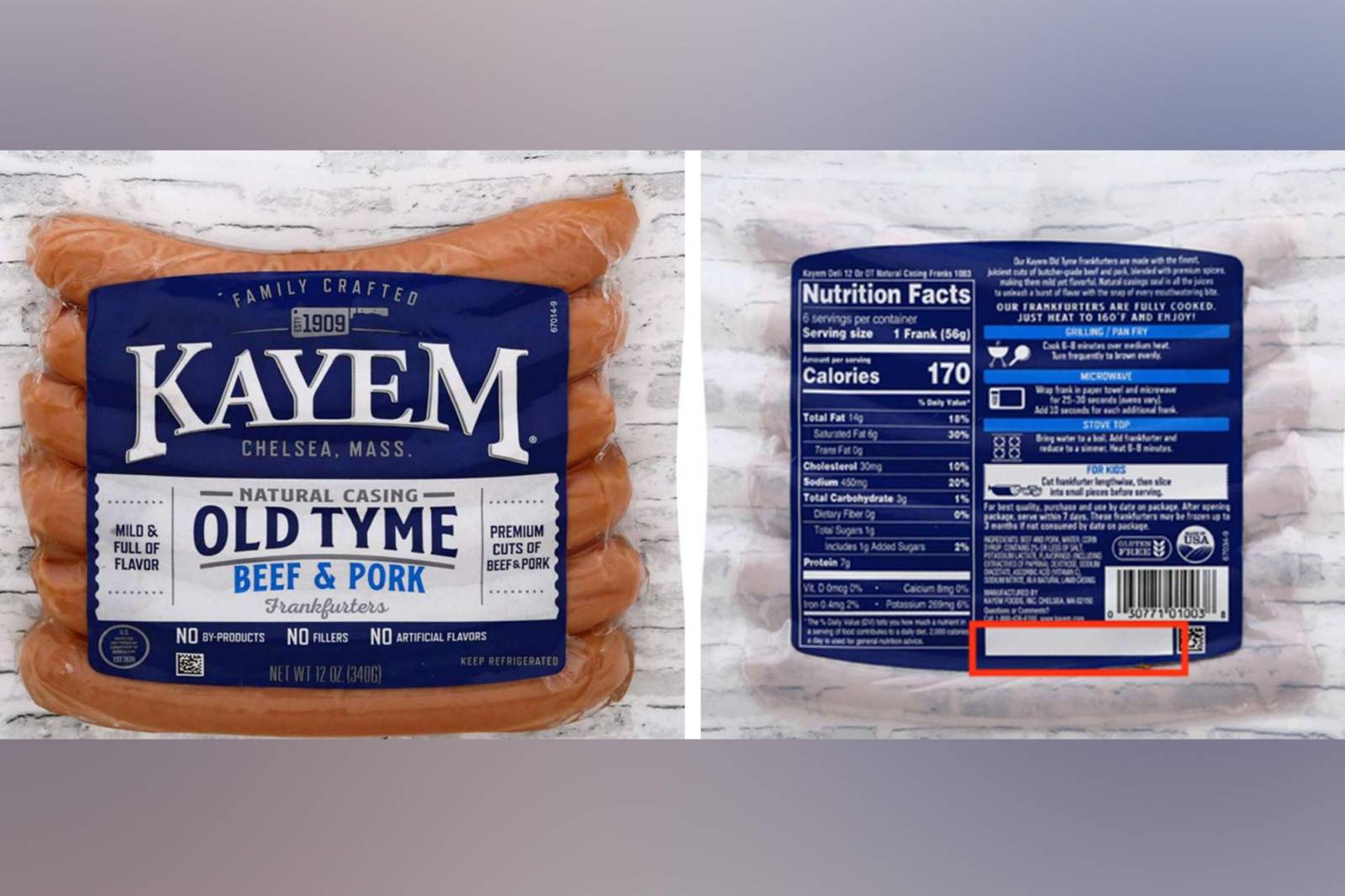

Massachusetts-based Kayem Foods Inc. is recalling roughly 1,584,361 pounds of poultry and meat products due to potential issues with storage temperatures.
The ready-to-eat (RTE) items, produced between around March 31 and Oct. 7, were sold under the following brand names: Kayem, Genoa, Al Fresco, Triple M, McKenzie, Deutschmacher, Jordan’s, Essem, and Winnisimmet. The products were shipped to retail and foodservice locations across the United States, USDA’s Food Safety and Inspection Service (FSIS) said in an Oct. 17 announcement.
The recalled items have establishment numbers “EST. M 9520,” “EST. P 20935A,” and “EST. M/P 7839” mentioned within the U.S. Department of Agriculture (USDA) mark of inspection.
“The problem was discovered after the firm received a retail customer complaint regarding warm product temperatures at point of delivery on October 1, 2026,” FSIS said in the statement.
“The establishment investigated and determined that they stored various RTE meat and poultry products in a warehouse cooler that experienced temperature deviations.”
Microorganisms in food can rapidly grow under certain temperatures, making temperature control a key factor in ensuring food safety.
According to the FSIS, there have so far been no confirmed reports of consumers getting sick. It advised concerned individuals to get in touch with a healthcare provider.
The recall has been issued a “High-Class I” designation, the most severe among the three USDA recall classifications. This is only issued when there is a reasonable possibility that the use of a product could cause adverse health consequences or death.
In an Oct. 16 statement, Kayem said that the company was contacting its wholesale and retail customers.
“Our business depends on providing consumers with safe food of the highest quality,” Kayem Foods CEO Matt Monkiewicz said in the statement.
“Out of an abundance of caution, we are undertaking this voluntary recall.
“We take food safety very seriously and apologize to our valued consumers. Our management team takes full responsibility. We have learned from and corrected the issue and will not allow this to happen again.”
FSIS said in the statement that it was concerned some of the recalled products may be in consumers’ refrigerators. The agency asked customers not to consume the products and to dispose of them or return them to the place of purchase.
When it comes to storing food, the temperature between 41 degrees Fahrenheit and 140 degrees Fahrenheit is known as a danger zone, as it is ideal for bacterial growth.
As such, it is important to store food, especially food ready for consumption, out of this temperature zone. The three common food-borne pathogens associated with improper food storage temperatures are Bacillus cereus, Staphylococcus aureus, and Clostridium perfringens.
Bacillus is a toxin-producing bacterium that can cause intestinal illnesses, while Staphylococcus infections can look like skin conditions, with serious conditions including pneumonia, bloodstream infections, and bone infections.
As for Clostridium, the bacterium is a common cause of food poisoning in the United States, with the CDC estimating nearly 900,000 foodborne illnesses annually from this pathogen in the United States.