
Initial jobless claims declined for the second straight week as the U.S. labor market holds steady heading into 2026.
For the week ending Dec. 20, the number of Americans filing for unemployment benefits fell by 10,000 to 214,000, according to new data released by the Department of Labor on Dec. 24.
This was down from the previous week’s reading of 224,000 and came in below the market consensus of 223,000.
Claims data have been volatile over the past month, reflecting holiday-season distortions, the 43-day government shutdown, and the persistent “no fire, no hire” climate across the job market.
The four-week average, which removes week-to-week volatility, ticked lower to 216,750 from 217,500.
A program for federal workers reported a decline in claims, from 1,091 to 805.
Over the past year, market watchers have closely monitored this metric to gauge the White House’s impact on government payrolls.
Continuing jobless claims—a measure of the number of unemployed individuals currently receiving unemployment benefits—returned above 1.9 million for the first time in a month.
The Department of Labor reported that recurring claims climbed to 1.92 million from a downwardly revised 1.88 million.
Economists say this statistic can indicate the challenge that out-of-work people may have in finding new jobs. With the figure remaining elevated since the spring, it reaffirms stalling employment conditions.
In November, the long-term unemployment rate—jobless for 27 weeks or longer as a percent of total unemployed—edged up to 24.6 percent from 23.6 percent in September, according to the Bureau of Labor Statistics.
New claims figures come as private payrolls appear to be rebounding.
U.S. private companies added an average of 11,500 jobs per week in the four weeks ending Dec. 6, from an upwardly adjusted 17,500 in the previous period, says payroll processor ADP.
It marks the third straight period with gains as hiring continues to gain momentum.
Heading into the Christmas break, a flurry of government economic data has been released, including GDP data.
‘Goldilocks Scenario’ for US Economy
The third-quarter gross domestic product surged 4.3 percent, topping economists’ expectations and rising from 3.8 percent in the second quarter.
With inflation slowing sharply, growth intact, and employment conditions trending sideways, the United States is facing a “goldilocks scenario,” says Eric Teal, CIO for Comerica Wealth Management.
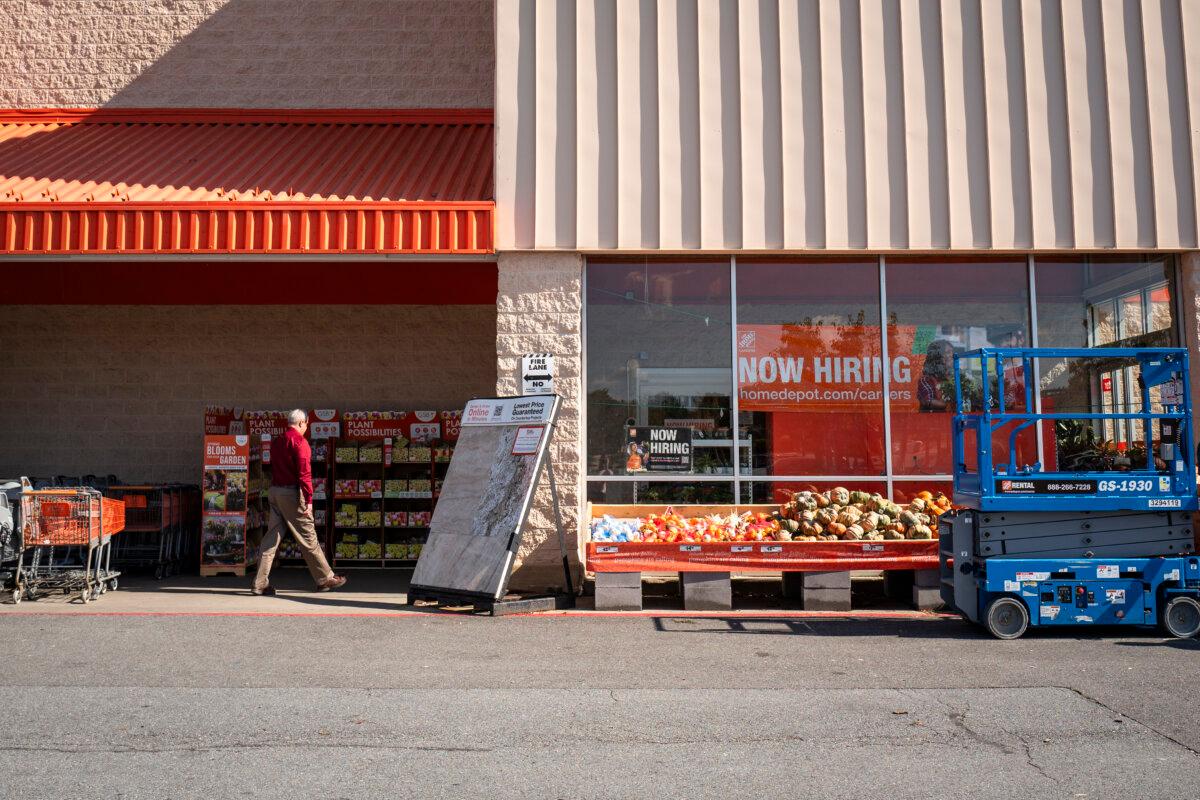
A hiring ad is displayed at a store in Columbia, Md., on Sept. 18, 2025. (Madalina Kilroy/The Epoch Times)
“The economy is demonstrating a Goldilocks scenario with above-potential U.S. economic growth, and declining but elevated inflation and a less robust labor market,” Teal said in a note emailed to The Epoch Times.
Last month, the economy added a better-than-expected 64,000 new jobs, and the unemployment rate rose to 4.6 percent from 4.4 percent.
The annual inflation rate eased to 2.7 percent in November, coming in firmly below market estimates.
“If the economy keeps producing at this level, then there isn’t as much need to worry about a slowing economy, and concerns may actually flip back to the price-stability constraint,” Chris Zaccarelli, CIO for Northlight Asset Management, said in a note emailed to The Epoch Times.
Federal Reserve officials lowered interest rates at the latest meeting for the third straight time, pulling the trigger on a quarter-point rate cut.
A growing chorus of policymakers has voiced anxiety about the U.S. labor market, but less concern about inflation.
Before the December Federal Open Market Committee meeting, Fed Governor Stephen Miran said that a deteriorating labor market was the result of tight monetary policy.
“We have to recognize that the unemployment rate has been drifting higher, and that is a function of monetary policy being too tight,” Miran said in a Nov. 25 interview with Fox Business.
Miran, appointed by President Donald Trump, is worried that restrictive monetary policy “will be the source of continuing increases in unemployment, which is not a good thing.”
Still, based on their forecasts, policymakers expect the unemployment rate to remain above 4 percent in the upcoming year—a historically low level.