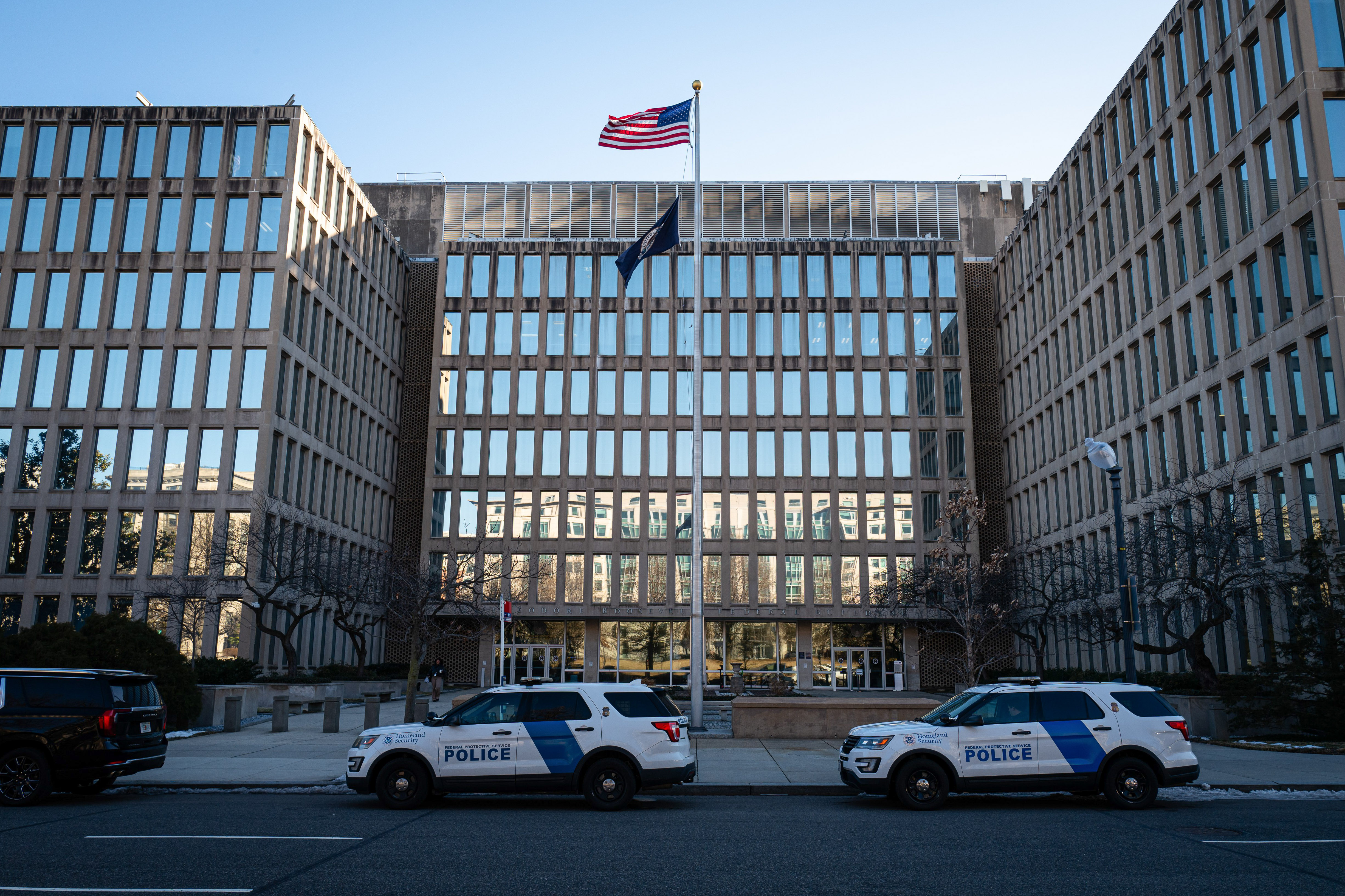

The U.S. federal workforce has fallen significantly, registering a low not seen since 2015, according to new numbers from the Office of Personnel Management (OPM) Federal Workforce Data, last updated on Jan. 8.
There are 2,084,618 federal civilian employees currently serving, according to OPM data. The federal government remains the largest single employer in the United States, with employees working across hundreds of agencies and occupations.
On Oct. 15, 2025, President Donald Trump issued Executive Order 14356, “Ensuring Continued Accountability in Federal Hiring,” to curb federal hiring. This order was built upon an earlier order issued in February last year that called for reforms and reductions in the federal workforce.
The February order stated that each agency should not hire more than one employee for every four employees that depart.
“We exceeded this goal—the government hired roughly 68,000 people this year, while approximately 317,000 employees left the government,” said Scott Kupor, Director, OPM, in a Nov. 21, 2025, report.
According to Kupor, some of the goals regarding the annual headcount plans include requiring agencies to focus their headcount resources on the most critical objectives that deliver maximum value to the taxpayer, while eliminating expenses that are in direct contradiction of administration priorities.
“No longer will we hire employees based on a self-attestation of their skills but rather based on formal assessment of their qualifications,” Kupor said.
Agency-Wide Employee Distribution
The Department of War, formerly the Department of Defense, is the largest employer, with around 709,352 workers, accounting for over 34 percent of the total. The OPM noted that 106,422 nurses were serving as federal employees—the largest occupational group.
The Department of War, at its peak in 2024, accounted for 772,549 workers.
The largest agencies by workforce are the Department of Veterans Affairs (VA) with more than 451,000 employees, the Department of Homeland Security (DHS) with over 221,000, the Department of Justice (DOJ) with over 107,000, and the Department of the Treasury with more than 92,000.
The VA registered significant growth during the Biden era, with the workforce increasing from 429,196 employees to about 462,000 in 2025, peaking at over 482,000 in 2024.
The DHS also trended high during the prior administration, adding nearly 18,000 employees. DOJ, meanwhile, lost around 4,652 employees during 2021–2025.
The agencies with the lowest workforce count were the Small Business Administration, Nuclear Regulatory Commission, Department of Education, OPM, National Science Foundation, and the U.S. Agency for International Development, with around 378 employees each.
“The hiring freeze required that agencies only hire for mission-critical roles. Imposing this discipline meant that only 68,000 new federal employees were hired this year, a dramatic reduction from previous years that ensured government resources are focused on core statutory responsibilities and administration priorities, not bureaucratic expansion,” The OPM said in a year-end statement.
“The Deferred Resignation Program resulted in approximately 154,000 voluntary resignations, allowing agencies to streamline non-essential roles while protecting critical operations and safeguarding taxpayer dollars,” OPM said, referring to a voluntary retirement program introduced by the Trump administration in January 2025 that provided government employees with eight months of paid leave.
OPM numbers also cited a reduction in federal employees represented by a bargaining unit (i.e., union representation), while there was an uptick in workers who were not eligible for union-related negotiations. At present, around 37.9 percent of federal employees are represented by unions.