
The U.S. economy sharply rebounded in the second quarter following a contraction in the first three months of 2025.
The GDP surged 3 percent in the April-to-June period, up from the 0.5 percent decline in the first quarter, according to the advanced estimate from the Bureau of Economic Analysis.
Economists had penciled in a 2.4 percent growth rate.
Last quarter’s gross domestic product—the total value of all goods and services produced in the national economy—was fueled by a decline in imports and a modest increase in consumer spending.
Imports plummeted by 30.3 percent, down from the previous quarter’s 38 percent spike, when companies stockpiled foreign goods to avoid higher tariff-related costs.
Exports fell by 1.8 percent after rising by 0.4 percent in the January-to-March period.
“Impacts from trade policy has showed up. The decrease in imports were led by nondurable consumer goods, mainly medicinal, dental, and pharmaceutical items,” Jeffrey Roach, chief economist at LPL Financial, said in a note emailed to The Epoch Times.
Economists have closely monitored the trade component of the GDP data, as imports subtract from the total.
Real consumer spending advanced by 1.4 percent from the 0.5 percent first-quarter jump. Recent numbers suggest that shoppers have reopened their wallets, but market watchers have debated whether this is because they have shrugged off tariffs or are trying to front-run higher prices.
This can be attributed to tariff uncertainty and businesses adopting a wait-and-see approach, said Bill Adams, chief economist at Comerica Bank.
“Sour consumer sentiment weighed on business and consumer spending in the second quarter,” Adams said in a note emailed to The Epoch Times.
Housing was also weak as “cautious consumers and higher mortgage rates” caused a pullback in home sales and residential construction, he added.
Despite the category’s 24 percent increase in the first quarter, gross private domestic investment, or GPDI, fell by almost 16 percent. This is a key component, as it highlights investments by private companies and individuals in the economy, ranging from home construction to spending on factories and machinery.
Government consumption made a negligible contribution to the final GDP reading. There was a divergence between the three levels of government, as federal outlays fell by 3.7 percent, while state and local spending increased by 3 percent.
On the inflation front, the GDP price index—a gauge of prices of goods and services produced domestically—climbed by a lower-than-expected 2 percent, lower than the 3.8 percent increase in the first quarter.
Personal consumption expenditures (PCE) prices, which reflect changes in the cost of goods and services purchased by households, increased by 2.1 percent, easing from 3.7 percent in the previous quarter and coming in below the market expectation of 2.9 percent.
Core PCE, which excludes the typically volatile categories of food and energy, rose at a higher-than-anticipated rate of 2.5 percent, though this marks a slowdown from the 3.5 percent recorded in the prior three-month period.
Market Reaction
Wall Street shrugged off the solid GDP data, with the leading benchmark averages little changed in pre-market trading.
The U.S. Treasury market was green across the board as the benchmark 10-year yield topped 4.35 percent.
The U.S. dollar index, a measure of the greenback against a weighted basket of currencies, was up by 0.02 percent at 98.77. It hit a five-week high at 98.92 on July 29 and was on course to post its first month of gains this year. Year-to-date, the index is down by 8.5 percent.
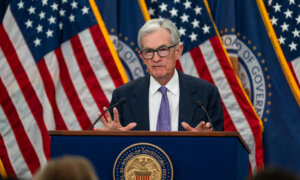
Investors are focusing on today’s Federal Reserve policy meeting. The U.S. central bank is expected to leave interest rates unchanged for the fifth consecutive meeting as monetary policymakers monitor trade developments and digest more data.
“The Fed will likely be in a good place to cut rates by their September meeting. We should expect Chairman Powell and other committee members to prepare investors for a September cut,” Roach said.
2nd Half of 2025
Economic observers widely anticipated the GDP numbers for the second quarter. All eyes will now be on data in the coming months to determine third-quarter growth prospects.
According to the New York Fed Staff Nowcast, the U.S. economy is estimated to expand by 2.4 percent in the July-to-September period.
“The economy was on uneven, wobbly footing in the second quarter, but early signs for the third quarter are pointing up,” Adams said. “Headline GDP will likely stay volatile near-term due to ongoing gyrations of tariff rates, but trend spending by consumers and businesses seems likely to firm.”
As President Donald Trump’s Aug. 1 tariffs deadline approaches, the United States has announced several trade agreements, including with the European Union, the UK, and Japan. Trump has stated that he will likely introduce a global baseline tariff rate ranging from 15 to 20 percent.
Retail sales data for July will be released in August. Multiple consumer sentiment surveys have rebounded.
The Conference Board’s July Consumer Confidence Index improved as individuals felt less pessimistic about future business conditions, the labor market, and income.
“Consumer confidence has stabilized since May, rebounding from April’s plunge, but remains below last year’s heady levels,” Stephanie Guichard, senior economist of global indicators at The Conference Board, said in a press release. “In July, pessimism about the future receded somewhat, leading to a slight improvement in overall confidence.”
Outlook among businesses for the next six months has been mixed. Recent investments suggest some are optimistic about the future.
Last week, the Treasury Department highlighted the “capex comeback,” pointing to new data that suggest private-sector investment has surged in the first half of 2025.
Capex, short for capital expenditures, refers to investments that companies make to upgrade or purchase industrial equipment, machinery, technology infrastructure, and other durable goods. Higher spending suggests that businesses are anticipating future growth.
Citing Federal Reserve Board data, the Treasury said capex spending increased at an annualized rate of 11 percent in the second quarter after a 23 percent spike in the first three months of the year.
Treasury Secretary Scott Bessent projects that capex spending could reach $300 billion a year, or 1 percent of gross domestic product, and initiate a productivity boom.
“I think that we could see growth and productivity well in excess of 3 percent for the coming year,” Bessent said in a recent Fox News interview.
More data to be released this week will help measure the broader economy’s health. The Federal Reserve’s preferred inflation metric—the PCE price index—will be released for June. The consensus estimate expects the headline annual PCE inflation rate to rise to 2.5 percent from 2.3 percent. Core PCE inflation, which strips out the volatile food and energy categories, is forecast to hold steady at 2.7 percent.
The Bureau of Economic Analysis will also publish personal income and spending data. Economists have penciled in gains of 0.2 percent and 0.4 percent, respectively.
The July jobs report will conclude the week, with the market forecasting 110,000 new jobs and the unemployment rate expected to rise to 4.2 percent.
“While the decline in new hires may fall, payroll numbers above 100k are considered to be relatively healthy, heuristically speaking,” Siebert Financial CIO Mark Malek said in a note emailed to The Epoch Times.
This week’s data dump could set the tone for the rest of the year, he added.
“This week is the market inflection point of the year,” Malek said.