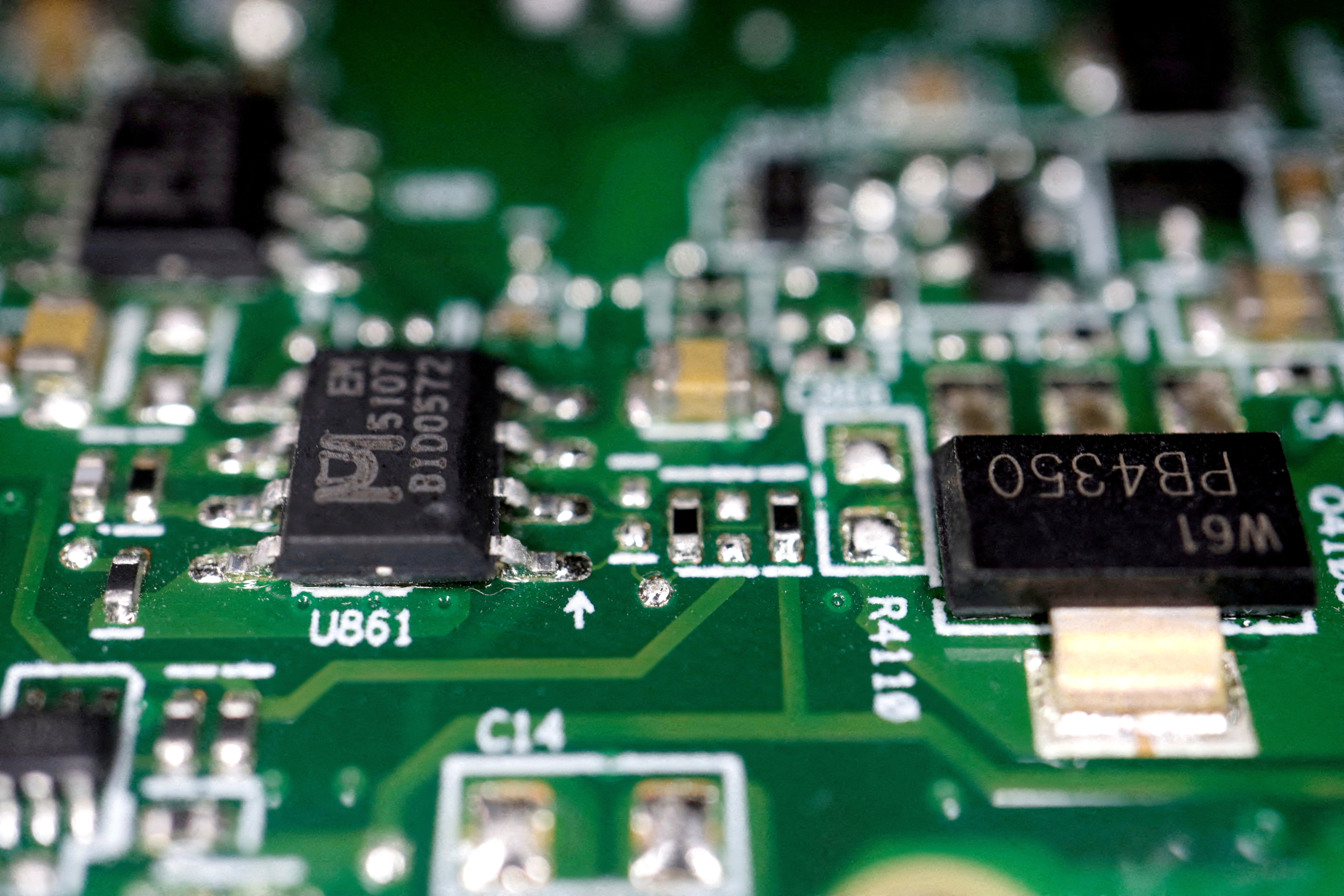

President Donald Trump said he will announce new tariffs on imports of chips and semiconductors as he kicks his trade agenda into the next gear.
Speaking to reporters aboard Air Force One on Aug. 15, the president stated that the tariff rate would initially be lower. After a while, if businesses have not built their factories in the United States, “they have to pay a very high tariff,” he said.
“If they don’t open here, they have to pay, in some cases, 200 percent, 300 percent,” Trump said.
He plans to unveil the newest phase of his tariff plans next week.
This comes days after the president confirmed chipmakers Advanced Micro Devices (AMD) and Nvidia will pay a 15 percent fee on revenues from their chip sales to China in exchange for export licenses to ship key artificial intelligence (AI) chips to the world’s second-largest economy.
Shares of Intel rose by about 3 percent to close out the trading week on reports that the current administration is considering a possible stake in the semiconductor firm.
Global demand for semiconductors has surged in recent years, driven by the increasing reliance on advanced technology across various industries, including automotive manufacturing and AI. In response, the administration’s latest proposal aims to restructure global tech supply chains, with the president pushing to bring manufacturing back to domestic soil across key sectors.
Earlier this month, the president told CNBC’s “Squawk Box” that he would announce levies on chips and semiconductors soon “because we want them made in the United States.”
More Steel Tariffs
Trump also told reporters that he will be setting tariffs on steel, although it was unclear whether he would increase the current import duties.
In February, Trump imposed 25 percent levies on steel and aluminum and confirmed in May that he would raise the rate to 50 percent to enable domestic production.
Sweeping tariffs on almost 70 U.S. trading partners came into effect on Aug. 7. Despite the higher rates, ranging from 10 percent to 50 percent, Trump and senior administration officials have stated that countries can always return to the negotiating table and present offers to bring down their tariff rates.
In the meantime, the United States will continue to negotiate with Canada, China, and Mexico in the coming months.
Trump signed an executive order extending the tariff pause with China for 90 days. He also authorized a 90-day extension for Mexico to allow for further trade talks.
Inflation, Stocks, and Tariffs
U.S. stocks have largely shrugged off the president’s tariff pursuits since the April peak of uncertainty.
The blue-chip Dow Jones Industrial Average reached an all-time high on Aug. 15, rising about 0.3 percent at the opening bell. The broader S&P 500 briefly touched a new intraday high. The tech-heavy Nasdaq Composite Index slipped 0.3 percent.
Investors cheered the solid retail sales numbers and shrugged off higher-than-expected import prices.
In July, retail sales increased by 0.5 percent, in line with market expectations. Higher receipts at automobile dealers (1.6 percent) and furniture and home furnishing stores (1.4 percent) fueled last month’s gain.

A promotional price label at a Smart & Final store in San Diego on March 24, 2025. (Jane Yang/The Epoch Times)
Import prices, considered a measure of pipeline inflation, rose by 0.4 percent last month, up from the 0.1 percent decline in June. Export prices ticked up by 0.1 percent.
Despite all-time highs in the stock market and potential headwinds, investors remain optimistic that consumers will continue to open their wallets and that the economy’s growth prospects will remain intact, says Chris Zaccarelli, CIO for Northlight Asset Management.
“As long as consumer spending holds up and companies are able to retain workers because of that robust spending, the flywheel can continue to spin, pushing corporate profits and stock prices higher,” Zaccarelli said in a note emailed to The Epoch Times.
“These aren’t the perfect conditions for a robust rally, but right now they are good enough for a slow grind higher—with the occasional pullback—on a path to a higher stock market by year end.”
Wall Street is also hopeful that the Federal Reserve will restart its easing cycle at the September Federal Open Market Committee policy meeting.
The futures market is overwhelmingly betting that the U.S. central bank will cut the benchmark federal funds rate—an influential interest rate that impacts business, consumer, and government borrowing costs—by a quarter point next month, according to the CME FedWatch Tool.
But Chicago Fed President Austan Goolsbee says the institution still needs another inflation report to ensure the United States is not facing an “inflationary spiral that looks to be persistent.”
“I feel like we still need another one at least to figure out if we’re still on the golden path” to reaching the central bank’s 2 percent target rate, Goolsbee said in an Aug. 15 interview with CNBC’s “Squawk Box.”
Monetary policymakers left interest rates unchanged in a target range of 4.25 percent to 4.5 percent for the fifth straight meeting last month.
The Fed will hold its next two-day policy meeting on September 16–17.