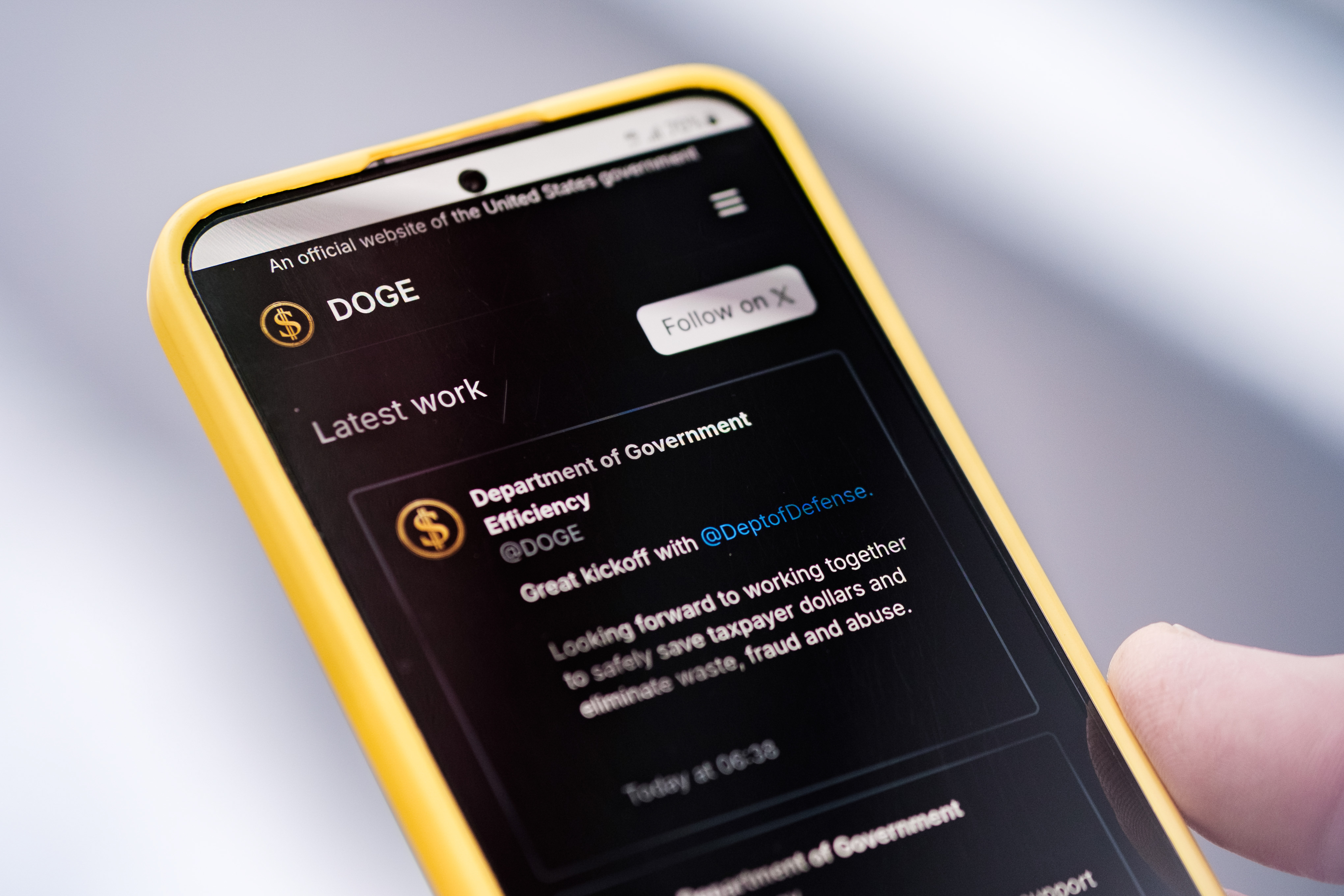

Over the past seven days, various government agencies have terminated 312 “wasteful contracts” with a ceiling value of $2.8 billion, the Department of Government Efficiency (DOGE) said in a June 26 post on social media platform X.
The cancellation saves $470 million for the taxpayers, it said. Canceled contracts include a $286,000 Department of Defense “professional and management development contract for an ‘entrepreneurship course at Harvard University’” and a $485,000 “USAID contract for a ‘senior general development advisor at USAID Madagascar.’”
According to the DOGE website, it had saved an estimated $180 billion in government spending as of June 3, which comes to $1,118 per taxpayer.
The savings are the result of contract and lease cancellations and renegotiations, grant cancellations, deletion of fraud and improper payments, asset sales, and workforce reductions.
Agencies that have accounted for the most of the $180 billion savings include the Department of Health and Human Services, the Department of State, the Department of Defense, the General Services Administration, and the Department of Education.
Some of the major cost-cutting initiatives include canceling $2.9 billion for the Department of the Interior for a refugee resettlement program, a $1.9 billion tech program at the Treasury, and a $1.7 billion grant program at USAID.
DOGE said it has also helped cut various programs it described as the “strangest, most baffling uses” of government funds.
This includes a $620,000 teen pregnancy prevention program aimed at “transgender boys,” a $20,000 grant for a gender equity program in math, a $250,000 grant for paid leave programs based on racial equity, and $10 million for “decolonizing” the curriculum under the Department of Education.
DOGE is operating under new leadership after Elon Musk exited from the initiative last month when his 130-day mandate as a special government employee expired.
On May 30, Musk and President Donald Trump appeared at the Oval Office, with the president crediting the entrepreneur for bringing “a colossal change in the old ways of doing business in Washington.”
According to the White House, DOGE is currently being led by Amy Gleason, who was in charge of the U.S. Digital Service during the first Trump administration.
Codifying DOGE Cuts
This week, the House Subcommittee on Delivering on Government Efficiency held a hearing on DOGE, which called for codifying the spending cuts recommended by DOGE, according to a June 24 statement from the Committee on Oversight and Government Reform.
In her opening statement, Rep. Marjorie Taylor Greene (R-Ga.) said lawmakers need to “lock in” DOGE savings and consider “locking in” the DOGE processes that have produced these savings.
“DOGE has attracted enemies because it’s taken on Washington’s culture of spending. We should make that a permanent battle. We should institutionalize the battle against waste, fraud, and abuse in government,” she said.
David Burton, senior fellow in Economic Policy at The Heritage Foundation, said DOGE represents a push to return “fiscal sanity” to the United States.
However, most of the personnel and grant reductions, as well as other spending cuts suggested by DOGE, “will not result in actual savings unless Congress takes action through appropriations bills and the accompanying explanatory statements,” he said.
“DOGE and the Administration can, within certain limits, reprogram spending, implement administrative efficiencies, and rely on statutes authorizing withholding of expenditures, but ultimately Congress is going to have to make entitlements,” he said.
On June 12, the House of Representatives passed HR 4, the Rescissions Act of 2025, by a vote of 214–212.
The $9.4 billion bill codified some of the DOGE-recommended cuts. The act cuts funding for the Corporation for Public Broadcasting and scales back billions of dollars in economic assistance via USAID.
“President Trump and congressional Republicans campaigned on attacking wasteful spending,” Rep. Virginia Foxx (R-N.C.) said.
“So the new administration ... then found wasteful spending. President Trump then acted and recommended that these funds be permanently canceled. I cannot think of a more textbook scenario of the proper utilization of this process.”
The bill must now be passed by the Senate before it hits the desk of the president to be signed into law.