
MediNatura New Mexico Inc. is recalling one lot of ReBoost Nasal Spray after identifying microbial contamination in the item, the company said in a Dec. 10 announcement published by the Food and Drug Administration.
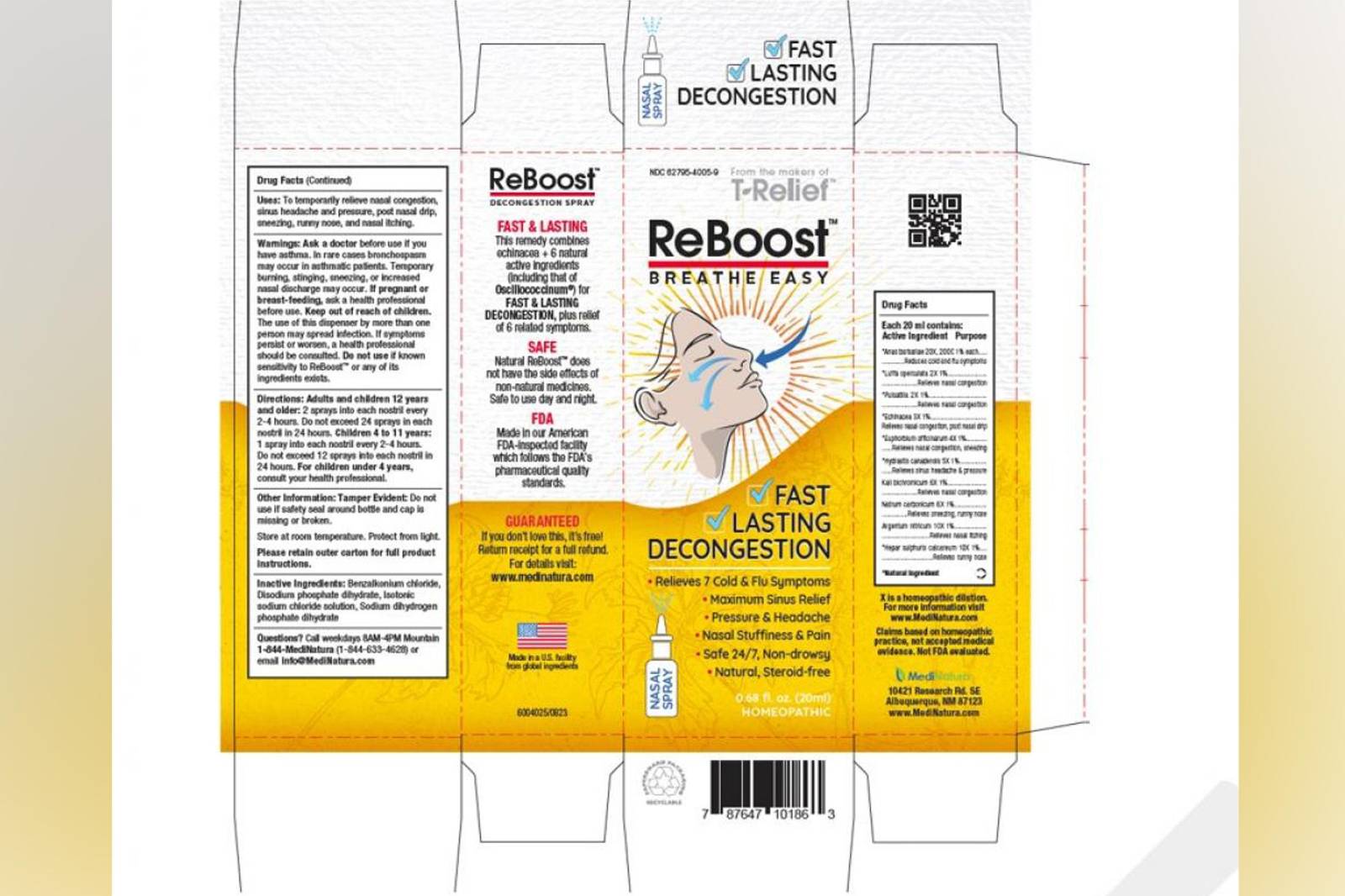
The product is used to relieve conditions such as nasal congestion, a runny nose, sneezing, nasal itching, and sinus headache. It is sold in a 20 milliliter bottle, packaged in a white and yellow carton, and distributed nationwide through retail outlets and online via the company website.
“The product has been found to contain yeast/mold and microbial contamination with one species identified as Achromobacter, at levels above specifications,” the announcement said.
“There is a reasonable probability that adverse health consequences, including life-threatening infections, will occur with use of the product in the immuno-compromised population. To date, MediNatura has not received any reports of adverse events related to this recall.”
The recalled item carries UPC number 787647 10186 3, NDC number 62795-4005-9, lot number 224268, and an expiration date of December 2027.
MediNatura advised all people who have purchased the recalled nasal spray to “immediately discontinue” usage of the item.
People who bought it directly from the company should contact MediNatura to request a refund. Those who bought it via retail shops should return the product, the announcement said.
Customers with queries can contact MediNatura at 800-621-7644.
The Epoch Times reached out to MediNatura for comment, but did not receive a response by publication time.
Achromobacter, the microbe identified in the product recall, is a bacterium that is “intrinsically resistant to several antibiotics,” according to an October 2020 study published by the National Library of Medicine.
This poses challenges for treatments. The intrinsic resistance of the bacteria to several antibiotic classes leaves “very few treatment options,” it said.
Multiple nasal spray recalls have been issued over the past few years due to microbial contamination.
In October 2023, Virginia-based Biomic Sciences recalled all lots of its ION Sinus Support, ION Sinus, and Restore Sinus Spray products. FDA testing had identified these products to contain several varieties of microbes.
Earlier in June 2022, California-based Green Pharmaceuticals Inc. withdrew some of its SnoreStop NasoSpray after discovering microbial contamination.
According to a June 2025 study published in the National Library of Medicine, the issue of microbial contamination in drugs is multifactorial, including inadequate manufacturing practices and sterility failures.
“The preparation and compounding of drugs in hospital pharmacies, along with poor handling and repackaging, also pose a risk of microbiological contamination, particularly in non-sterile pharmaceutical products,” it said.
“A broad spectrum of bacteria and fungi has been implicated in pharmaceutical contamination, leading to serious health risks.”
While drug contamination tends to be largely accidental, there is a risk of intentional contamination when drug supply chains or their oversight are controlled by adversaries during conflict situations.
In October, Sen. Tom Cotton (R-Ark.) introduced the American Medicine Safety and Security Act, which seeks to ban the FDA from employing nationals from Russia, China, or Iran, according to an Oct. 13 statement from Cotton’s office.
Under the bill, employees working with the FDA will have to report whether their immediate family members are Chinese, Iranian, or Russian nationals. Employees will be banned from working for entities operating in these three nations for 10 years following their employment with the FDA.
If an employee worked at an entity based in Iran, China, or Russia prior to joining the FDA, or has an immediate family member who is a citizen of these nations, they will be subject to restrictions on accessing drug or device data.
“The oversight of our food and medicine is too important to allow corruption from adversarial foreign nationals. My bill will establish safeguards at FDA to protect Americans’ health and intellectual property,” Cotton said.