
President Donald Trump has expressed disappointment with the majority of NATO countries, as most alliance members have offered little to no support in the ongoing military operations against Iran.
While expressing disappointment with his European allies on March 17, Trump praised the support of local partners in the Middle East.
The U.S. president offered his critiques days after raising calls for the international community to support efforts to secure commercial traffic in the Strait of Hormuz against threats from Iran.
After U.S. and Israeli forces launched attacks on Iran on Feb. 28, Iranian forces began attacking commercial vessels attempting to transit the narrow waterway, which serves as a key artery for global oil exports.
“The United States has been informed by most of our NATO ‘Allies’ that they don’t want to get involved with our Military Operation against the Terrorist Regime of Iran, in the Middle East,” Trump wrote in a post on Truth Social on March 17.
“This, despite the fact that almost every Country strongly agreed with what we are doing, and that Iran cannot, in any way, shape, or form, be allowed to have a Nuclear Weapon.”
Attacks have slowed traffic through the Persian Gulf and the Strait of Hormuz. Oil prices have spiked since the start of the conflict, and Iran has threatened that oil could hit $200 per barrel as the conflict winds on.
Despite this snub by those allies, Trump said U.S. forces have had great success against Iran’s military.
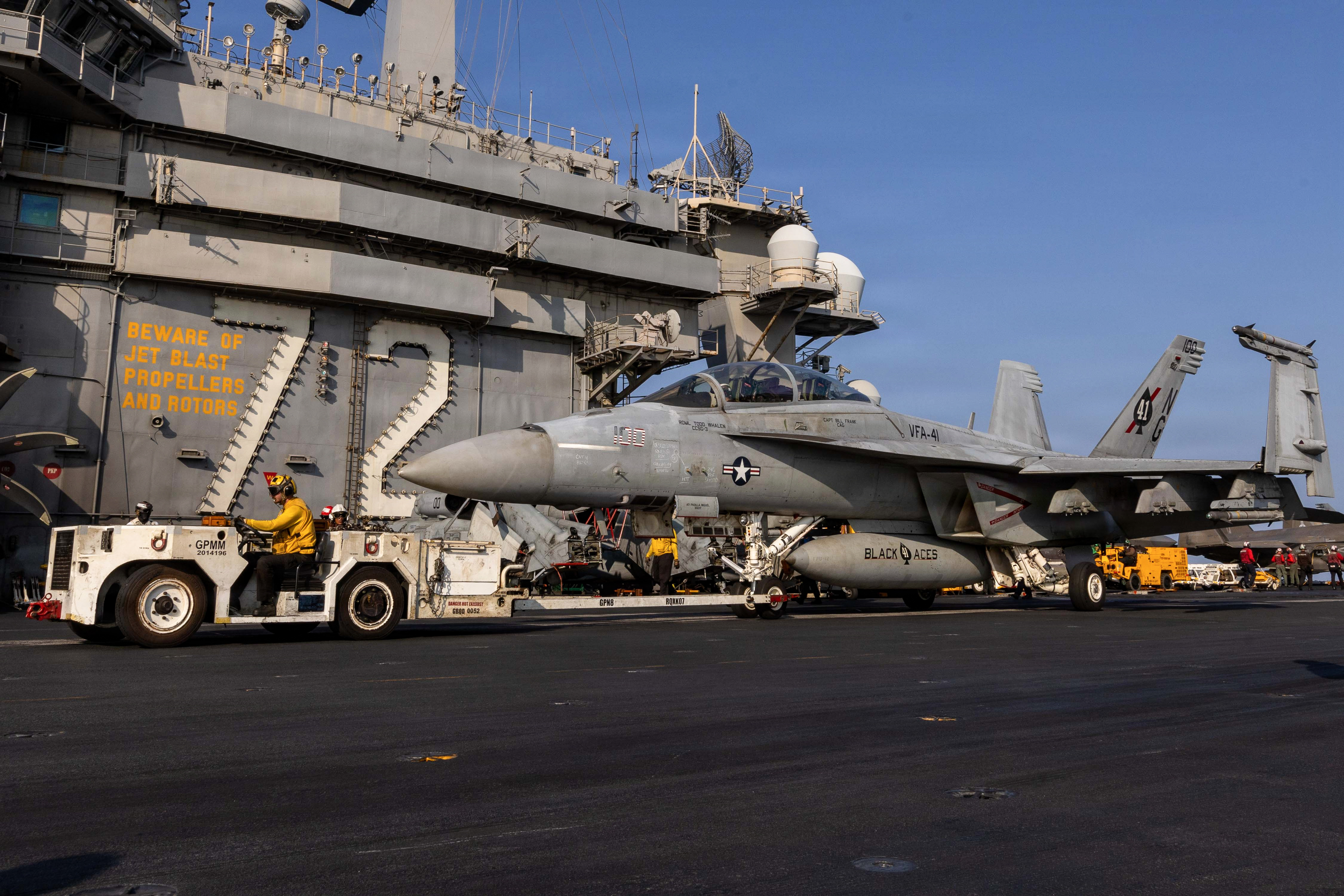
U.S. Central Command has reported that U.S. forces have flown more than 6,500 combat flights against Iran since Feb. 28, striking more than 7,000 targets. The military said those strikes have damaged or destroyed more than 100 Iranian vessels.
“Because of the fact that we have had such Military Success, we no longer ‘need,’ or desire, the NATO Countries’ assistance—WE NEVER DID!” Trump wrote. “Likewise, Japan, Australia, or South Korea.”
European Allies Not Racing Into Fight
Trump’s calls for NATO support have met with mixed reviews.
Early on, the Spanish government blocked U.S. forces from using military bases in Spain to support operations against Iran, and said the conflict is at odds with the U.N. Charter.
The German government has also questioned the case for becoming involved in the conflict.
“This is not our war; we have not started it,” German Defense Minister Boris Pistorius told reporters on March 16.
At a luncheon at the Trump Kennedy Center on March 16, Trump said British Prime Minister Keir Starmer had denied his request to dispatch two aircraft carriers to the Middle East.
French President Emmanuel Macron, by contrast, had dispatched an aircraft carrier to the eastern Mediterranean just days into the conflict.
“We are not party to the conflict,“ Macron said on March 17. ”But we are ready in the Strait of Hormuz, with our partners, to guarantee freedom of navigation when conditions permit.”
A French soldier was killed and six more were injured on March 12 in a drone attack on their outpost in Iraq.
Romania, another NATO ally, has offered the United States access to its Black Sea bases for surveillance, communications, and aerial refueling in support of operations against Iran.
A Test for NATO
In further comments as he hosted Irish Taoiseach Micheal Martin at the White House on March 17, Trump said, “I think NATO is making a very foolish mistake.
“I’ve long said that, you know, I wonder whether or not NATO would ever be there for us.
“So this was a great test, because we don’t need them, but they should have been there.”
When asked whether NATO’s lukewarm response to the Iran conflict has caused him to rethink the U.S. position within the alliance, he said, “It’s certainly something that we should think about.”
“I’m disappointed in NATO, that we spend trillions of dollars on NATO. ... It’s one of the reasons we have deficits, and we help other countries, and when they don’t help us, it’s certainly something that we should think about,” he stated.
Trump went on to say he had no specific decision in mind with regard to the NATO alliance.
Middle Eastern Partners Earn Trump’s Praise
Although he criticized his European allies, Trump praised several Middle Eastern partners—including Qatar, the United Arab Emirates, Bahrain, Saudi Arabia, and Israel—for their support during the ongoing Iran conflict.
“The Middle Eastern countries have been very strong in their support,“ he said. ”And of course, Israel has been our partner. Israel’s been very, very strong along with us.”
As Trump amassed forces in the Middle East in the weeks leading up to the U.S.–Israeli strike on Iran, officials in Tehran warned that new attacks by the Islamic Republic would set off a regional conflict. Iranian forces have since launched dozens of salvos of ballistic missiles and explosive-laden one-way attack drones across the region.
Many of the Iranian drone and missile attacks have targeted U.S. bases throughout the region, but strikes have also targeted civilian infrastructure.
Over the weekend, Iranian state media listed three port facilities in the UAE as legitimate targets, alleging that those ports were used to support strikes on Iranian territory.
On March 17, Anwar Gargash—an adviser to UAE President Mohamed bin Zayed Al Nahyan—said the Gulf Arab state could join a U.S.-organized effort to secure the Strait of Hormuz. For now, he said, the UAE has yet to see a formal structure take place for such a mission.
Gargash said Iranian attacks across the region will likely reshape the UAE’s perception of the Iranian threat “for decades to come.”
John Haughey, T.J. Muscaro, Rachel Roberts, Reuters, and The Associated Press contributed to this report.