
The Federal Reserve left interest rates unchanged for the fifth consecutive policy meeting.
Officials chose to keep the benchmark federal funds rate—a key policy rate that influences business, consumer, and government borrowing costs—in a range of 4.25 percent to 4.5 percent.
For the first time since 1993, two Fed officials dissented from the majority decision, advocating for a rate cut. Fed Board of Governors member Christopher Waller and Fed Vice Chair for Supervision Michelle Bowman—both Trump appointees—broke with the consensus.
Bowman and Waller preferred to lower the target range by a quarter point at the July Federal Open Market Committee (FOMC) meeting.
The Fed said recent indicators suggest that economic activity moderated in the first half of the year.
“The unemployment rate remains low, and labor market conditions remain solid,” the FOMC said in a statement. “Inflation remains somewhat elevated.”
Financial markets had overwhelmingly expected the Fed to hold steady, despite persistent pushback from President Donald Trump and senior administration officials.
“We at the White House 100 percent respect their independence, but we also like to respect their analysis,” National Economic Council Director Kevin Hassett said in a July 30 CNBC interview. “We expect that the Fed will catch up to the data soon. That’s going to be a really big, positive story.”
The next two-day FOMC meeting is scheduled for Sept. 16 to Sept. 17.
‘Reasonable Base Case’
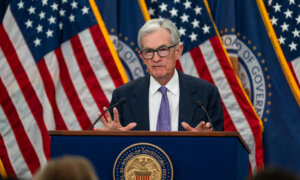
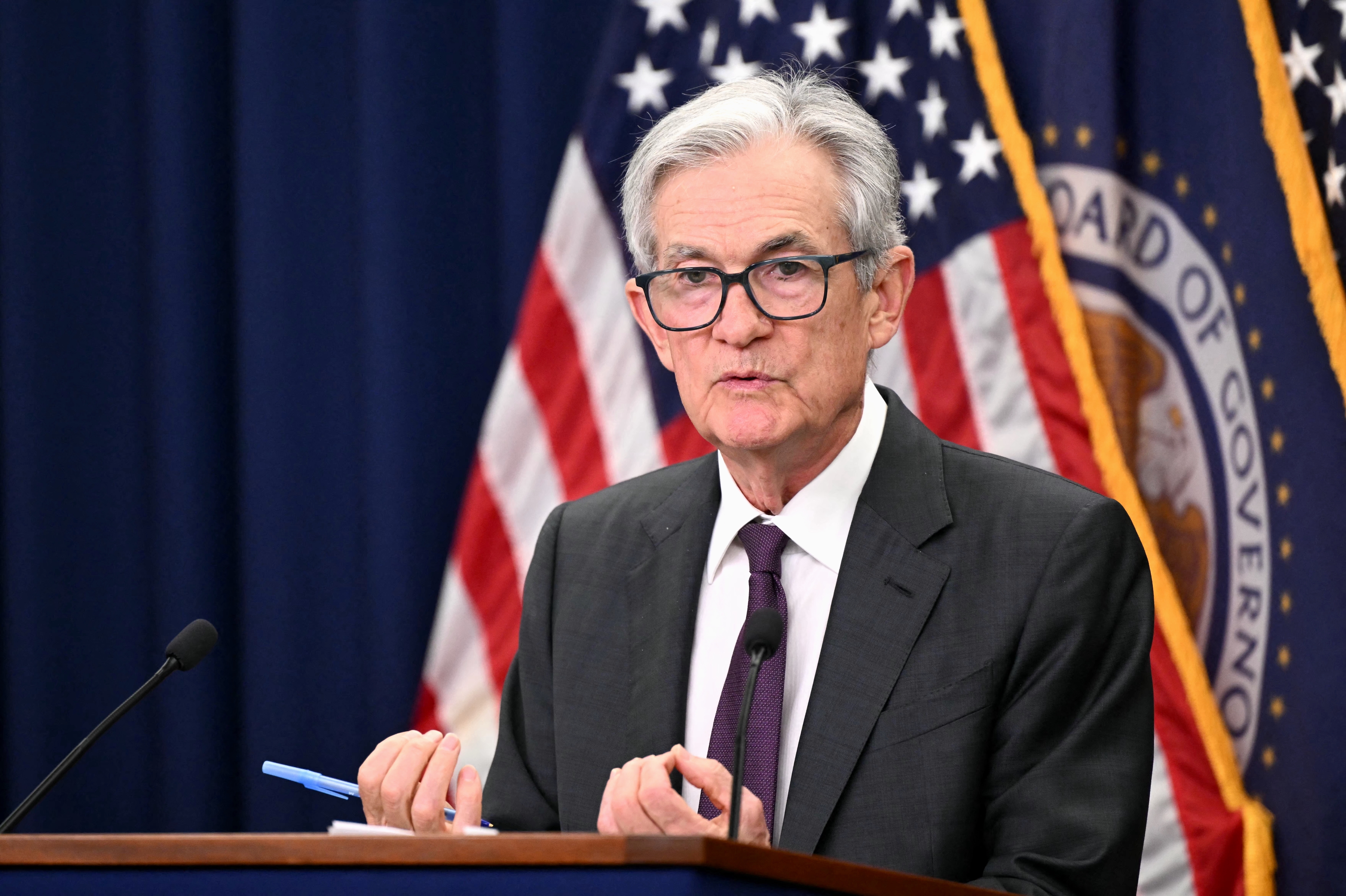
The Fed will keep waiting, Fed Chairman Jerome Powell said.
Speaking to reporters at the post-meeting news conference on July 30, Powell noted that higher tariffs are starting to appear in the inflation data.
“Higher tariffs have begun to show through more clearly to prices of some goods, but their overall effects on economic activity and inflation remain to be seen,” Powell said.
Powell said he believes that the “reasonable base case” is for tariffs to create one-time price adjustments, making inflationary pressures “short-lived.” At the same time, he also cautioned that inflation could become “more persistent.”
“Our obligation is to keep longer-term inflation expectations well-anchored and to prevent a one-time increase in the price level from becoming an ongoing inflation problem,” he said.
The central bank chief said he also thinks that maintaining modestly restrictive monetary policy “seems appropriate” as the U.S. economy remains in solid health.
As for the two dissents, Powell embraced the diverse thinking at the July policy meeting.
“This was quite a good meeting all around the table where people thought carefully about this and put their positions out there,” he said. “You want that clear thinking and expression of your thinking, and we certainly had that today, I think, all around the table.”
Market Reaction
U.S. stocks turned negative later in the July 30 trading session as investor expectations of a September rate cut diminished.
The blue-chip Dow Jones Industrial Average declined by about 300 points, or 0.7 percent. The tech-heavy Nasdaq Composite Index and the broader S&P 500 fell by about 0.3 percent.
The futures market trimmed the odds of a quarter-point rate cut in September to 47 percent, down from as high as 75 percent a month ago.
However, Powell offered hints that a September rate cut could be in the cards, according to Chris Zaccarelli, chief investment officer for Northlight Asset Management.
“Despite the Fed statement giving little new information to investors, Chairman Powell dropped some hints in his press conference that a rate cut was more likely at the next meeting in September, saying ’most measures of longer-term expectations remain consistent with their 2 percent inflation goal‘ and that a reasonable assumption is that inflation from tariffs will be ’short-lived, reflecting a one-time shift in the price level,’” Zaccarelli said in a note emailed to The Epoch Times.
U.S. Treasury yields were green across the board, with the benchmark 10-year yield reaching 4.37 percent.
The U.S. Dollar Index (DXY), a measure of the greenback against a weighted basket of currencies, surged by nearly 1 percent to 99.80. The index is poised for a July gain of 3 percent, making its year-to-date loss 8 percent.
Zaccarelli said he expects the stock market to perform well.
“We expect the stock market to keep moving higher in the absence of a sharp increase in unemployment or a significant rebound in inflation, especially as corporate profits continue to surprise to the upside,” he said.
A Tale of 2 Feds
For months, monetary authorities have insisted that they can afford to wait before taking policy action. As the current administration implements fundamental changes to trade policy, the Fed is awaiting further clarity to determine whether tariff efforts will result in a one-time price adjustment or persistent inflation pressures.
Waller, speaking in an interview with Bloomberg Television on July 18, stated that basic economic theory suggests that trade levies do not generate serious, persistent inflation threats throughout the broader economy.
“You would have to cook up some other amplification mechanisms,” Waller said.
“And that’s what people talk about: Wages will start going up, and everything will get out of control.
“You’re not seeing that at all.”
Waller has been an advocate of lowering interest rates, pointing to weakness in the labor market as justification for cutting now rather than waiting.
Bowman has also expressed support for reducing rates.
“As we think about the path forward, it is time to consider adjusting the policy rate,” Bowman said during a June 23 speech in Prague.
Like Waller, Bowman said downside risks to the labor market could begin forming.
Headline employment data indicate a healthy job market, with the unemployment rate hovering slightly higher than 4 percent. However, according to Waller, a closer examination of the data reveals fading momentum.
“Once we account for expected data revisions, private sector payroll growth is near stall speed, and other data suggest that the downside risks to the labor market have increased,” he said at a July 17 New York University event.
Appearing before the New York Association for Business Economics, Federal Reserve Bank of New York President John Williams said he is beginning to see higher inflation driven by tariffs. In the coming months, he said, the effects should begin to be realized.
“Overall, I expect tariffs to boost inflation by about 1 percentage point over the second half of this year and the first part of next year,” Williams said in prepared remarks.
The Bureau of Economic Analysis will release the central bank’s preferred inflation measure—the personal consumption expenditures (PCE) price index—on July 31.
According to the Cleveland Fed’s Inflation Nowcasting estimate, inflation in the headline PCE price index is expected to come in at 2.5 percent for June from 2.3 percent in May. Core PCE inflation, which excludes volatile food and energy prices, is expected to remain steady at 2.7 percent.