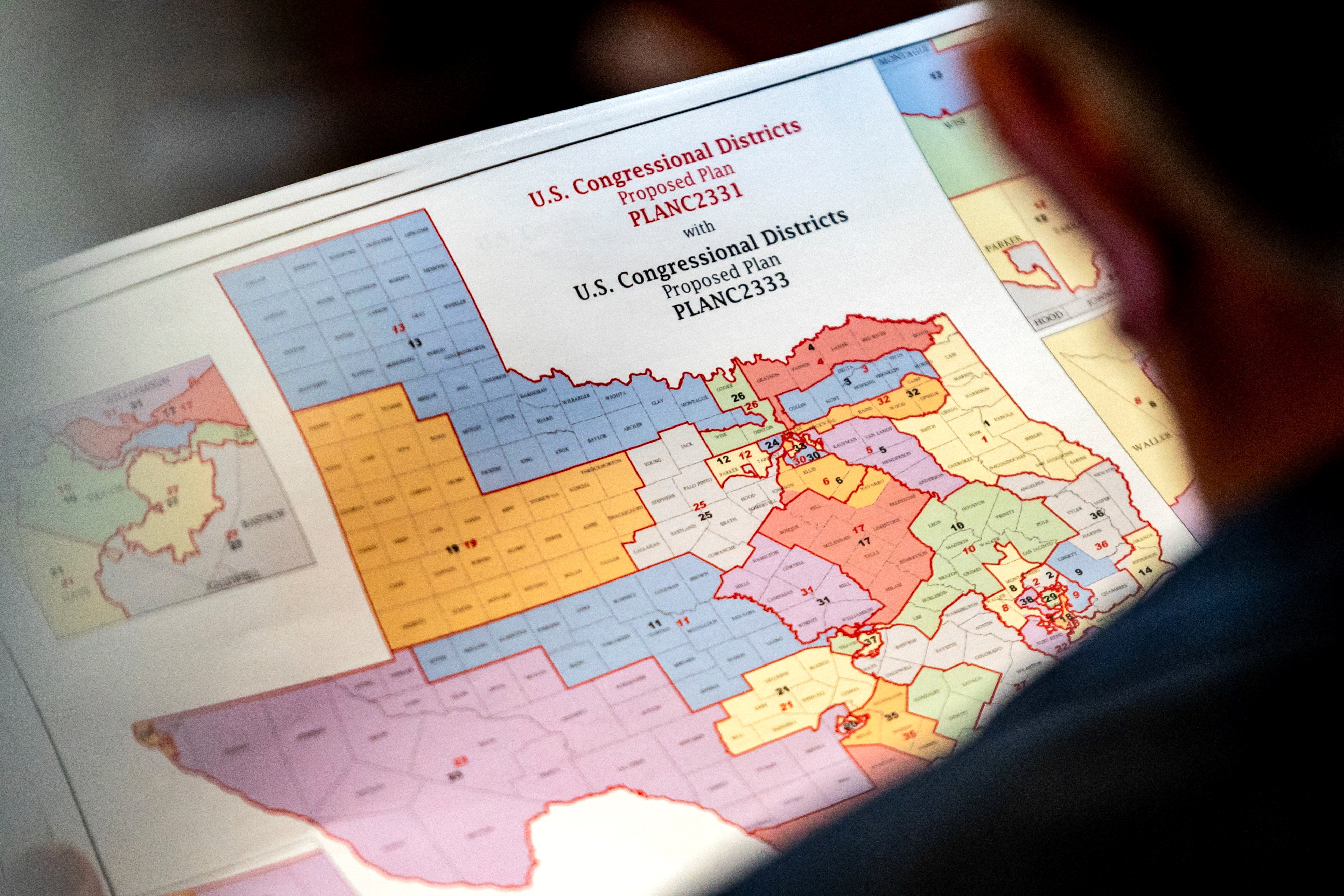

A panel of federal judges in Texas has ruled that the state cannot use newly redrawn House maps aimed at securing additional seats for Republicans.
“The public perception of this case is that it’s about politics. To be sure, politics played a role in drawing the 2025 Map. But it was much more than just politics. Substantial evidence shows that Texas racially gerrymandered the 2025 Map,” wrote U.S. District Judge Jeffrey V. Brown in the 2-1 ruling.
“The Plaintiff Groups are likely to prove at trial that Texas racially gerrymandered the 2025 Map. So, we preliminarily enjoin Texas’s 2025 Map.”
The decision marks a loss for Republicans who have been looking to gain a seat advantage in the House of Representatives, where they currently hold a slim majority.
Texas may appeal the decision directly to the Supreme Court of the United States, pursuant to the Voting Rights Act (VRA), which was cited in the ruling. The preliminary injunction was ordered by a three-judge panel mandated by the VRA for such cases, which voted 2–1 in favor of granting it.
In its decision, the court cited public statements made by Texas state legislators, Assistant Attorney General for Civil Rights Harmeet Dhillon, and others to demonstrate the racial intentions of the parties.
“The redistricting bill’s sponsors made numerous statements suggesting that they had intentionally manipulated the districts’ lines to create more majority-Hispanic and majority-Black districts. The bill’s sponsors’ statements suggest they adopted those changes because such a map would be an easier sell than a purely partisan one,” Brown wrote.
The Supreme Court has repeatedly ruled that while racial gerrymandering violates the 14th Amendment, “partisan” gerrymandering—i.e., redrawing district boundaries to ensure more voters registered with one party are in a district—is not unconstitutional, as one’s political party is not a protected class of citizenship. States are free to redraw districts in a purely partisan manner.
“[P]artisan gerrymandering claims present political questions beyond the reach of the federal courts,” Chief Justice John Roberts wrote for the Court’s majority in 2019’s Rucho v. Common Cause.
The court held that Texas’s actions were not purely partisan gerrymandering, which would immunize them from federal judicial review, but were racial gerrymanders designed to undermine and eventually overturn the Voting Rights Act through appeal to the Supreme Court.
“[L]egislators stated in media interviews that the Legislature had redistricted not for the political goal of appeasing President Trump nor of gaining five Republican U.S. House seats, but to achieve [the Justice Department’s] racial goal of eliminating coalition districts,” Brown wrote.
The Justice Department had initiated the redistricting process by writing a letter to Texas Gov. Greg Abbott and Texas Attorney General Ken Paxton on July 7, asking for the state to redistrict the 9th, 18th, 29th, and 33rd congressional districts.
“When race is the predominant factor above other traditional redistricting considerations including compactness, contiguity, and respect for political subdivision lines, the State of Texas must demonstrate a compelling state interest to survive strict scrutiny,” the Justice Department wrote in its letter, referring to the standard by which such cases are reviewed.
It termed the districts to be “coalition districts” in which the African-American race was the primary consideration in the district’s creation.
The Department of Justice was not a party to the suit, which was brought against Abbott and the State of Texas by the League of United Latin American Citizens.
The court criticized the department’s letter as having “so many factual, legal, and typographical errors.”
Texas’s legislature enacted the new maps on Aug. 29, 2025, when Abbott signed the bill into law.
“The Legislature redrew our congressional maps to better reflect Texans’ conservative voting preferences—and for no other reason. Any claim that these maps are discriminatory is absurd and unsupported,” wrote Abbott in a statement about the ruling. “The State of Texas will swiftly appeal to the United States Supreme Court.”