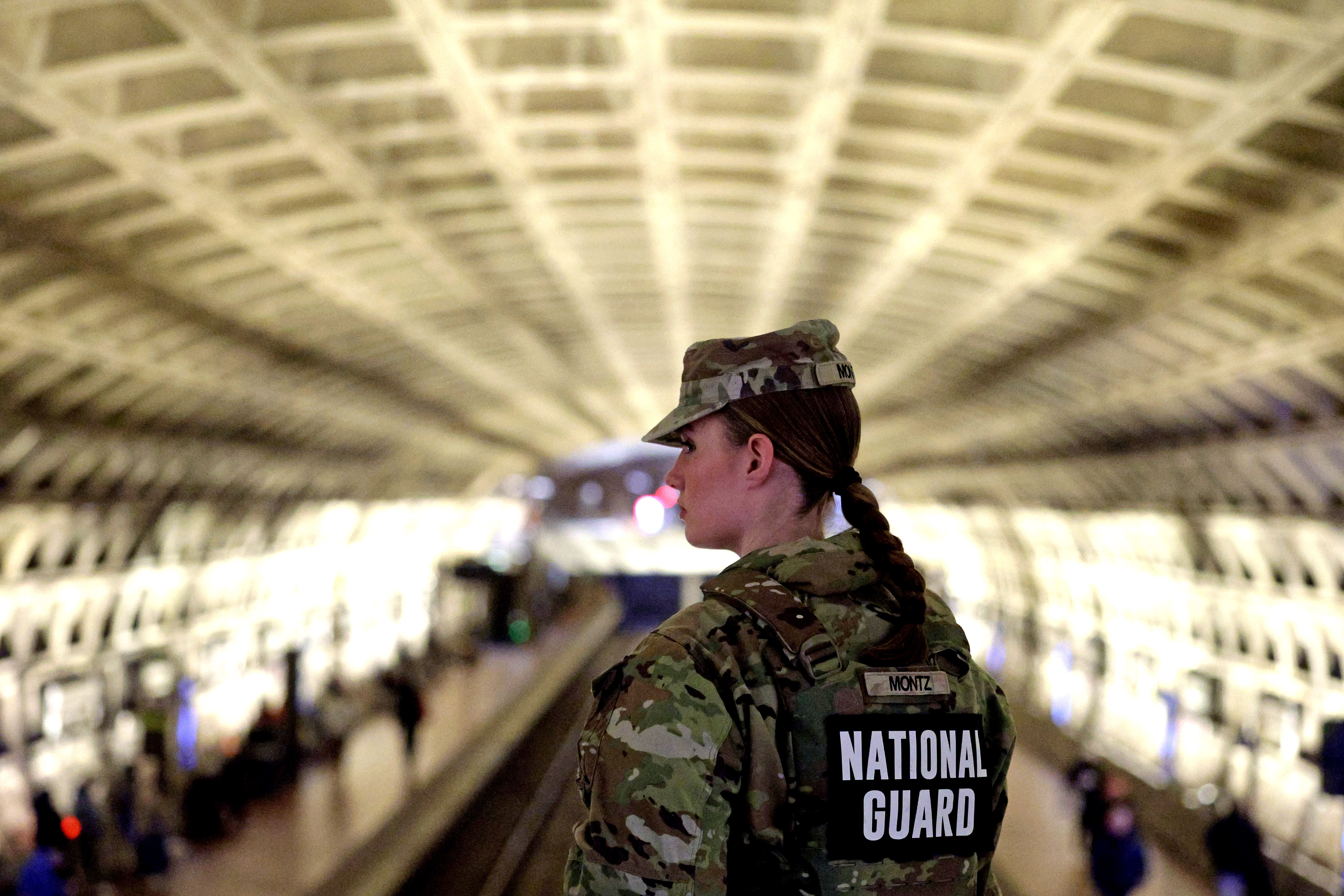

A federal appeals court on Dec. 17 allowed President Donald Trump’s use of District of Columbia National Guard troops in the nation’s capital to continue while an appeal of a lower court order blocking the deployment plays out.
Trump has said the troops were needed to deal with crime and violence in Washington and support federal immigration law enforcement efforts there.
Although the federal Posse Comitatus Act restricts the ability of the federal government to use military resources for domestic law enforcement, a president may take over, or federalize, state National Guard troops on an emergency basis in certain circumstances.
However, the D.C. National Guard is in a unique position because the District of Columbia is a federal enclave and not a state. The president is the commander-in-chief of the D.C. National Guard.
A three-judge panel of the U.S. Court of Appeals for the District of Columbia Circuit granted a temporary stay of the Nov. 20 ruling of Judge Jia Cobb of the U.S. District Court for the District of Columbia.
Cobb said the president has authority to call up the D.C. National Guard only “through the exercise of a specific power outlined in state law,” and not for “whatever reason” he sees fit.
Cobb also said in her order that the court rejects the federal government’s “fly-by assertion of constitutional power, finding that such a broad reading of the President’s Article II authority would erase Congress’s role in governing the district and its National Guard.”
Cobb had found that the deployment runs afoul of the U.S. Constitution and unlawfully interferes with local officials’ authority to control law enforcement in the District of Columbia.
The appeals court said it was granting the federal government’s motion for a stay pending appeal “because the District of Columbia is a federal district created by Congress, rather than a constitutionally sovereign entity like the 50 states.”
The federal government appears likely to prevail on the merits of its argument “that the president possesses a unique power within the district—the seat of the federal government—to mobilize the Guard under 32 U.S.C. Section 502(f),” the appeals court said.
“It also appears likely that the D.C. Code independently authorizes the deployment of the D.C. Guard,” it said.
The appeals court said not staying Cobb’s ruling would likely “result in a profound level of disruption to the lives of thousands of service members who have been deployed for four months already.”
The appeals court noted that the district court had declined to address two issues. One is whether the National Guard units are participating in law enforcement activities in violation of the Posse Comitatus Act. The other is whether the federal government is properly “exercising federal command and control” over National Guard troops deployed to the capital city from various states.
The appeals court said it would “not reach those issues either,” presumably leaving them to be dealt with in the ongoing appeal.
Deputy Assistant Attorney General Eric Hamilton had said at an Oct. 24 hearing before Cobb that the National Guard members were “not doing law enforcement.” The National Guard was carrying out a protective function and was not involved in “core law enforcement activities,” Hamilton said.
When a guard member temporarily detains someone, the guard member is “doing it for protective purposes” rather than “to enforce a law,” he said.
Hamilton said guard members will detain someone “to neutralize what was a threat, and this is consistent with their ability to provide protection.”
District of Columbia government attorney Mitchell Reich said at the same hearing that the federal government’s position was that the president has “essentially unbounded authority to deploy the [D.C. National Guard] as a parallel police force in the District of Columbia.”
Reich said this interpretation of the law “flies in the face of every principle of statutory interpretation and would overthrow the system of home rule and local control of law enforcement that Congress enacted.”
In an opinion concurring with the Nov. 17 ruling, Circuit Judge Neomi Rao suggested that the District of Columbia may not have legal authority to sue the federal government because it is not a state. Circuit Judge Gregory Katsas joined the opinion.
“Permitting the District to sue the President and other federal officials based on a sovereign injury is unprecedented and likely at odds with the unique legal status of the District,” Rao wrote.
The order follows the Nov. 26 shooting of two West Virginia National Guard members stationed near the White House in Washington, which left one dead and another in the hospital.