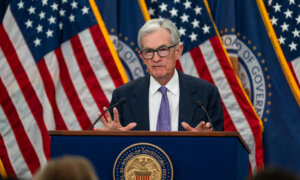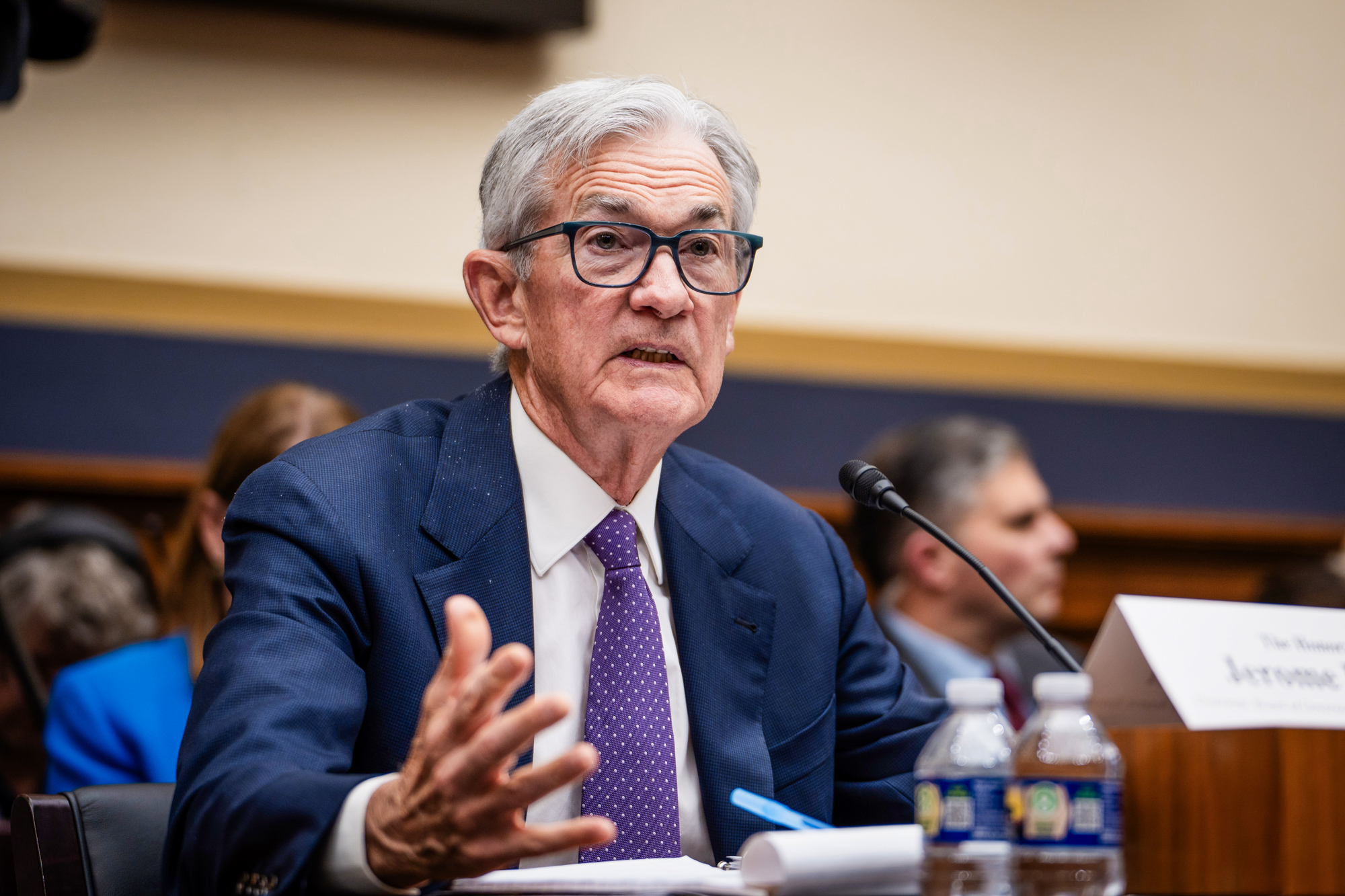

Federal Reserve Chair Jerome Powell presented his final keynote address at the central bank’s annual Jackson Hole summit on Aug. 22.
Powell’s highly anticipated speech signaled that monetary policymakers could be set to lower interest rates for the first time since December.
But his prepared remarks also cautioned about potential inflation and labor market risks.
Here are five key takeaways from Powell’s Jackson Hole speech.
Interest Rate Cuts Coming—Possibly
Powell left the door open to an interest rate cut.
Since the benchmark federal funds rate is 1 percent lower than where it was a year ago, and the unemployment rate remains around a historically low level of 4.2 percent, the current environment will allow the Federal Reserve “to proceed carefully as we consider changes to our policy stance,” according to Powell.
“Nonetheless, with policy in restrictive territory, the baseline outlook and the shifting balance of risks may warrant adjusting our policy stance,” Powell said.
While he did not explicitly state that the Fed is restarting its easing campaign at the September Federal Open Market Committee policy meeting, this is the closest he has come to indicating a rate cut.
Powell’s prepared remarks may have also been surprising, as his colleagues had expressed a lukewarm reception to a potential interest rate cut, citing concerns about inflation and the need to wait for more data between now and next month’s meeting.
‘Curious Kind of Balance’
Data indicate that labor market conditions are in balance.
However, according to Powell, they are “a curious kind of balance” stemming from a slowdown in the supply of and demand for workers.
“This unusual situation suggests that downside risks to employment are rising,” he said. “And if those risks materialize, they can do so quickly in the form of sharply higher layoffs and rising unemployment.”
The Fed head presented various employment figures, including the July jobs report that showed monthly payroll growth slowing to a three-month average of 35,000.
But, he noted, it presents only a partial view of the overall labor market.
“It does not appear that the slowdown in job growth has opened up a large margin of slack in the labor market—an outcome we want to avoid,” Powell said.
In addition to the low unemployment rate, other key indicators, such as nominal (non-inflation-adjusted) wage growth, layoffs, quits, and the vacancies-to-unemployment ratio, have remained little changed or softened modestly.
Inflation Risks Tilted to the Upside
A primary reason the Federal Reserve has maintained the benchmark federal funds rate within a target range of 4.25 percent to 4.5 percent is the impact of tariffs on inflation.
While higher import duties have not dramatically bolstered aggregate inflation levels, Powell says they “have begun to push up prices in some categories of goods.”
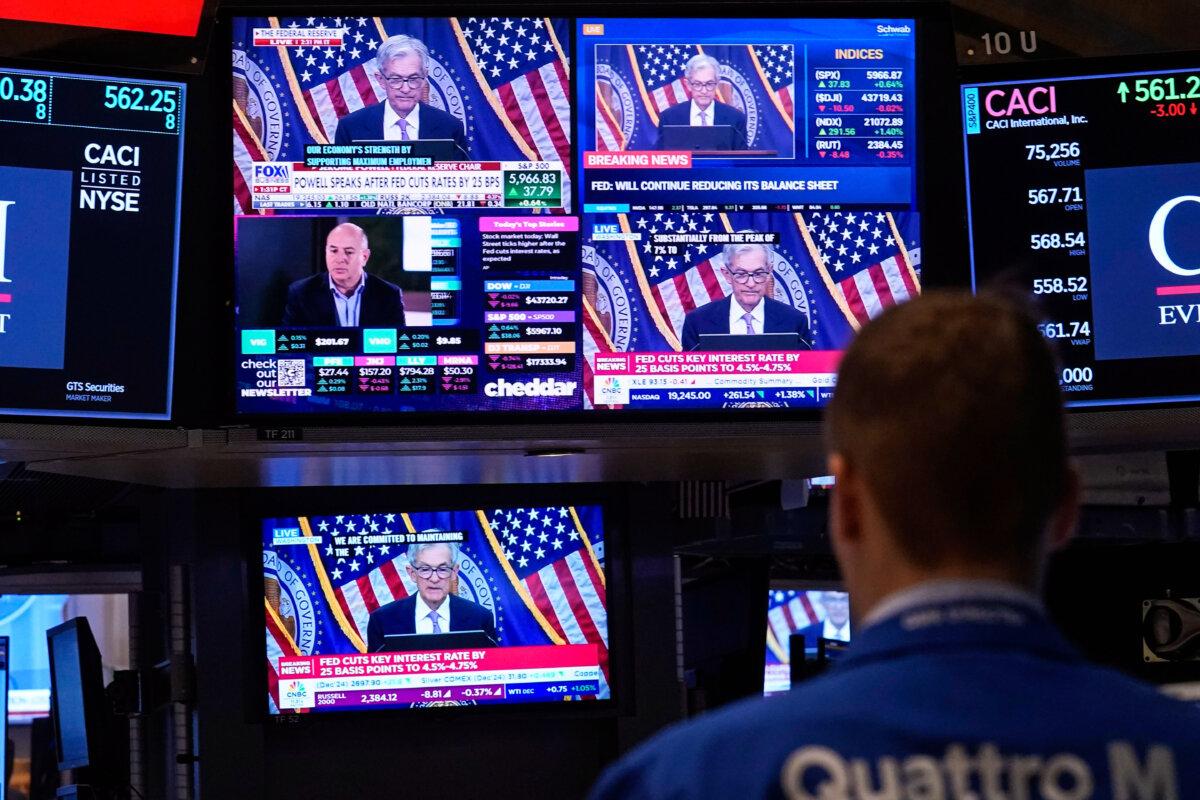
Comments by Federal Reserve Chair Jerome Powell appear on a bank of screens on the floor of the New York Stock Exchange on Nov. 7, 2024. (Richard Drew/AP Photo)
“The effects of tariffs on consumer prices are now clearly visible,” Powell stated. “We expect those effects to accumulate over coming months, with high uncertainty about timing and amounts.”
Comparable to what officials stated in the July meeting minutes, tariff-driven price increases may take time to propagate through the U.S. economy.
He noted that upward pressures on prices from tariffs will need to traverse through supply chains and distribution networks, adding that continued evolution of tariff rates would lead to “potentially prolonging the adjustment process.”
Still, according to Powell, tariff-driven inflation might be transitory.
“A reasonable base case is that the effects will be relatively short-lived—a one-time shift in the price level,” he said.
At the same time, he says, it remains possible that levies could cause persistent inflation challenges for monetary policymakers and trigger higher inflation expectations.
“Come what may, we will not allow a one-time increase in the price level to become an ongoing inflation problem,” Powell said.
Monetary Policy Framework Changes
Powell provided updates on the Federal Reserve’s review of its monetary policy framework, indicating changes from the last assessment conducted by officials in 2020.
Five years ago, the Fed shifted to a flexible average inflation targeting strategy, which allows policymakers to allow the annual inflation rate to run above the 2 percent target following an extended period of keeping policy intact below that goal.
However, inflation reached a 40-year high soon after, and the central bank shrugged off the increase as transitory, not requiring policy tightening.
“As it turned out, the idea of an intentional, moderate inflation overshoot had proved irrelevant. There was nothing intentional or moderate about the inflation that arrived a few months after we announced our 2020 changes to the consensus statement, as I acknowledged publicly in 2021,” Powell said.
“The past five years have been a painful reminder of the hardship that high inflation imposes, especially on those least able to meet the higher costs of necessities.”
In addition, the Fed revised its consensus statement, effectively removing language considered confusing and providing more clarity.
But the Federal Reserve will maintain its long-run inflation target rate of 2 percent.
“We believe that our commitment to this target is a key factor helping keep longer-term inflation expectations well anchored,” Powell said.
Wall Street Cheers
Powell’s speech sparked a widespread rally on Wall Street.
The blue-chip Dow Jones Industrial Average climbed almost 1,000, or 2.1 percent, to a fresh all-time high.
The tech-heavy Nasdaq Composite Index increased by about 1.8 percent, while the broader S&P 500 jumped 1.6 percent.
Forecasts for a quarter-point rate cut in September spiked to 91 percent from 75 percent on Aug. 21, according to updated data from the CME FedWatch Tool.
“The bar is extremely high now for the Fed to leave rates unchanged in less than a month,” Chris Zaccarelli, CIO for Northlight Asset Management, said in a note emailed to The Epoch Times.
According to Zaccarelli, Powell “gave himself an out” should the economic data head in the wrong direction before the Sept. 16–17 meeting.
Additionally, he says, Powell did not outline a path of multiple rate cuts moving forward.
“He was clear that one rate cut didn’t mean the Fed would follow that by a string of additional rate cuts on a pre-set course, but he did acknowledge that the current level of interest rates is a little too high,” Zaccarelli added.
Ultimately, Powell’s remarks “leaned more dovish than we expected,” Deutsche Bank economists said in a note emailed to The Epoch Times.
They are penciling in a quarter-point rate cut in September, and similar reductions in December and March.
U.S. Treasury yields were mainly in the red. The benchmark 10-year yield fell below 4.26 percent. Yields for the 2- and 30-year bonds plunged to 3.69 percent and 4.88 percent, respectively.
The U.S. dollar index, a measure of the greenback against a weighted basket of currencies, fell by about 0.9 percent to below 98. The index erased this week’s gains and is poised for a loss of nearly 0.2 percent. Year to date, the U.S. dollar has fallen by 10 percent.
“It’s no surprise that markets reacted with glee, and both stock and bond investors will be happy if prices close this afternoon at the levels they are now trading,” Zaccarelli said.
“To use the old Fed-analogy, the party isn’t over yet and Jay isn’t ready to take away the (spiked) punch bowl.”