
The San Diego Planning Commission threw its full support behind a $3.9 billion development, endorsing a proposal to reshape a 49-acre parcel in the Midway District with a mix of residences, entertainment venues, and green spaces.
In a 6-0 decision on Sept. 25, the panel forwarded the Midway Rising Project to the City Council. The project will include over 4,000 new apartments—with half designated as affordable housing—while replacing a dated sports arena area with a modern hub. The move caps years of review, including environmental assessments required under California law.
The approved package encompasses a detailed project blueprint, an environmental impact assessment, amendments to the city’s general and community plans, and a rezoning of the area from commercial to mixed residential use.
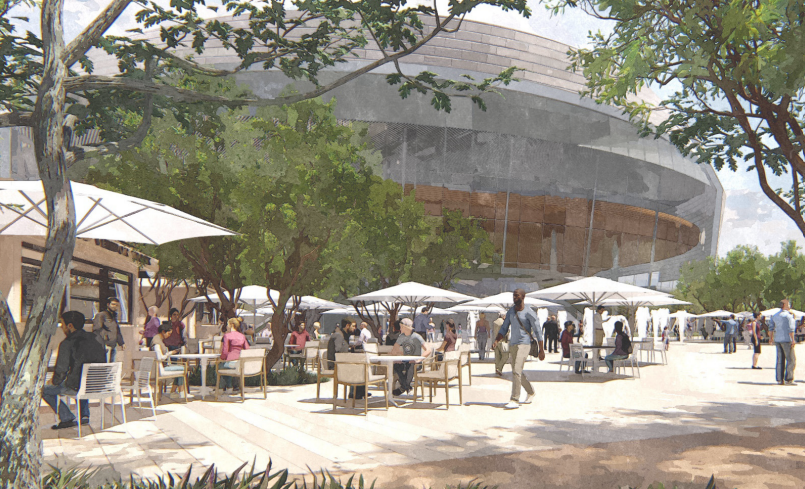
This shift paves the way for 4,254 homes—2,000 of them affordable for lower-income families—a 16,000-seat arena, 130,000 square feet of retail space, and 14 acres of parks and pathways, lead developer Shelby Jordan II told the commission.
The commission required an amendment for the proposal to move forward. The development agreement must be revised to ensure transit enhancements—specifically, a redesign of Sports Arena Boulevard to include dedicated bus lanes—are completed in the project’s initial phase, rather than delayed to later stages.
The mandate reflects concerns from residents and board members about the area’s already congested roads, intensified by its proximity to major freeways and the San Diego International Airport.
Jordan presented renderings showcasing a revitalized district, replacing aging lots with vibrant public spaces and modern infrastructure. The plan also introduces two new streets to improve traffic flow and roughly 4,000 parking spaces reserved for residents and shoppers.
Commissioner Matthew Boomhower, who moved to recommend approval, said the project will be a landmark for the city, comparing its potential to transformative developments such as Petco Park, Liberty Station, and SDSU Mission Valley.
“This initiative will not only reimagine this underutilized site but also spark renewal across surrounding neighborhoods,” Boomhower said during the meeting.
“The status quo here is simply not an option.”
He acknowledged community concerns about connectivity to the Old Town Transit Center, a main transportation hub.
”The proposed express bus lanes will help, but they must be prioritized in phase one to ensure this project delivers on accessibility,” he added.
The Midway District, long defined by outdated warehouses, strip malls, and the aging Pechanga Arena, has been a focal point for revitalization since the city declared the site surplus property in 2021.
The selected developers—Chelsea Investment Corporation, Legends, Zephyr, and The Kroenke Group—secured the bid in 2022, with an emphasis on building affordable housing to address the shortage in the city where median rents have surged 5 percent annually amid sub-3 percent vacancy rates.
During the meeting. Cathy Kenton, speaking for the Midway-Pacific Highway community board, described the project as long overdue for renewal.
“Midway Rising is the much-needed catalyst to change for our decades-long stagnant neighborhood,” she told the commissioners.
“Day after day, year after year, we’ve seen the same strip clubs, the same industrial warehouses, the same commercial strip malls and rotating homeless encampments.”
Echoing that sentiment, Councilmember Jennifer Campbell applauded the project as a step in the right direction.
“This project is on track to completely revitalize the Midway District by adding an upgraded new sports arena in addition to over 4,000 new homes, nearly half of which will be affordable housing,” she said in remarks submitted ahead of the vote.
“In the state of California, we have yet to see an affordable housing development of this magnitude, and I am proud that San Diego will be the first to build a project of this scale.”
Not everyone shared that enthusiasm.
Dozens of public comments in opposition to the project were submitted online ahead of the meeting, primarily regarding concerns about traffic congestion and building heights.
With the commission’s approval, the proposal heads to the City Council’s land use committee for review.