
For most people, cleaning is just a household chore. But for Chinese people, cleaning the house means a lot more than that—especially as the Chinese New Year approaches.
In traditional Chinese culture, the act of sweeping is symbolic—a deliberate clearing out of stale energy, misfortune, and anything from the old year that shouldn’t follow you into the next.
Traditional Chinese culture, before communism, values a meaningful lifestyle that nurtured both mind and body.
Though the Chinese New Year is still two months away, as the 2026 New Year approaches, people can carry this approach to cleaning into their own homes as they prepare for the year ahead.
Out With the Old; In With the New
Spring cleaning traditionally symbolizes a fresh start after winter. In Chinese culture, however, cleaning starts more than a week before the new year so that people can clear out all of the bad luck, stagnant energy, and negativity—to make space for prosperity in the year ahead.
Chinese people call cleaning “saochen,” which literally translates to sweeping dust. The word for “dust” (chen) is a homophone for “old” (chen) in Chinese. Sweeping dust, therefore, signifies clearing out the old, bad luck included.
While bright and clean places attract luck and good spirits, dark corners and seldom-moved furniture attract negative spirits, according to Chinese folklore.
For people who want to time their cleaning ritual with the Chinese New Year, Zheng Qu, a Chinese cultural scholar and associate professor at Fei Tian College, Northern Campus, New York, told The Epoch Times that families can start cleaning their house starting from the 23rd day of the last lunar month through New Year’s Eve.
The 23rd day of the last lunar month, also known as the Little New Year, is when the kitchen god, who resides in the family’s hearth, leaves for the heavens to report to his supervising god. In Chinese folklore, the kitchen god watches over the family and keeps track of all wrongs and good deeds, which are then reported to the heavens.
From his departure until New Year’s Eve, there is what Qu calls a “spiritual interval,” a rare moment when deities are away from their posts. This makes it the ideal time for the Great New Year Cleaning. “Under normal circumstances, it is considered irreverent to disturb higher places with brooms,” Qu said.
Cleaning the house becomes the family’s formal way of preparing to welcome back the deities and the spirits of their ancestors. “The idea is that only a space scrubbed clean is worthy of such a sacred presence,” Qu said.
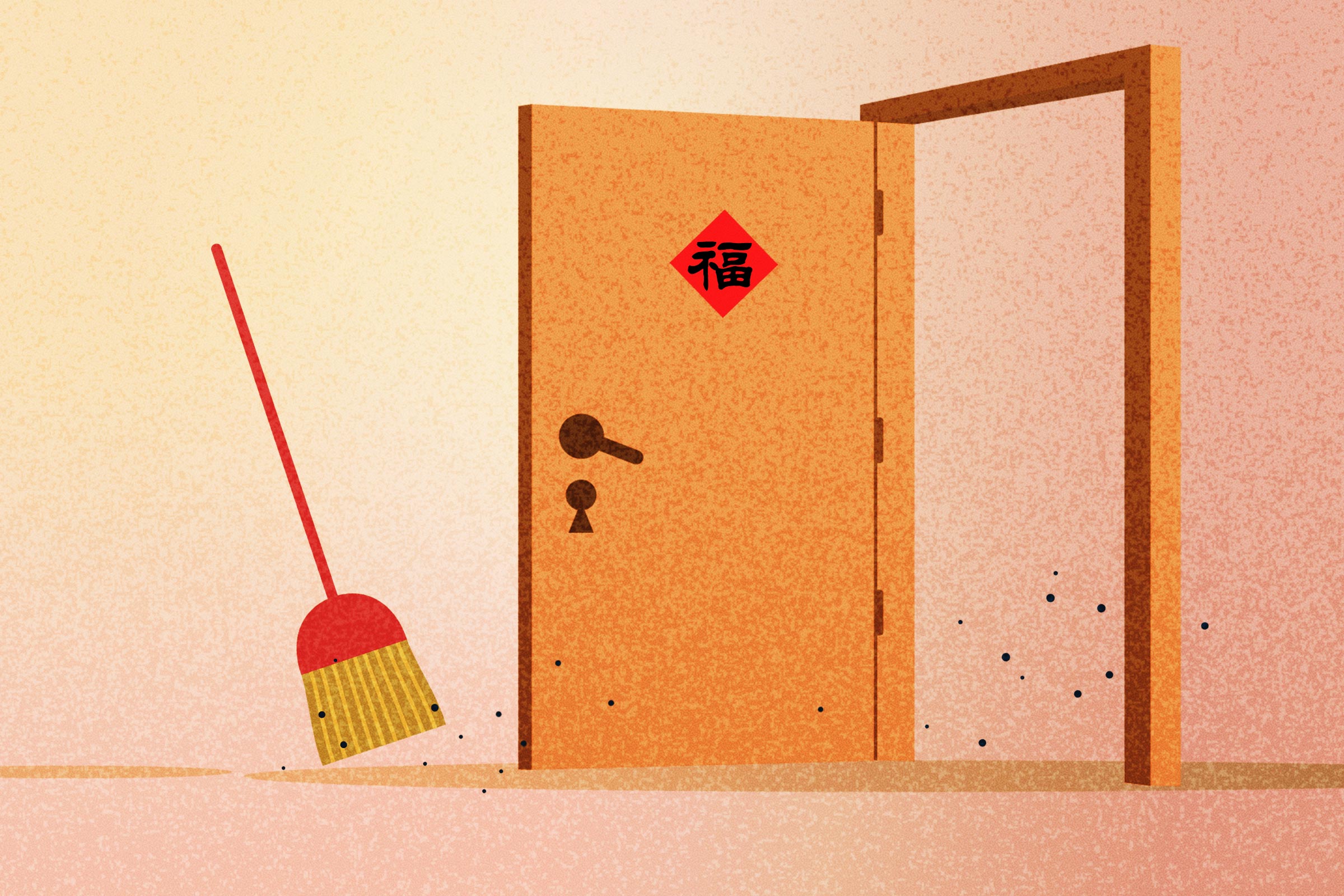
Family members need to follow specific rules: sweeping inward and gathering debris into a central pile, then removing trash through a side or back door—never the front, which is considered the entrance for prosperity and luck.
All cleaning must be completed before midnight on New Year’s Eve. Sweeping on New Year’s Day is avoided because it symbolically throws away one’s fortune. Many families store sweepings until the fifth day—the day of dispelling poverty—when taking out the trash represents casting off misfortune.
Cleaning: A Reflection of Character
Even outside of New Year rituals, Chinese people have traditionally placed great emphasis on running a clean and organized household. Cleanliness is often seen as a measure of good character.
Chen Fan was a well-known politician in the Eastern Han Dynasty who later rose to the rank of grand commandant, the highest military position in the imperial court. At the age of 15, he rented a room away from his family.
When Xue Qin, a friend of his father, came to visit, he found Chen’s room in disarray and asked, “Why did you not clean the room to greet a guest?”
Chen replied: “A man of ambition should aim to clean up the world. How could he be reduced to cleaning a single room?”
Xue responded, “If you cannot clean your own room, how can you clean the world?”
Red-faced, Chen took Xue’s advice and cleaned his room.
This lesson reflects Confucious thought that one’s outer environment reflects one’s inner world, and that discipline in small tasks forms the foundation for greater responsibilities, Qu said.
These ideas are supported by modern scientific research. Studies have shown that living in a cluttered home may increase cortisol levels and depressive symptoms.
Similarly, a 20-year study found that one of the strongest predictors of adult success was simply doing small household chores at age 3 or 4.
Other Rituals for a Fresh Start
Cleaning prohibitions extend to other activities throughout the new year period, reinforcing the central idea of protecting good fortune at the year’s start.
Just as people put on new clothes, bathing and getting a haircut before the holiday is believed to usher in a fresh start. However, because “hair” (fa) sounds like “prosper” (fa), washing or cutting it during the festival is believed to wash away or cut off one’s luck.
Among the most iconic decorations is the “Fu” character, meaning “blessing” or “good fortune,” displayed on doors and windows. Many families turn it upside down because in Chinese, “Fu upside-down” sounds like “fortune arrives.”
Posters of the door gods—fearsome deities that ward off evil—are placed at entrances for protection, and images of the kitchen deity are displayed inside to acknowledge his watch over the family.
The new year is also a time to clear emotional and practical burdens. Paying debts, resolving quarrels, and letting go of grudges allows families to begin the year with a clean slate, free from the weight of unfinished business.
Qu describes the holiday as “a sustained spiritual journey” dedicated to honoring deities and ancestors—a journey in which each ritual reinforces and deepens the others.
In this light, the great cleaning becomes more than a year-end chore. It becomes a bridge not just between the passing year and the one to come, but also between the human and the divine.
“As people sweep away dust and inwardly repent for the past year,“ Qu said, ”they are, in effect, reshaping a cleaner, truer self.”