

The U.S. Centers for Disease Control and Prevention has said it will begin screening people traveling from Siberia for pneumonic plague after a plague laboratory researcher’s death in far east region. U.S. officials have pushed the Russian government for greater transparency regarding the death.
Erica Schwartz, the head of the CDC, said Wednesday that the risk posed to the United States is currently extremely low.
Although person-to-person transmission of the pneumonic plague hasn’t occurred since the 1920s in the United States, cases of the bacterial infection are still reported each year. A man in Arizona died after being exposed to plague-infected cats last year, and a New Mexico woman died from the disease earlier this year.
Where Does Plague Occur?
Most plague cases in the United States are reported in the western part of the country, namely in rural areas of northern New Mexico, northern Arizona, southern Colorado, California, southern Oregon, and far western Nevada, according to a CDC map.
There have been isolated cases reported in places such as Montana, Michigan, Connecticut, Idaho, Texas, Oklahoma, and Alabama, the CDC map shows.
But the CDC noted that the last U.S. epidemic of plague, which was introduced into the country in the year 1900, occurred in Los Angeles between 1924 and 1925. Over time, infected rats transferred the bacterium to rodent species in other areas of the western United States.
Around the world, plague is found most often in Congo, Madagascar, and Peru, according to the World Health Organization (WHO).
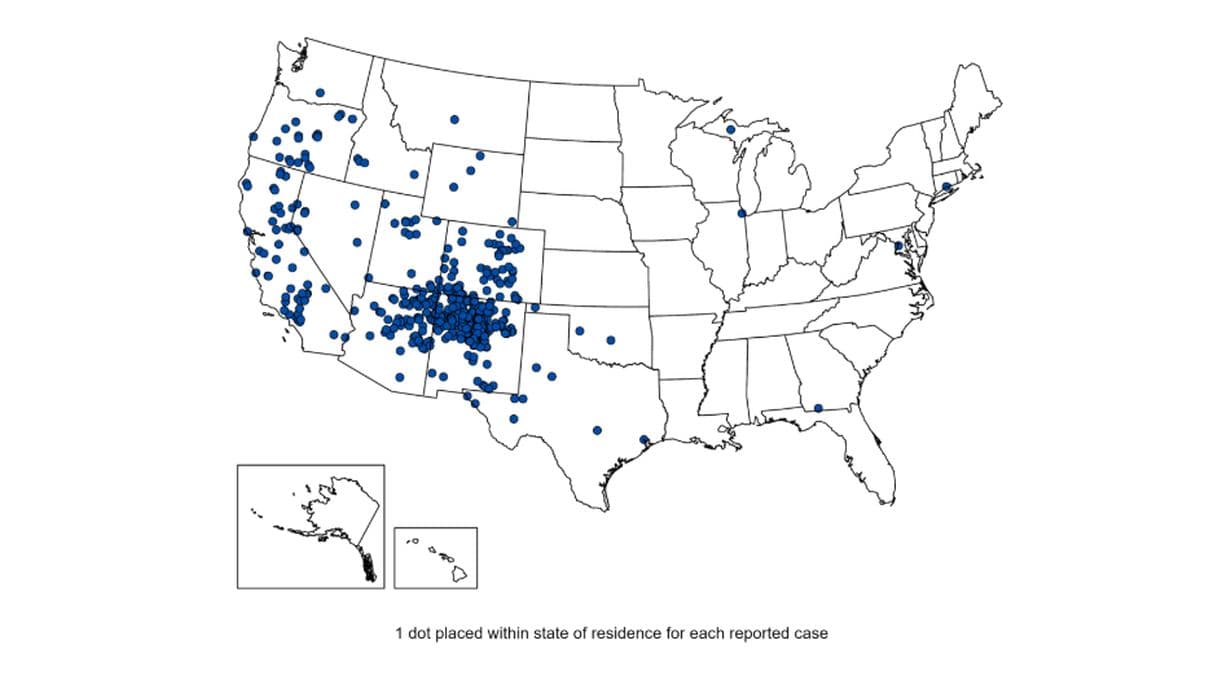
An undated map published by the Centers for Disease Control and Prevention shows where plague has occurred in the United States between 1970 and 2025. (CDC via The Epoch Times)
Is It Rare?
The CDC says on its website that an average of five human plague cases are reported in the United States each year, with more than 80 percent being in the bubonic form.
Since 2000, the highest number of plague cases reported in the United States was in 2006, when 17 people were infected, according to CDC data.
“More recent plague epidemics have occurred in Africa, Asia, and South America, but most human cases since the 1990s have occurred in Africa,” the agency says. “Almost all of the cases reported in the last 20 years have occurred among people living in small towns and villages or agricultural areas, rather than in larger towns and cities.”
On Oct. 1, the CDC issued a reminder to doctors in the southwestern United States to be aware of plague cases, citing the Arizona man’s 2025 death linked to plague-infected cats.
What Is Plague?
The plague, caused by the Yersinia pestis bacterium, is the same one that caused millions of deaths during the European Middle Ages, known as the Black Death.
There have been other pandemics caused by the plague throughout human history, notably the Plague of Justinian that impacted the Byzantine Empire and around the Mediterranean Sea between 541 and 750 AD. That plague was the first documented outbreak of a bubonic plague epidemic in human history.
The bubonic plague is the most common form of the bacterial infection, which spreads naturally among rodents like prairie dogs and rats. There are two other forms of the plague: septicemic plague—which spreads through the whole body, and pneumonic plague, which infects the lungs.
Pneumonic plague is easily transmissible to other people, according to the WHO. Bubonic and septicemic plague, meanwhile, are caused by the bite of an infected flea.
Bubonic plague causes painfully swollen lymph nodes that are most commonly found in the groin, armpit, and neck, called buboes.
It will often advance and turn into one of the other two forms of plague if untreated. Other symptoms of the plague include sudden high fever and chills, headaches, and pain in the abdomen, legs, and arms, according to the Cleveland Clinic.
How Do Treatments Work?
The plague can be cured when treated early with antibiotics. The key is to seek treatment quickly, otherwise the disease can be deadly, the WHO says.
Keeping areas around the home clear of debris and other things that can attract rodents can lower the risk of infection, as can making sure pets are up to date on flea treatments.
The Associated Press contributed to this report.