
A mold dog was the missing piece that solved Cami Cunningham’s seven-year battle with an inexplicable illness that began when she was a baby.
She had dropped from the 70th percentile developmentally to the third, plagued by mysterious, ongoing neurological problems, sleep apnea spells, and the most aggressive case of the autoimmune skin condition vitiligo that her dermatologist had ever seen. She was tested for dozens of diseases and driven hundreds of miles to see numerous specialists.
The dog, named Sarg, who traveled to Illinois from Florida with his handler, sniffed out a large patch of toxic mold behind Cami’s bedroom wall—mere feet from where she slept and where two reputable mold inspectors with cutting-edge tools had thoroughly searched.
“It was a gut punch,” Cami’s dad, Coltin Cunningham, told The Epoch Times, noting his wife had learned about the mold dog during relentless online searches. “How much sicker would she have gotten? How much more would my wife and I be stressed out?” he asked.
“It was a life-changer to have a really good old dog and a sympathetic ear in a handler come in and solve what nobody could solve.”

Cami Cunningham underwent a sleep apnea test and numerous tests in an effort to understand her illness. (Photo by Megan Cunningham)
Cunningham’s skepticism that mold could cause the extensive health challenges his daughter experienced and that a dog would provide answers that top experts could not turned into a hope of helping others. After their experience, he trained the family dog, JoJo, to become a mold dog and now uses his construction background to facilitate mold dog inspections.
Super-Sniffer Science
Gaining popularity across the country, mold dogs use their olfactory superpowers to detect mold hidden behind walls, under floors, and in attics—places where people and equipment cannot easily access. Dogs can help inspectors know where to test, which home structures need to be dismantled for further study, and whether remediation efforts were done satisfactorily.
Dogs can smell 10,000 to 100,000 times more than the average person, and their ability to detect volatile organic compounds such as mold is one part per trillion—something dog trainers describe as the equivalent of a single drop of water in 20 Olympic-size pools.
“Using the strength of dogs’ sense of smell, humans work with dogs for the recognition of different odors, with a precision far exceeding the analytical capabilities of most modern instruments,” according to a 2021 review published in Animals.
There’s evidence suggesting the skill begins developing prenatally. Anatomical and physiological features are responsible for canines’ superior olfactory skills. For instance, dogs have 20 times as many olfactory receptors as humans do.
They use sniffing, which increases the volume of air—and odors—and allows 12 percent of each breath to directly enter the olfactory region to capture and store odor molecules. The remaining air is dedicated to respiration.
The dog’s nose translates scent particles into signals that eventually reach the brain for smell decoding. Dogs can detect the smell of a wild tortoise from up to 65 yards away, a rodent in its natural environment up to 55 yards, and decaying meat up to 218 yards, according to the review. They can also retrace the path of a human who passed through a busy city center up to 48 hours prior with 77 percent accuracy on average.
“The possibility remains that in using dogs’ sense of smell for work, the limits still lie in humans’ perception and learning, rather than in the dogs’ olfactory system,” according to the authors of the 2021 review.
How Mold Dogs Complement Inspections
Handlers require training and typically refer clients to companies that can offer further testing and remediation, as dogs and handlers can pinpoint mold but rarely offer information on the types, amounts, severity, sources, or how to clean it up.
A certified mold inspector, sometimes called a hygienist, validates dogs’ findings by drilling pilot holes in walls or floors, collecting samples, and sending mold spores for laboratory testing.
Once mold is confirmed, a remediator removes the mold, determines how water leaks and damage occurred—typically through an insurance claim—and fixes them to prevent new mold growth.
Dogs can play a role in ensuring the remediation job is satisfactory. Poor remediations are common, and using a mold dog can protect consumers and validate companies’ work, Lambros Avgerinos, a professional dog trainer, told The Epoch Times.
“Their noses are the most refined tool that we have on the planet if you know how to work it,” said Avgerinos, whose experience spans decades of using and training dogs for medical services, such as those related to diabetes and seizures, as well as for search and recovery efforts. “The mold dogs are a key piece in the puzzle. The cost for mold dog service is currently an out-of-pocket expense, but we’re working on getting insurance to recognize the dogs.”
Canine Limitations
Dog sniffing science isn’t fail-proof.
A small study using four mold-detection dogs trained at the Florida Canine Academy found 75 percent accuracy in identifying toxic indoor molds grown in vitro in a double-blind study. Each dog had four samples—three different types of mold and one with no mold. Two dogs correctly identified all positive controls, one dog missed one, and a fourth dog missed two.
Previous studies have found that dogs can detect mold-inoculated drywall with 94 percent accuracy. The difference may be because dogs are trained on mold-inoculated drywall—the type of materials they’re likely to encounter—not petri dishes, the authors noted.
Variables that might affect dog-sniffing performance include illness, pain, fear, mood, stressful situations, traumatic experiences, rest, sleep, sexual cycle, and more. Continued training is vital to ensure dogs recognize various mold odors. Dogs can be limited in that they often train with pure odors but work in environments with mixed, distracting smells, the 2021 review stated.
How Human Inspections Fail
Human mold inspectors and equipment aren’t perfect either. Not only did Cunningham personally experience this lack of perfection, but his mold dog has located mold overlooked by top-notch inspectors.
One client he worked with had multiple inspections and small remediations, but a persistent mold spore count of 6 million. Mold spore counts of 20,000 to 30,000—measured in spores per cubic meter— indicate a mold problem, he said.
“She pulled in all the big guns—inspectors from Chicago, New Jersey, and New York—and they found a little mold but nothing that would equate to that high a mold count,” Cunningham said. “I found a little bit of additional mold that they hadn’t found, but again, nothing that explains 6 million equivalents.”
JoJo, however, laid down underneath the woman’s attic access and wouldn’t budge. Cunningham had already looked in the attic and cleared it. It had spray foam insulation, which isn’t a typical medium for mold to grow on—at least not when done properly. He returned to the attic and noticed one rusty nail sticking out of the pristine insulation. The homeowner then permitted him to disturb the insulation.
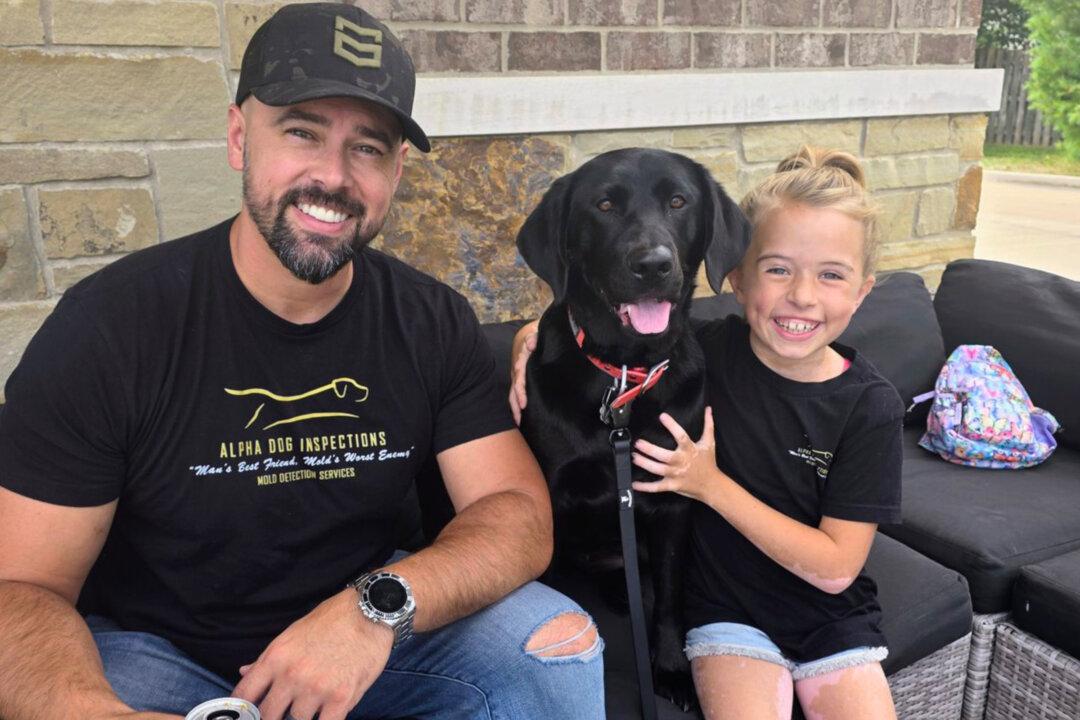
Coltin and Cami Cunningham with JoJo, the mold-sniffing dog. (Photo by Megan Cunningham)
“I stick my hand in, and buckets of water come out,” he said. “Her roof was a total loss. Water had been trapped up underneath the insulation, and everything was full of mold.”
JoJo was able to smell through inches of thick spray foam, through the attic floor, and into the main living space.
Mold’s Controversy
Mold illness, also called chronic inflammatory response syndrome, remains controversial in conventional medicine. Mold illness describes broad, whole-body symptoms involving hormonal disruption, cognition, digestion, the nervous system, and joints.
The Centers for Disease Control and Prevention notes that people who spend time in damp buildings may report a range of mostly respiratory symptoms and the possibility of developing hypersensitivity pneumonitis, an immune system disorder causing lung inflammation, much like the flu or pneumonia.
Caused by inhaled bacteria, fungi, and chemicals, hypersensitivity pneumonitis can cause symptoms such as shortness of breath, coughing, muscle aches, chills, fever, night sweats, and extreme fatigue. Unlike flu and pneumonia, hypersensitivity pneumonitis isn’t helped by antibiotics.
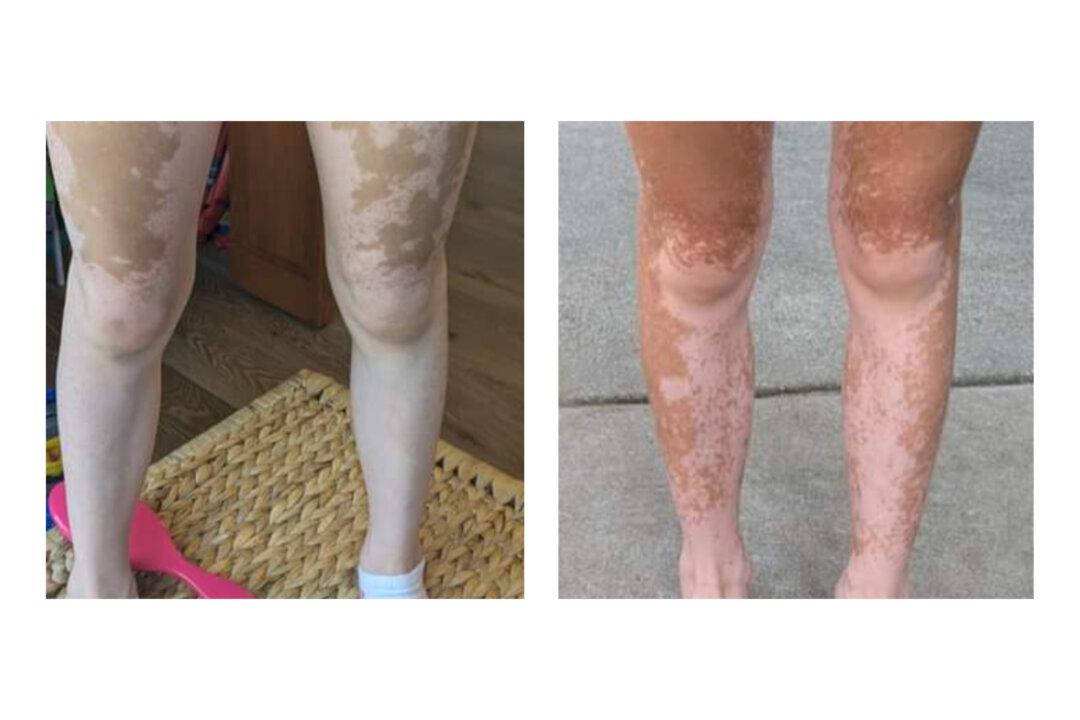
Pigmentation began to reappear in Cami's skin, right, months after moving out of the moldy environment. (Photo by Megan Cunningham)
When Mold Dogs Make Sense
Once Cunningham moved out of his home for remediation to begin, his own symptoms, which included irritable bowel syndrome, chronic back issues, and joint problems, vanished.
Sarge’s discovery of mold behind Cami’s wall also led to rapid healing. About 95 percent of Cami’s health issues disappeared within three months of living away from mold, Cunningham said, with a few developmental delays that lingered.
“She could barely move, communicate, and pass a test in school. She had major emotional dysregulation,” he said. “She is night and day.”
Dr. Amy Beard, certified functional medicine practitioner and former emergency physician, is now suggesting her patients consider using mold dogs after friends recommended she use one to investigate water damage in her home.
“I was like, ‘That makes perfect sense. Why would I not use a dog?’” Beard told The Epoch Times. “I know what their noses are capable of.”
The dog found two areas of mold growth, and after leaving her house during remediation, she reported feeling and sleeping better.
A red flag that mold might be present is feeling fewer symptoms after a period away from your home, such as on a vacation, Beard said. That could help you decide if it’s worthwhile to initiate an inspection, and mold dogs can offer an additional layer of assurance, she said.
“It’s another tool that we have for better detection of a potentially harmful substance, and we should be embracing that.”