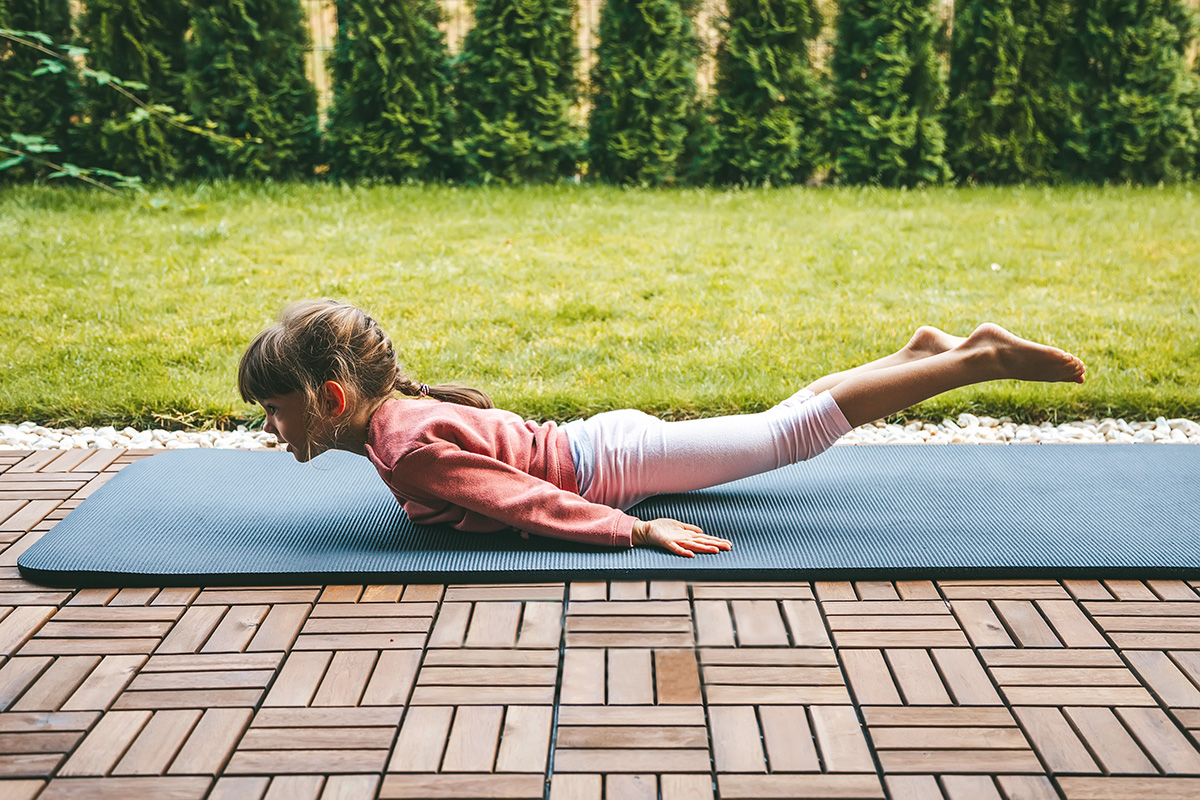
There are all kinds of weird poses in exercise. Take the locust pose, for example—it looks like Superman flying when he’s feeling fancy, and the banded monster walk is just as funny as its name.
These funny poses can have impressive benefits for your core strength and different muscles.
Let’s unleash some fun with exercises.
6 Funny, Fun, and Fantastic Exercises
These are safe, effective exercises, but you may want to consult your health care provider to ensure that they are right for you.
1. Banded Monster Walk
The banded monster walk is an excellent exercise that utilizes a wide-based walking pattern coupled with a resistance band to challenge your muscles and build your endurance. You will find them monstrously beneficial.
Step 1: Securely tie approximately 2 feet of elastic band in a loop and place it around your ankles. Stand with your feet approximately 2 to 3 feet apart to place tension on the band.
Step 2: Start walking, but instead of moving your feet straight forward, step out and then forward, as if walking around an obstacle, making sure to maintain tension on the band as you walk.
Step 3: Performing this movement for one minute counts as one repetition. Try to perform three repetitions.
Modifications: If you can’t place much tension on the band, just do what you can at first—you will still look adequately funny and grow stronger over time.
Why I like it: The banded monster walk places excellent focus on your hip abductors and core musculature, and its sustained nature can help increase activity endurance.
2. Locust Pose
Among a multitude of benefits, this Superman-like pose exercise helps stretch and open your chest muscles while actively engaging the muscles on the backside of your body.
Step 1: Lie face down on the floor with your arms by your sides and your feet hip-width apart.
Step 2: Keeping your elbows and knees straight, raise your head, arms, and legs simultaneously up as far as you comfortably can. Bring your head up with the rest of your body so that you are looking straight forward rather than down or up.
Step 3: Hold this position for 15 seconds before lowering back down to the starting position. Try to perform this movement up to 10 times.
Modifications: If you can’t lift both your upper and lower body off the floor at the same time, just lift one first and then the other. Alternatively, you can lift and lower your upper body before lifting and lowering your lower body.
Why I like it: The locust pose does wonders for reversing the effects of sitting and for your posture.
3. Fire Hydrant
You'll likely agree that this is a funny-looking exercise. The fire hydrant exercise isn’t one you would want to perform in public—unless you don’t mind second glances—but it is one you want to perform to work on your core musculature and tensor fascia latae (TFL) muscles, which lie on the lateral surface of the thigh and help lift your leg to the side.
Step 1: Start on the floor on your hands and knees. While keeping your knee bent, lift your right leg straight out to the side as far as you can while keeping the rest of your body in position. When you move your leg as far as it will go, hold for one second before slowly lowering it back down.
Step 2: Lifting your leg up and then lowering it back down counts as one repetition. Try to perform three sets of 12 repetitions on each side.
Modifications: If you can’t lift your leg very high—and many people can’t—just lift as high as you can at first. Your hips should loosen up as you go.
Why I like it: For one, it’s an excellent exercise for dialing in on your TFL muscles. Beyond that, the fire hydrant provides significant core muscle engagement while making you feel silly.
4. Frog Pump
The frog pump looks like what you might see when frogs perform a hip bridge. Frog pumps focus heavily on your gluteal muscles and also strengthen your quadriceps muscles.
Step 1: Lie on the floor with the soles of your feet together and open your knees out to the sides.
Step 2: Keeping the soles of your feet together, push your hips up as far as you comfortably can and pause before lowering them slowly back down.
Step 3: Moving your hips up and then back down counts as one repetition. Try to perform three sets of 12 repetitions.
Modifications: If you can’t come up very high when you perform the bridge action, just rise as far as you can—you'll still reap the benefits.
Why I like it: The frog pump exercise focuses precisely on strengthening your glutes. Plus, it looks funnier than the classic glute bridge.
5. Happy Baby Pose
I always get a kick when performing the happy baby pose with others. It gets people laughing and effectively stretches your hips, hamstrings, and inner thighs.
Step 1: Lie on your back with your knees bent and your feet flat on the floor.
Step 2: Bend your knees and press the soles of your feet upward, drawing your knees toward the floor. Take hold of the bottom of your feet with your hands. Be sure to keep your arms inside your legs so you’re not having to reach around them. You'll look like a very happy baby.
Step 3: Once you’re holding onto both feet with your hands, remain in the position for 15 to 30 seconds. Lower and straighten your legs between each holding session.
Step 4: Raising and holding both feet counts as one repetition. Try to perform three sets of 15- to 30-second or longer holds.
Modifications: If you can’t reach your feet, try holding onto your ankles or your shins.
Why I like it: Beyond looking funny, the happy baby pose is plain fun. While it may seem like more play than work, it opens the hips and hamstrings while releasing tension in the lower back, which makes most people feel downright blissful.
6. Heel Walking
Heel walking is a delightfully fun exercise, excellent for strengthening your tibialis anterior muscles, which lie on the front of your calves and help lift your toes. The stronger these muscles are, the better you lift your toes while walking naturally, which decreases the chance of tripping and falling.
Step 1: Start walking on your heels only, without letting your toes or the balls of your feet touch the ground.
Step 2: Keep your toes a few inches off the ground, and resist the temptation to point your toes outward or inward. This exercise can make your tibialis anterior muscles burn, so rest as needed.
Step 3: Walking for one minute counts as one set. Try to perform three repetitions.
Modifications: If you struggle with balance while performing this activity, walk near a wall so that you can reach out to maintain your balance as needed.
Why I like it: Heel walking works nicely to improve balance while also targeting muscles that are frequently neglected. In addition to eliciting giggles, it demonstrates your fancy footwork.
These exercises are funny enough to make you—and passive observers—laugh out loud. I think you will enjoy them enough to want to perform them as many as three times per week or more—and even invite your friends to join you. You will all get healthier, and they will laugh with you instead of at you.
About the fitness model: Aerowenn Hunter is a health editor and fitness model for The Epoch Times. Vibrant in her 60s, she’s an accredited yoga therapist who has dedicated three decades to teaching yoga.