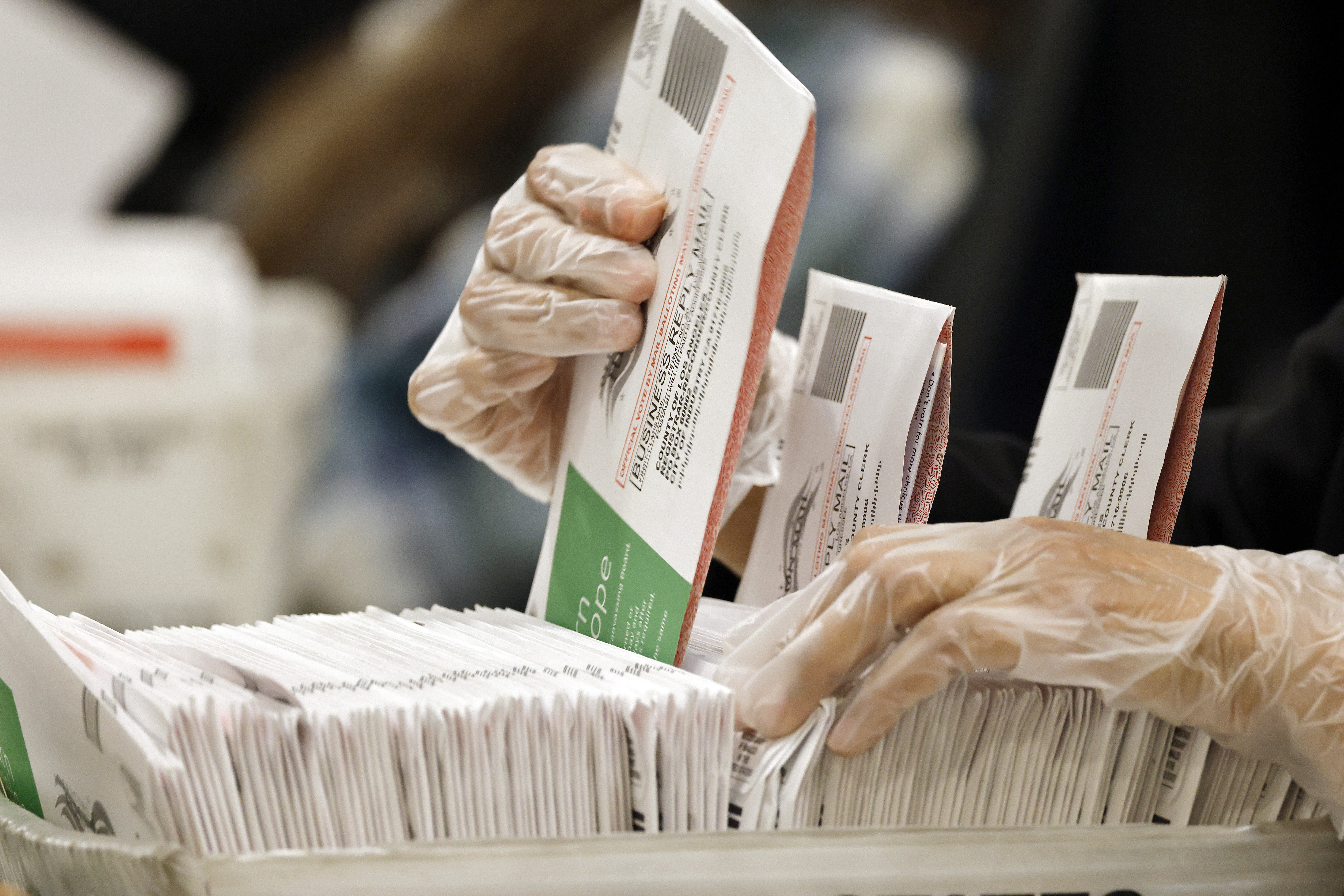

The Trump administration has dropped its lawsuit seeking to force California to set aside mail-in ballots cast by roughly 20,000 people whom federal authorities suspected were not U.S. citizens.
The Department of Justice (DOJ) filed its voluntary dismissal on Nov. 6, four days after the U.S. Supreme Court rejected its emergency appeal to prevent the disputed ballots from being counted until the voters’ citizenship could be verified.
In its dismissal filing, the DOJ said the requested relief would no longer be available because, by a scheduled Nov. 13 hearing, all the challenged ballots would have been processed and stripped of any identifying information.
“California will have already commingled the challenged ballots with lawful ones,” government attorneys wrote. “There is then no way to get the challenged ballots segregated.”
The department said it was evaluating other ways to address suspected voting by noncitizens.
Courts Rejected Emergency Intervention
The lawsuit, filed Oct. 15, followed federal demands that California and Los Angeles County review a list of individuals who appear to be illegally registered to vote and withhold their ballots from the count pending citizenship verification.
California officials questioned the list’s reliability, saying it included eligible voters.
On Oct. 28, U.S. District Judge David O. Carter denied the government’s request for a temporary restraining order. He warned that changing ballot-processing procedures so close to Election Day could disrupt the election and prevent eligible citizens from having their votes counted.
Carter later scheduled the Nov. 13 hearing to further examine the government’s evidence, including a court-appointed special master’s review of the disputed voter list.
California Attorney General Rob Bonta criticized the withdrawal as an attempt to avoid the review.
“Rather than face that scrutiny, it chose to drop its case,” Bonta said in a statement.
Dispute Over Federal Authority
A divided panel of the U.S. Court of Appeals for the Ninth Circuit denied emergency relief on Oct. 30, with a 2–1 majority concluding that the government lacked authority to dictate how state officials process challenged ballots.
“Nothing on the face of [federal law criminalizing noncitizen voting] prescribes a process California must follow when handling challenged ballots,” the majority wrote.
Judge Patrick Bumatay dissented, arguing that courts should intervene when state elections run afoul of federal law.
“We should have at least granted the federal government temporary, narrow relief tailored to safeguarding the election,” he wrote.
The Supreme Court declined to intervene on Nov. 2 in an unsigned order with no noted dissents. The order addressed emergency relief rather than judging on the underlying lawsuit.
Ongoing Challenge in Alaska
The California case was among several election-related actions the DOJ brought before the midterms.
In Alaska, the department sought to halt certification of the Senate contest to investigate possible voter confusion amid allegations by Republicans and in a recent New York Times report that Democratic Senate candidate Mary Peltola’s campaign brought a spoiler candidate —Daniel J. Sullivan Jr., who has no party affiliation—into the race to divert votes from Republican incumbent Sen. Dan Sullivan.
Peltola’s campaign has denied involvement in the alleged scheme.
U.S. District Judge Sharon Gleason dismissed the lawsuit on Nov. 1, finding, among other problems, that the government had not offered a workable way to investigate ballots while preserving voter secrecy.
The DOJ filed a notice of appeal shortly after that ruling.