

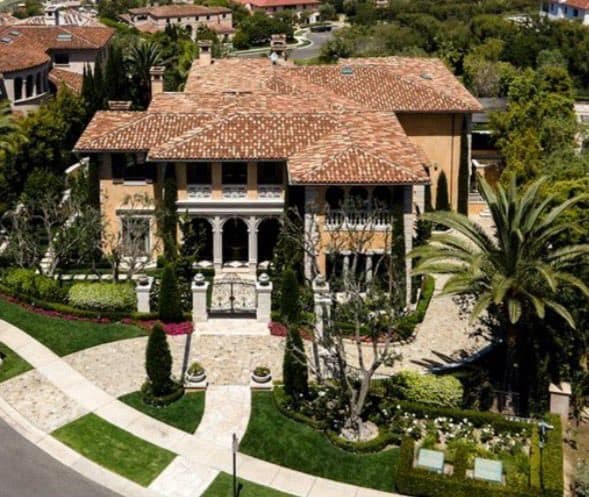
Federal authorities arrested a dual U.S.-Iranian citizen living in a $35 million mansion on the Southern California coast on June 3 and charged him with violating sanctions against Iran by allegedly supplying American-made technology to Iran’s nuclear program and military.
Jamshid Ghomi, 63, of Newport Coast, Calif., was charged with conspiracy to violate the International Emergency Economic Powers Act, the U.S. Attorney’s Office in Los Angeles announced. If convicted, Ghomi faces a maximum sentence of 20 years in federal prison.
“These allegations assert that the defendant violated U.S. sanctions against Iran, aided one of our nation’s enemies, supported Iran’s nuclear program, and got rich doing it,” acting U.S. Attorney General Todd Blanche said in a post on X. “Not only is he being arrested today, but we also are beginning the process of seizing his mansion, which was purchased with his illegal proceeds.”
Ghomi is the chief executive officer of Faraz Pardaz Rayaneh Co. Ltd., a Tehran-based computer networking company with annual sales exceeding $10 million and a customer base that included top Iranian state entities, according to federal officials.
“A relatively small but significant portion of that business went to the most sensitive end-users in Iran: the Iranian regime’s nuclear and military establishment,” the U.S. Attorney’s Office stated.
Prosecutors allege the company supplied U.S.-made computer networking equipment to the Atomic Energy Organization of Iran (AEOI)—the Iranian government’s agency responsible for the country’s nuclear program and its centrifuge and uranium-enrichment programs—from 2017 to 2023.
Sanctions Violations
The U.S. State Department sanctioned the AEOI in 2020 for playing a key role in breaching Iran’s nuclear commitments, and exceeding the limits of the country’s agreement on its uranium stockpile and enrichment levels.
The sanctions were part of President Donald Trump’s “maximum pressure campaign” against Iran taken during his first term that included a wide range of actions to force Tehran to negotiate a new deal on its nuclear program, missiles, and Middle East extremist support.
“Today’s arrest reflects our commitment to disrupt the illegal flow of American technology to foreign nations, especially our adversaries,” said Darren Lian, acting special agent in charge of IRS Criminal Investigation’s Los Angeles Field Office.
Ghomi is accused of violating the International Emergency Economic Powers Act. The act, along with the Iranian Transactions and Sanctions Regulations, puts controls and restrictions on what can be sold to Iran based on national security. These restrictions prohibit the export, re-export, sale, or supply of goods, technology, or services without getting authorization.
Prosecutors allege Ghomi did not seek authorization or get a license from the U.S. Treasury to authorize transactions his company made over more than a decade with Iran in violation of U.S. sanctions.
From 2014 to 2022, Ghomi’s company allegedly supplied U.S.-made networking, security, and encryption equipment to Iran’s Ministry of Defense and Armed Forces Logistics—the Iranian ministry responsible for research, development, and manufacturing across Iran’s defense industry. The equipment also allegedly went to affiliated military and defense-electronics entities, prosecutors said.
Jamshid Ghomi, of Newport Coast, Calif., is accused of using the money he earned from illegal Iranian technology sales to pay for a $35 million coastal mansion. (U.S. Department of Justice)
Prosecutors claim Ghomi identified, negotiated, purchased, and arranged shipments of large quantities of controlled U.S. technology for his own company. From 2011 to 2023, he used his own eBay and PayPal accounts to make hundreds of purchases of computer networking equipment and directed the goods to intermediaries in the United Arab Emirates (UAE).
In 2023, Ghomi allegedly also bought American-made networking equipment directly from suppliers in Minnesota and Nebraska, routed it through the UAE front company, and then sent it to Iran.
None of the items could be lawfully exported to Iran without a license, according to federal authorities.
For four years starting in 2014, Ghomi allegedly smuggled more than 275 tons of networking equipment into Iran, using freight forwarders and intermediaries in Dubai to disguise that Iran was the final destination, prosecutors claim.
Suspicious Money Transfers
Ghomi is also accused of laundering the proceeds of his business into the United States by depositing the Iranian sales revenue into his company’s operating account at a sanctioned Iranian bank, and then sweeping those funds to himself, according to prosecutors.
Within days of the deposits, Ghomi would allegedly receive matching wires into his U.S. accounts from a rotating set of unrelated trading companies and exchange houses in the British Virgin Islands, Hong Kong, Turkey, and the UAE. The money transfers would be allegedly listed with false descriptions, such as “buying goods” and “for consulting fees,” according to the U.S. Attorney’s Office.
From 2011 to 2024, Ghomi allegedly moved more than $15 million from Iran into his U.S. bank accounts and into a construction escrow account held in his name. Prosecutors claim he also falsely reported the funds to the Internal Revenue Service as a foreign inheritance.

Central District of California First Assistant U.S. Attorney Bill Essayli speaks during a news conference at the U.S. Department of Justice in Washington on Nov. 19, 2025. (Madalina Kilroy/The Epoch Times)
Ghomi’s federal tax returns reported almost no income.
Despite living in a $35 million mansion near the coast, Ghomi’s highest reported income in any year was $20,684, according to court documents.
Ghomi allegedly claimed the Earned Income Tax Credit, a federal tax break given to low- to moderate-income working people and families, for seven different tax years, prosecutors said.
Over that same time, Ghomi reported more than $1.7 million in home-mortgage interest and $1.25 million in state and local real estate taxes on his federal income tax returns, according to federal prosecutors.
Mansion Money
Ghomi is accused of using the money he earned from his Iranian technology sales to pay for the coastal mansion. He bought a vacant lot in Newport Coast in 2010 for $4.5 million and paid about $10.5 million to build the home from 2010 to 2013, according to court records.
From 2011 to 2015, $7 million in overseas money transfers were wired into the escrow account to fund the home’s construction, according to prosecutors. The wire transactions had the same characteristics as the ones that sent money to Ghomi’s personal accounts, prosecutors said.
“The facts [in] the case we are announcing today are shocking,” First Assistant U.S. Attorney Bill Essayli said in a post on X. “He did this while living and enjoying the freedoms our great country provides. Today, he is under arrest and will face the full force of justice.”
Ghomi was scheduled to make his first appearance in district court later in the day. He did not return a request for comment about the arrest, and it was not clear if he had retained an attorney.