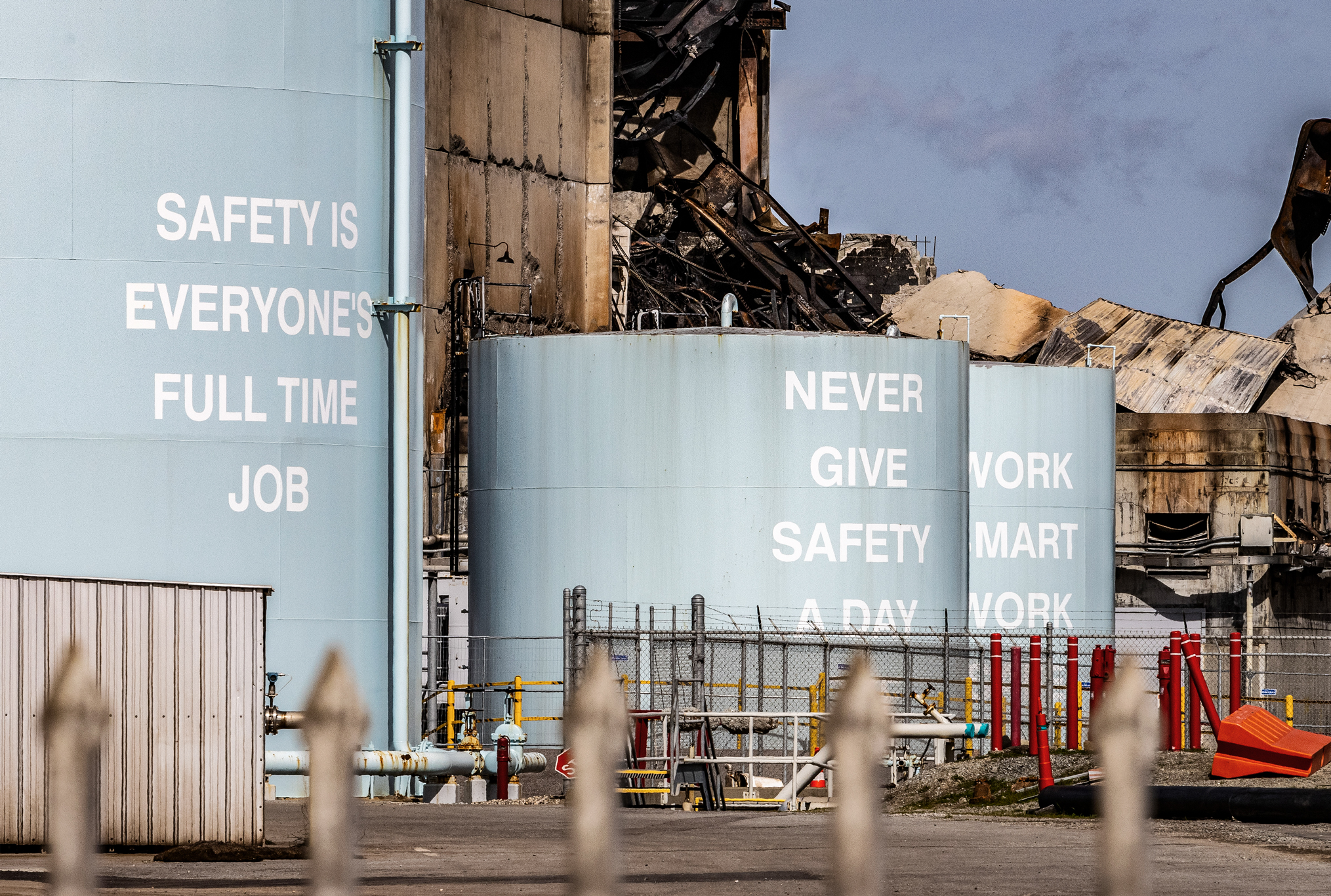

LOS ANGELES—As a federally supervised cleanup continues at the Vistra Energy plant in Moss Landing, California—where a fire erupted in January at one of the world’s largest lithium-ion battery storage sites—residents are still seeking answers about possible contamination and the future safety of their communities.
Representatives from the Environmental Protection Agency (EPA) presented an update at a Sept. 16 Monterey County Board of Supervisors meeting, where they were met with concerns, questions, and frustration from residents.
The EPA in July entered into a legal agreement with Vistra, which is responsible for the costly cleanup and debris removal, to oversee the process. Officials estimated that it could take up to two years for total decommission of the damaged site, which was used to store renewable energy for the California power grid.
“We want to make sure we’re making a thoughtful, structured, slow, and prioritized approach to doing this,” said Lynn Keller, a supervisory environmental engineer with the EPA.
The agreement with Vistra, she said, is a framework for the cleanup, ensuring that it meets EPA guidelines. Battery removal and demolition will take place in phases. The company said it can’t define a “firm timeline” but officials estimated it could take up to two years.
“That’s the reason for the surgical demolition, for all the mitigation measures we have in place, the [private] fire department, the thermal imaging, the non-stop air monitoring that’s been going on since day one, the air sampling, and the posting of the results so the community can see that on the county’s website,” Keller said.
But delays leading to the remediation process, some suggested, were avoidable.
“I’m really concerned that it took six or seven months to come to an agreement with Vistra and EPA on the cleanup,” Monterey County Supervisor Glenn Church told The Epoch Times after the meeting. “There should be a cleanup agreement in place before the batteries go on site.”
Church said he plans to introduce a new county ordinance in the coming weeks that will attempt to establish such requirements but noted counties are limited by state legislation, which in 2022 streamlined the permitting process for large clean energy projects, allowing them to bypass local authority.
Cleanup and Assessment
Ed Mitchell, a resident of nearby Prunedale who is active in the community group Never Again Moss Landing, said the agency failed to fully investigate contamination at the charred plant before starting cleanup.
“The EPA did not provide any contamination characterization of any pollution on the Vistra Energy burn site,” he told The Epoch Times after the meeting.
Doing so, he added, would have been as easy as scraping ash off the shoes of EPA workers who entered the site to delink the batteries during the first phase of the cleanup.
Several federal environmental laws, including the Resource, Conservation, and Recovery Act, mandate site characterization—whereby the EPA determines the nature, extent, and risks of contamination after such a disaster, as well as how it may have spread—before cleanup, in order to determine what kind of remediation is warranted.
“A person listening to the EPA presentation, who had not lived through the fire and smoke release, would walk away believing the incident was a one-day fire; no pollution, no big thing,” Mitchell said.
The fire that erupted on Jan. 16 sent a 1,000-foot plume of toxic smoke into the air, zigzagging across the agricultural basin and depositing high concentrations of heavy metals in a nearby nature preserve. Contaminants also showed up in surface wipe testing carried out by local residents.
The fire stopped and the smoke settled after about a week but the charred ruins reignited, twice, more than a month later.
Around 65 percent of the facility’s more than 100,000 batteries, each weighing 200 pounds, burned in the fire. The rest remain inside a structurally unstable building. Officials say the exact cause of the fire is still under investigation but acknowledged that thermal runaway—a chain reaction caused by overheating for which lithium-ion batteries are notorious—had been a factor.
Lithium batteries are pyrophoric, meaning they can ignite spontaneously with exposure to air or water, making their fires tricky to extinguish—and raising concerns about rains during the cleanup process.
“It was the biggest release of pollution from the largest indoor ion-battery storage site in America, and the EPA failed in the briefing to inform the board and the public of how well the EPA detected air and surface sampling inside the fence of the burn site,” Mitchell said.
Keller answered that waste characterization “is a part of the process” and would happen as cleanup proceeds. “There is a lot of the site we can’t get to yet because the building is in too damaged of a condition to be able to enter,” she said.
Nothing will be disposed of without being sampled first, she said. “And through waste characterization, we’ll figure out the constituents and that will certainly be public. We haven’t gotten to the point yet where we can access the ash. And there isn’t soil on this site to speak of, it’s a building footprint on a concrete pad,” she said.
Not satisfied with that response, Never Again Moss Landing on Sept. 22 submitted a Freedom of Information Act request to force the EPA to release contamination site characteristics from Jan. 16 to Sept. 16.
Monitoring for Contaminants
Air, water, and soil testing by state agencies, the EPA, and Vistra have found no threats to public health or agriculture to date.
Air monitoring began immediately after the fire erupted, and subsequent air, soil, surface, and water sampling followed, both on-site and in surrounding areas.
But some residents remain skeptical, in light of their own symptoms and experiences.
Exactly what was released in the fire and how it might impact residents, animals, and the surrounding environment have been points of contention, as community groups have coalesced around independent testing efforts and grilled authorities on timelines and transparency.
An Epoch Times investigation in February found that while the EPA began air monitoring almost immediately when the fire broke out, the agency did not instruct Vistra to conduct air sampling until nearly a week after the fire, and did not make that information available to the public at the time. Air samples, which are collected and sent to a laboratory for analysis, can detect finer particulate matter that heavy metals and other toxic organic compounds tend to stick to, and that can be missed in air quality monitoring.
In February, Michael Polkabla, an industrial hygienist who lives in the area and was volunteering in community sampling efforts, took issue with EPA’s decision to give an “all clear” based only on testing for hydrogen fluoride and particulate matter.
“They didn’t even consider the other contaminants involved,” he said, suggesting the agency should have immediately looked for heavy metals, PCBs, chlorinated compounds, dioxins, and polycyclic aromatic hydrocarbons.
Since then, the Center for Toxicology and Environmental Health, a consultant hired by Vistra, has collected air samples on site and at perimeter stations around the facility, as well as fixed locations throughout the community, with roaming hand-held monitors to test for aluminum, asbestos, cobalt, copper, manganese and nickel, as well as other compounds.
The results, along with data from community groups and various agencies, are posted to the county’s fire dashboard, along with analysis of soil, surface water, and surface wipes.
Never Again Moss Landing in August reported elevated dioxins, which are highly toxic compounds, at six sites surrounding the plant. The EPA notes that without a long-term study and risk assessment, “it is difficult to determine if dioxins in the surrounding environment are a result of the January 2025 battery fire ... and whether the exposure constitutes a risk to human health.”
Data Set Insufficient
In June, a consultant for the county reviewed the now publicly available data, finding that “due to the frequency of discrepancies,” the data set was insufficient to support the preparation of a “robust and defensible” human health risk assessment.
There was no mention of heavy metals in reporting from the EPA, Vistra, state agencies, or the county until scientists working in the adjacent nature preserve made a stunning announcement in late January: As a result of fallout from the smoke, surface soil had drastically elevated levels of these compounds, hundreds to a thousand times above background levels.
California’s Department of Toxic Substances Control conducted its own soil analysis. After initial surface screenings detected a spike in heavy metals in eight sections around the plant, the department reported on Feb. 12 that soil samples sent to a lab for analysis contained no elevated concentrations.
Vistra used lithium-ion batteries composed of a blend of roughly 50 percent manganese, nickel, and cobalt.
At the Sept. 16 meeting, supervisor Wendy Root Askew asked the EPA if it was known what was being tested for, if the composition of the batteries is proprietary, and if adequate sampling was done prior to the rains last February.
“I think we’re confident the monitoring being done captures all the contaminants that would be of concern for the materials being handled,” Keller said. “We do know what to expect,” she added, pointing to asbestos, metals, hydrogen fluoride, hydrogen cyanide, and carbon monoxide as potential contaminants from lithium-ion battery fires.
Part of the concern over heavy metals is that they do not biodegrade and can easily accumulate in the food chain. Even at very low levels, they can have a cumulative effect over time, making the determination of a safe threshold a matter of contention.
In humans, exposure to heavy metals and other toxins, such as pesticides, can have longer-term impacts, damaging DNA, interfering with protein and enzyme function, creating oxidative stress, and stimulating cancer progression, according to multiple global studies.
During the Sept. 16 board meeting, Supervisor Glenn Church asked EPA representatives about recent reported decreases in local mosquito populations, and if such could be an indication that fallout from the plume was “working its way up the food chain.”
Keller replied that preliminary sampling has not shown widespread contamination but a second phase of the cleanup would involve sampling in a mosquito-impacted area.
The idea, EPA representatives said, is that if comprehensive air monitoring inside the perimeter of the facility doesn’t show elevated levels of contaminants, it is unlikely that they are migrating offsite.
Further Concerns
Diane Dutton-Jones, a resident of nearby Watsonville, raised concerns not just about the Moss Landing site but about three other proposed battery energy storage systems (BESS) sites in nearby Santa Cruz County.
As California pushes to reach its ambitious renewable energy goals, the number of BESS sites in the state is set to quadruple over the next decade or so.
“I’m concerned because it’s a lot. And if we don’t get it right now, we are going to be Superfund sites all over California. I don’t want to be a sacrificial community,” she said.
EPA representatives said the agency is using Superfund authority to oversee the cleanup but Moss Landing has not been added to the National Priorities list of the country’s most serious uncontrolled hazardous waste sites.
“I don’t want a ticking time bomb sitting around in our county—nobody does,” Dutton-Jones said. “The community is frightened to death ... and our community leaders are very quiet about this. It’s very unsettling.”
Other speakers expressed support for solar energy and BESS facilities as part of a transition to green energy but remained concerned about the fact that there had been several other safety incidents on the site in recent years, and wondered about the consequences. The January fire was the fourth “thermal incident” at the Moss Landing complex since 2021, and the third at the Vistra plant, which sits adjacent to a BESS operated by PG&E.
“This was a huge betrayal of our community,” one area resident said. “We have this positioned by a marine estuary, at the edge of a tsunami zone, in an agricultural area. This is terrible. It’s absurd ... I don’t even know why we’re discussing Vistra other than to get it cleaned up and get them the hell out of here.”
Safety Requirements
County Supervisor Church noted that, since state legislation introduced a bypass of local authority for BESS permitting, the county has little say over whether a facility can continue to operate in a community, even after a major disaster.
“At the county level, we walk a really delicate line here in terms of what our authority is and what we can do,” he said.
Church plans to introduce an ordinance to specify safety requirements for battery storage projects, separating those over 200 megawatts, which can bypass local authority with state permitting, and those under 200 megawatts, over which counties might maintain more control.
“We’ve got to address both of these, but obviously we could be more thorough with those under 200 megawatts,” Church said.
Church stressed that, even in light of recent improvements, large-scale lithium ion battery operations are still an experimental new technology.
“The key thing is we’re going down a road that nobody’s walked before. ... Everybody is frankly learning as they go,” he said.
After conferring with other county leaders in the state, Church said many localities don’t have ordinances in place but are thinking about it in the aftermath of Moss Landing.
Supervisor Luis Alejo said, “Obviously the governor and the legislature have assumed jurisdiction in this particular area and that’s why a state law preempts local law, they created a different process on permitting, with different statewide agencies handling most of the decisions to allow these projects to move forward, because it’s a statewide interest.”
With a state goal of reaching 100 percent renewable energy by 2045, he said, there also has to be a recognition “by all of us adults that you can’t have wind and solar energy without a place to store it.”
Future Development
Church asked a Vistra representative to clarify its plans for potential reopening of the site, which also houses two separate, subsequent expansions of the damaged facility, one of which has a similar design.
“We know this is a flawed design, because of what’s happened. ... So I’m really, really concerned about that ever opening up again,” he said.
David Yeager, director of project development for Vistra, said there has been no decision. “The investigation does need to go forward, we need to learn more, understand these findings and all that will inform any decision going forward,” he said.
There is no restart plan for one of the additional buildings, while the other is under evaluation. “We’re still working through that,” he said.
This was little consolation to concerned community members.
One pointed out: “Vistra said it has no plans to restart at that location. That, of course, is very different from ‘we are not restarting at that location.’”
Vistra did not respond to a request for comment from The Epoch Times.
Correction: A previous version of this article misspelled the name of industrial hygienist Michael Polkabla. The Epoch Times regrets the error.