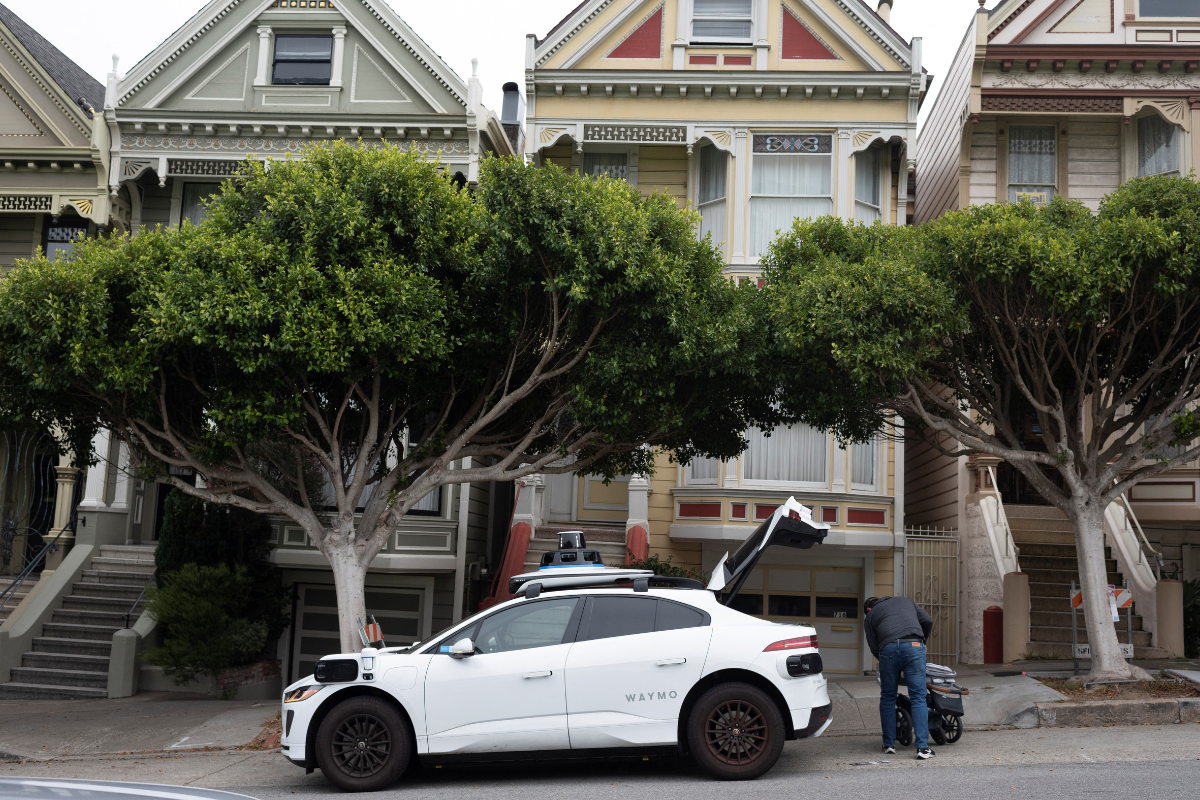

SAN FRANCISCO—Waymo recently announced a major expansion of its autonomous ride-hailing service across the San Francisco Bay Area and Los Angeles, to broader areas, including Sacramento and San Diego, but experts say it’s going to take time for the changes to reach riders for various safety and logistics reasons.
“My expectation is that they won’t expand immediately,” Scott Moura, a professor and PATH (California Partners for Advanced Transportation Technology) faculty director at the University of California, Berkeley, told The Epoch Times in an interview on Aug. 18.
“But at the same time, I would expect expansion on the order of not weeks, maybe months. And even in months, it’s not going to be in every corner of that region,” Moura said.
Waymo said Aug. 14 on X that Riders still need to wait for further notification for the real service expansion, which will be “gradual and guided by our safety framework.”
Waymo’s newly expanded map, or “operational design domain,” would allow its autonomous fleets to operate in the Bay Area’s all nine counties, and Sacramento and Yolo counties in Northern California.
The map also covers Los Angeles, Ventura, Orange, San Bernardino, Riverside, and San Diego counties in Southern California.
The most challenging parts for companies like Waymo are these autonomous vehicles driving on highways or bridges, said Moura.
“In the city, if the [autonomous] vehicle gets confused or becomes disabled, then it can always pull over, you know, and it’s relatively safe,” Moura said. “It might upset some people, but the risk of a crash is relatively small compared to if something happens on the highway and vehicles are driving at quite high speeds.”
Waymo recalled on June 17 over 3,800 vehicles that were programmed to drive autonomously on highways because they may “enter and drive at speed in freeway construction zones,” according to the National Highway Traffic Safety Administration (NHTSA).
“Waymo actually pulled back their operation on highways,” Moura said, noting that not many Waymos were seen on the highway, even though the company was approved on March 17, 2025, by the Department of Motor Vehicles (DMV) to operate in the area from San Francisco to San Jose.
Moura said a bridge could be even more dangerous if a vehicle stalls and cannot be moved.
East Bay, a region people are excited about having autonomous ride-hailing services, may be Waymo’s next move, he said.
There are three bridges from the Silicon Valley area to the East Bay: the Bay Bridge, the San Mateo-Hayward Bridge, and the Dumbarton Bridge.
“It’s possible that they basically operate kind of in an East Bay zone, and then they mitigate safety risks by limiting how many miles on the highway and also not going along the bridges until they gain an extreme level of confidence,” Moura said.

Waymo robotaxis sit parked at a Waymo facility in San Francisco on Dec. 8, 2025. (Justin Sullivan/Getty Images)
The San Diego Metropolitan Transit System has raised concerns about Waymo’s expansion to the California Public Utilities Commission (CPUC), saying that Waymo vehicles could shut down and/or block streets or light rail tracks, citing the situations Waymo vehicles caused during the 2025 San Francisco power outage.
Waymo also got approval from the DMV late last year for Zeekr Ojai, the company’s all-electric vehicle with a newer generation of autonomous-driving technology.
“Waymo is really trying to scale two things at the same time: a new generation of vehicles and a much larger geographic service area. That makes the expansion more complicated,” wrote professor Ahmed Banafa, an electrical and computer engineering professor at San Jose State University, in an email to The Epoch Times on Aug. 19.
Banafa said if a company has thousands of robotaxis operating 24 hours a day, seven days a week, it needs large charging facilities that can support dozens or potentially hundreds of vehicles charging at the same time.
“That puts pressure not only on charging stations but also on the electric grid,” he said.
Bonafa said he expected Waymo to expand its service area gradually over the next six to 18 months.
“We have to remember that getting regulatory approval to operate in an area doesn’t mean Waymo is ready to offer rides everywhere in that area,” he said.
Waymo did not respond to questions about its expansion plans before publication.
“Before our vehicles drive in a new area, our team works to understand the nuances of driving in that locale, and we update our software so our vehicles are capable of operating safely and appropriately,” Waymo wrote in its passenger safety plan sent to the CPUC for consideration in January.
CPUC approved an updated plan on Aug. 14, the last obstacle to Waymo implementing its expansion plan.