
Boeing has been awarded two contracts worth more than $7 billion to bolster the U.S. military, the Pentagon announced on Nov. 25.
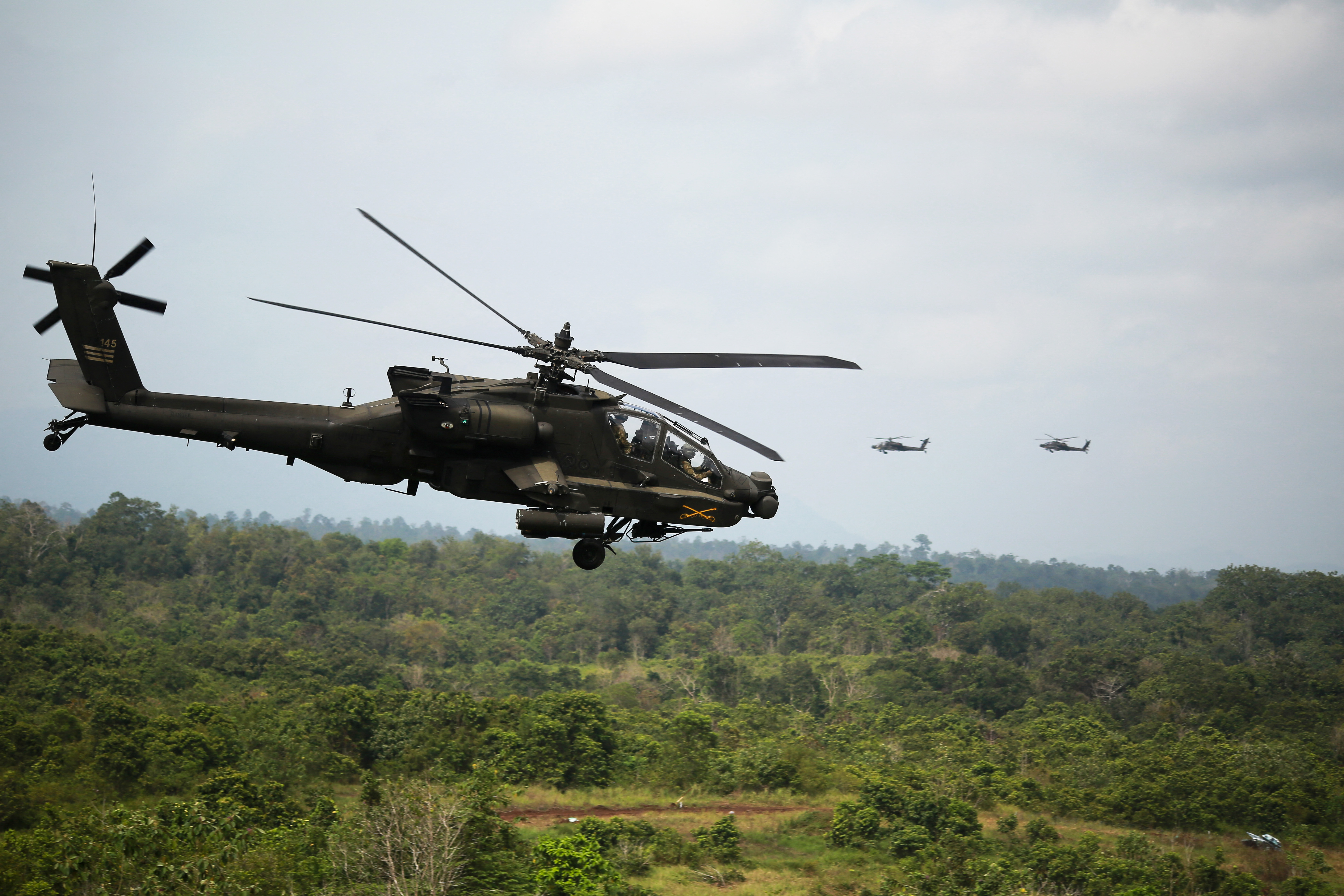
The aerospace giant received an almost $4.7 billion Army contract for new Apache AH-64E attack helicopters, Longbow crew trainers, and related equipment. The Pentagon also revealed that an additional $2.4 billion in Air Force contracts was awarded for Lot 12 Production Aircraft, G081 subscriptions, and licenses. This Air Force deal includes 15 more KC-46 Pegasus tankers.
The new contracts come after NASA announced on Nov. 24 that it was reducing its investment in Boeing’s beleaguered Starliner spacecraft and lowering the number of astronaut missions, opting to make the next trip to the International Space Station (ISS) a crewless one.
NASA’s turn towards SpaceX has not been the only headwind the company has faced; Boeing has also been hit by a strike over the past several months.
On Nov. 13, thousands of machinists based in the St. Louis region, where the company builds its military aircraft, voted to end a three-month strike that began in August. The workers had demanded better pay and schedules, and Boeing ultimately agreed to a deal that includes a 38 percent wage increase over four years and $12,000 bonuses. Workers returned to factories on Nov. 16.
The strike, which also shut down production in Washington state and Oregon, reportedly cost Boeing and its suppliers $9.7 billion. Boeing also makes B-52 bombers, F-18 fighters, and Chinook helicopters.
A recent audit by the Department of Defense Office of Inspector General criticized the company for considerable markups on C-17 Globemaster III parts, including charging 7,943 percent extra for soap dispensers, adding nearly $1 million in additional costs over several years.
The Air Force’s $11.8 billion contract from 2011 and a follow-up $23.8 billion deal through 2031 are not being re-opened over these additional costs, but the IG is urging stronger oversight of pricing. Boeing also agreed to pay a $51 million fine earlier this year for 199 arms export violations.
Foreign employees in China and elsewhere gained access to sensitive data on fighter jets, including the F-22, F-18, and F-15, as well as the AH-64 Apache helicopters and even Air Force One specs. Russia and Israel gained access to some of the leaks. Boeing has strengthened its procedures in the wake of the scandal through audits and the appointment of a special compliance officer.
In 2021, Australia stopped purchasing Airbus Tiger helicopters in favor of Boeing’s AH-64E Apache Guardian. Then-Defense Minister Linda Reynolds cited the Apache’s proven track record at the time.
Certain analysts argue that Boeing needs increased government support to stay afloat amid competition from China.
The company’s debt has skyrocketed to $57 billion since 2018, and the aforementioned strike is forcing layoffs that will affect 17,000 jobs. Boeing has also taken losses on some contracts, such as the KC-46 (over $7 billion) and Air Force One ($3 billion).
Reuters contributed to this report.