
Beijing has invited Taiwan’s largest opposition party leader to visit China in mid-April, reigniting concerns about the Chinese regime’s efforts to exploit Taiwan’s democracy to sow division amid political deadlock.
Chinese Communist Party (CCP) leader Xi Jinping has extended an invitation to Cheng Li-wun, chairwoman of Taiwan’s Nationalist Party, to visit the mainland from April 7 to April 12, Chinese state media Xinhua reported on March 30.
The Nationalist Party, also known as Kuomintang, which favors closer ties with the CCP, said in a statement that Cheng had “gladly accepted” Xi’s invitation.
In response to Cheng’s announcement, Taiwan’s presidential office spokesperson, Karen Kuo, told reporters that the government will “closely watch” the potential summit between Cheng and Xi, according to Taiwan’s national Central News Agency.
In coalition with a smaller party, the Nationalist Party holds a majority in Taiwan’s parliament, allowing it to approve or block government proposals. Taiwanese President Lai Ching-te’s plan to boost defense spending by $40 billion to counter threats from the Chinese regime has been held up by objections from the opposition coalition, triggering concerns among some lawmakers in Washington.
Beijing’s announcement of Cheng’s visit coincides with a trip by a bipartisan group of U.S. senators to Taiwanese capital Taipei. At a meeting with the Taiwanese president on March 30, they expressed hope that Taiwan could pass the stalled defense budget.
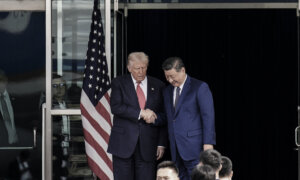
U.S. President Donald Trump has said he will go to China and meet with Xi on May 14 and May 15. While the topic of Taiwan didn’t come up during their summit in October 2025 in South Korea, Xi has used subsequent phone calls with Trump to emphasize Beijing’s stance on Taiwan.
Although it never ruled the island, the CCP claims Taiwan as part of its territory and that it will take the island by force, if necessary.
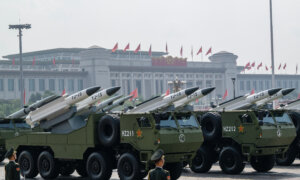
To exhaust Taiwan’s military and sap morale, China’s People’s Liberation Army has been conducting large-scale military exercises around the island and sending planes and warships near Taiwan on a near-daily basis. The regime’s intensified military maneuvers have sparked international concerns about a potential war in the Taiwan Strait, a key global shipping route.
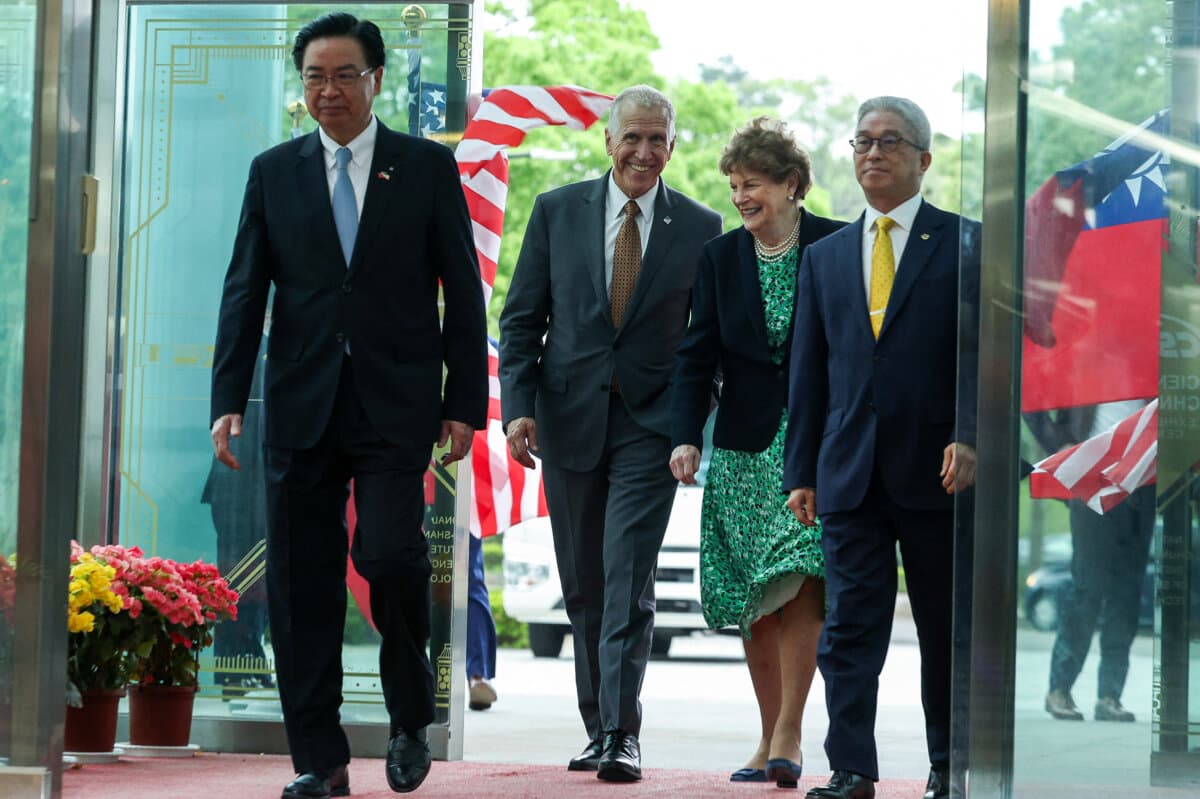
(L–R) Taiwanese Secretary-General of the National Security Council Joseph Wu (L) and U.S. Sens. Thom Tillis (R-N.C.) and Jeanne Shaheen (D-N.H.) arrive at the National Chung-Shan Institute of Science and Technology in Taoyuan, Taiwan, on March 30, 2026. (I-Hwa Cheng/AFP via Getty Images)
Speaking at a press conference later on March 30, Cheng said she would like to use her visit to show the world that the “two sides of the strait are not destined for war, nor do they need to remain on the brink of conflict.”
Cheng, who is preparing her party to challenge the ruling Democratic Progressive Party (DPP) in November’s local elections, defended her trip to China as consistent with the Nationalist Party’s longstanding stance on Beijing: opposing Taiwan independence and adhering to the “1992 consensus.” She refers to an informal, unwritten understanding reached that year between the CCP and Taiwan’s then-ruling Nationalist Party, which recognizes that there is only “one China,” but both sides could interpret what the “one China” is.
The ruling DPP, which refuses to recognize that vague agreement, said that while cross-strait exchanges are welcome, such engagements must take place on the basis of “equality and dignity, without political preconditions.”
It warned Cheng not to become a “pawn” in the CCP’s “united front” efforts to undermine Taiwan.
“As China exerts pressure on Taiwan and other nations in the region, it is also courting Taiwan’s opposition parties, urging them to accept a ‘common political foundation’ with Beijing,” the DPP said in a statement. “Its goal is crystal clear: to sow division within Taiwan and weaken our national unity.”
The DPP noted that over the years, China’s economic and military pressures have increasingly threatened the stability of the Taiwan Strait.
“If the Beijing authorities truly [seek] engaging with Taiwan and [are] genuinely willing to work together with all parties in the region—including Taiwan—to promote regional security and stability, they should immediately stop threatening us with the military aircraft and warships, respect Taiwan’s freedom and democracy, and honor the [Taiwanese] people—rather than orchestrating such showy such events designed to divide Taiwan,” it stated.
Frank Fang contributed to this report.