
Two lawsuits challenging Wisconsin’s congressional maps, which currently favor Republicans, who hold six of eight U.S. House seats in a politically divided state, may not be resolved ahead of the 2026 midterm elections.
Hearings held before three-judge panels on Dec. 12 revolved around schedules, as plaintiffs asked for new maps to be decided by March 2026 and defendants sought 2027 trials.
“We’ll decide them when we can decide them,” Dane County Circuit Judge Julie Genovese said of the pressure to issue a ruling or dismiss the case without further arguments.
One of the two lawsuits was filed by Wisconsin Business Leaders for Democracy, a progressive organization, against the Wisconsin Electoral Commission.
The organization contends that the current U.S. House of Representatives district maps violate the Constitution of Wisconsin and is seeking to have them nullified and redrawn ahead of the 2026 congressional general election in the state.
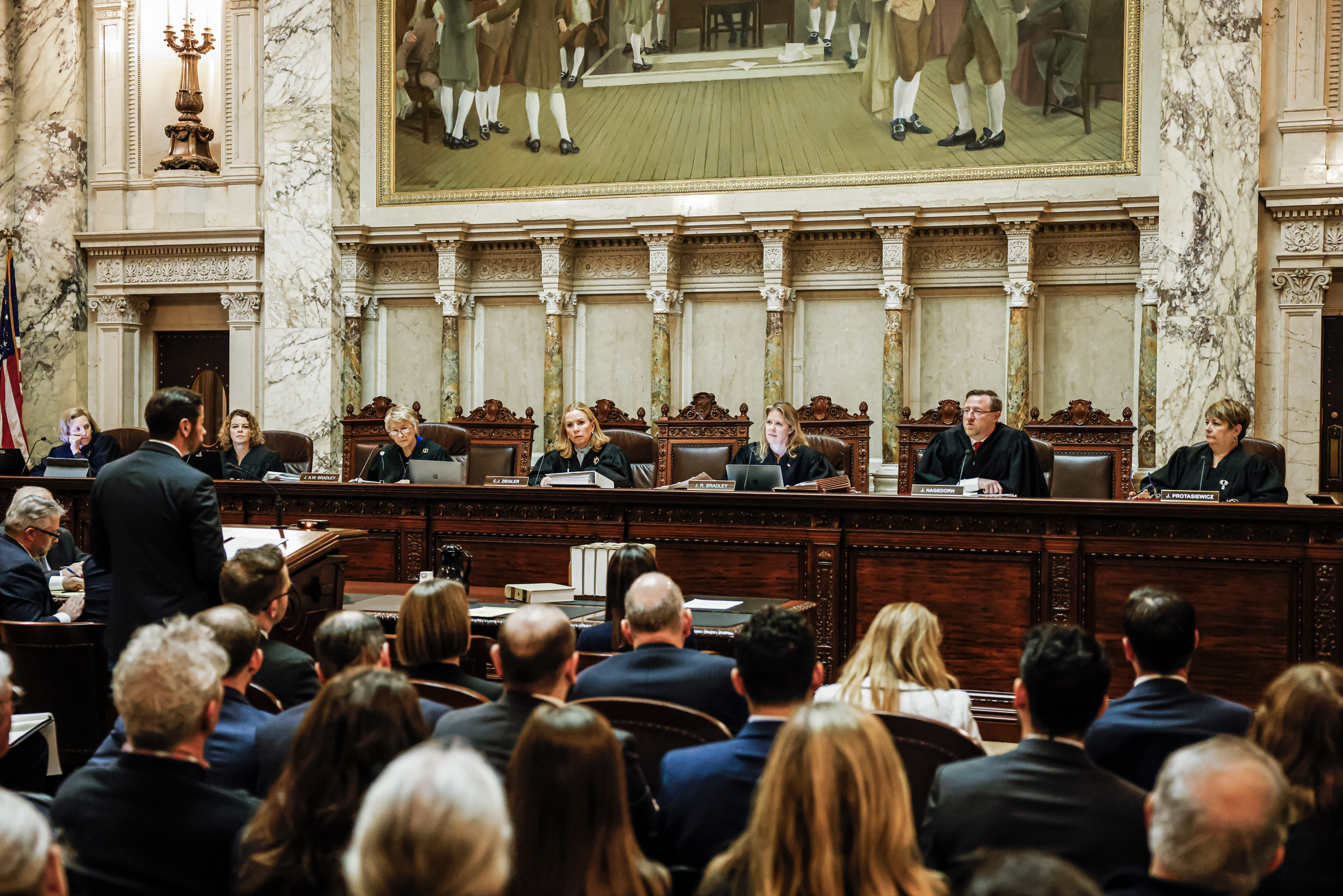
Under state law, cases regarding the “apportionment” of voters in an electoral district are initially heard by three-judge panels of state judges, after which an appeal may be made to the Supreme Court.
In orders on Nov. 25, the court declared that it would appoint such panels, which would meet at the Circuit Court of Dane County in the state capital, Madison.
It is unclear whether the panels will reach a final decision or whether the appellate process will be completed in time for the 2026 elections, which will be held on Nov. 3.
Redistricting cases usually require voluminous documentation to demonstrate how discrimination against a protected class of people has taken place in any given area or constituency.
Intervening in one of the lawsuits is U.S. Rep. Glenn Grothman (R-Wis.), who represents the 6th District of Wisconsin—covering many dairy farms and the cities of Oshkosh and Sheboygan—which is being targeted for reapportionment through the lawsuits.
Moving the district lines south, toward Madison and the Milwaukee metropolitan area, would increase the number of Democrats in the district and, thus, hurt his chances of reelection.
The order to issue the three-judge panels was decided by a vote of 5–2 on the court.
Justices Annette Ziegler and Rebecca Bradley, who are usually seen as conservatives, wrote separate dissents to criticize the court’s actions.
“Today is not a good day for Wisconsin’s judicial system. Our court has undermined its own constitutional authority in furtherance of affording the Democratic Party even more partisan political advantage than it already has with Governor Evers’ congressional maps in place,” wrote Ziegler.
“Redistricting and reapportionment authority belongs to the legislature—not the judiciary. It occurs after a census.”
Usually, congressional redistricting occurs every 10 years after the decennial U.S. Census, which measures population changes and apportions seats to states in the House of Representatives on that basis.
The last census was conducted in 2020, but in 2025, redistricting has occurred in several states at the behest of President Donald Trump to gain a political advantage for the GOP in the House.
Democrats have responded to thwart it.
“The majority ... entertains yet another kick at the redistricting cat. Unlike Schrödinger’s cat, this one most assuredly has been dead for years. I dissent,” wrote Bradley.