Commentary
You’ve probably seen the videos of the U.S. military blowing up alleged drug boats from Venezuela. And it looks like that’s just a small part of what’s going on.
U.S. warships have been moved nearby in the Caribbean. U.S. troops are carrying out drills in Puerto Rico. President Donald Trump declared that airspace over Venezuela is closed. And he even moved to designate the Cartel of the Suns as a terrorist organization, which also means that the United States now regards Venezuelan leader Nicolás Maduro as not only a cartel leader, but also a terrorist leader.
So, it’s fair to ask: What’s really going on? Is this about regime change? Is this about oil or resources? Or is it about drugs and stopping the cartels? Well, actually it’s all of those. But there’s also a lot more to it.
What we’re watching take place on the surface in Venezuela is just the tip of the iceberg. Some of this has ties to a war over oil that almost took place recently between Venezuela and Guyana. Some of this goes back to the Venezuelan election in 2018, when even the Biden administration recognized the government in exile with Juan Guaidó as the real winner. Then there’s the territory battle, as China, Russia, and Iran have built networks there and are acting to keep the United States out.
But to really understand this, we need to go back to what’s known as the “pink wave,” when socialist governments swept through Latin America in the late ’90s and early 2000s.
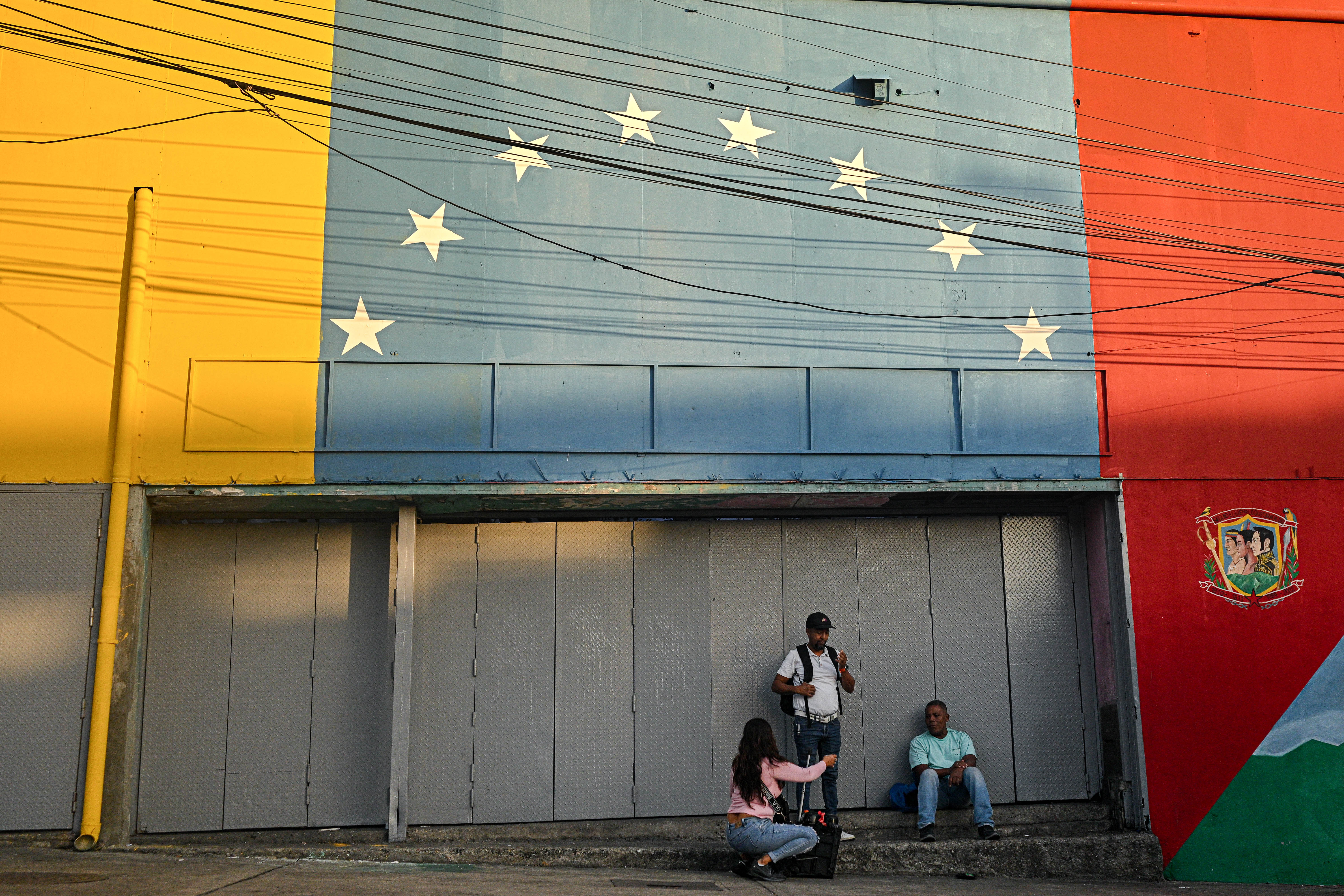
At the time, Venezuela was a very different place. It was one of the top rising economies in Latin America. It was also one of the most stable democracies in the region and a close U.S. ally. Most of the economy was in oil. Life, for most, was a lot better.
But bad spending and rising debt led to a downslide in the early 1980s. It didn’t get better. And in 1994, the country was hit by a banking crisis. People wanted affordability. And they turned to the guy who was promising to take from the wealthy and distribute it to the “people.” They didn’t realize that he would make things much, much worse.
Then the crash came. It was historic. A September 2024 report from Economics Observatory notes that Hugo Chávez “implemented exactly the wrong kind of macroeconomic policy during the 2000s and early 2010s, when Venezuela’s economy was booming due to the global commodity ’supercycle'—a prolonged period of high and rising prices of grain, metal, oil and gas.”
The results of this hit especially hard when Maduro first came into office in 2013. As the report notes, the collapse was historic. Living standards fell by about 74 percent between then and 2023.
The report states, “This is the fifth largest fall in living standards in modern economic history.”
It looked particularly bad for Maduro because the country wasn’t even at war. The collapse just involved a lot of bad economic decisions. It was socialism: extreme state control over all the workings of the economy, on both a micro and macro scale. And that heavy-handed approach was devastating.
But behind the scenes, something else was taking place, involving outside interests and backroom deals with communist states. It started before Chávez. But he made it part of his international strategy, breaking ties with the United States and establishing them instead with Cuba and other communist regimes.
According to a 2019 CNN report, this was part of a plan. Cuba’s Fidel Castro called it his “master trick on the gringos.” In fact, those were his words to former Venezuelan president Rómulo Betancourt. Castro wanted an oil deal to break Cuba’s economic dependence on the United States. Betancourt refused.
And it didn’t happen, at least not until Chávez came to power in 1998. Castro and Chávez became close friends. This also led them to form a new communist alliance for Latin America.
According to CNN, “Castro would eventually take the role of the elder statesmen, [with] Chávez his heir to the mantle of the leader of the Latin American left.” Lines between the two countries started to blur. Chávez even started referring to Venezuela and Cuba as one big homeland, or “La Gran Patria,” as he called it. And after the two leaders died, they had a replacement lined up. Chávez had handpicked a successor. That was Maduro.
This is also part of the huge power shake-up, and this is where the government in exile comes in. It explains why the United States—under both Trump administrations and the Biden administration—does not regard Maduro as the real leader of Venezuela.
The people of Venezuela knew that their country was cozying up to Cuba. They knew that Chávez had put his people into the oil industry, which imploded their economy. They knew that they were losing their country to outside Cuban influence.
That was part of the presidential platform of Guaidó. He had promised to end Cuba’s influence over Venezuela.
But that’s not so easily done. Because ending Cuban influence would also affect the influence of others—Russia, Iran, and the Chinese Communist Party (CCP). Breaking that would also mean bringing the sliding scale of global relations back to the United States. And that ties into a much broader battle for power taking place behind the scenes over Latin America.
You see, Venezuela had been a model country of sorts for the Monroe Doctrine, the U.S. policy that holds that Latin America is the backyard of the United States. According to the Monroe Doctrine, the communist bloc shouldn’t meddle in it.
Before Chávez, that was also where Venezuela stood. During the Cold War, the country did not have good relations with the Soviet Union. Venezuela held a pro-Western stance. Communist parties and movements in the country were even suppressed.
Chávez didn’t technically get rid of the Monroe Doctrine. He really couldn’t, since it’s not a law or treaty. It’s just a stated U.S. policy going back to 1823. Basically, it declared that the new world is off-limits to any new colonization or interference from Europe. And that also carried into the Cold War. But when Chávez came around, he declared that the U.S. policy was dead.
In 2006 at the U.N. General Assembly, Chávez even openly lashed out at the American system, claiming that the people of Latin America would declare, “Yankee imperialist, go home.”
He also moved to build new forms of order without the involvement of the United States or Canada. These included the Union of South American Nations and the Community of Latin American and Caribbean States. Venezuela and Cuba also established the Bolivarian Alliance for the Peoples of Our America. These were all built as direct challenges to the United States, to push it out of Latin America.
From that void, other powers stepped in, and Chávez also worked to facilitate this. He signed more than 200 military cooperation agreements with Russia. He allowed Iran to open factories and banks in the country. And he established military and intelligence ties to the CCP, signing hundreds of agreements with the Chinese regime. And after Chávez helped establish the CCP’s presence, Venezuela became a testing ground for the CCP to spread its control using the Belt and Road Initiative (BRI), infrastructure deals designed with debt traps.
When Chávez died, the CCP continued to deepen its foothold using the BRI. Venezuela sold out. The CCP’s BRI was used to replace the American Monroe Doctrine policies. And Venezuela fell into poverty, crime, and ruin.
This was also part of a broader shift. With the Cuban and Venezuelan network pushing out America and bringing in Russia, Iran, and the CCP, other far-left leaders—similar to Chávez and Maduro—had been taking power in Latin America. These included Luiz Inácio Lula da Silva in Brazil, Néstor Kirchner in Argentina, Evo Morales in Bolivia, Rafael Correa in Ecuador, and others elsewhere.
These leaders had the same basic agenda: Reject the Monroe Doctrine and bring in the CCP’s BRI programs. That meant loans and investments that were designed to never be repaid. When BRI countries default, they fall deeper and deeper under the control of the CCP.
Many of the rising far-left and communist policies had emerged from somewhere else. After the Berlin Wall fell, the global communist block tried to find ways to hold their regimes together. In Latin America, this took the form of the Foro de São Paulo, founded in 1990 by Lula in Brazil and Castro in Cuba. It established a new communist international conference for the region, bringing together more than 100 leftist parties, organizations, and movements. That included Marxists, socialists, even narco-terrorist organizations such as the Revolutionary Armed Forces of Colombia and the Cartel of the Suns.
The Foro de São Paulo was formed with the objectives Chávez had after working with Castro. It was designed to push out the United States and push for the election of far-left regimes.
The CCP fanned the flames. The regime even used its China Development Bank to give billions of dollars in loans to pink tide governments. It worked to get them funding without conditions from the International Monetary Fund. This helped the new regimes look good to the public as they grew and spread and as the CCP continued pulling them deeper into debt.
But the realities of the bad deals were doomed to show themselves, and this came to the forefront in the 2018 Venezuelan elections. Guaidó ran on a platform to fix the broken socialist policies and root out Cuban influence. He won the election; Maduro stole it back. Mass protests erupted on the streets in 2019 as Guaidó tried to establish an interim government. Maduro then crushed the opposition using pro-government militias with alleged ties to the Cartel of the Suns.
This occurred during Trump’s first term in office. He threatened to invade Venezuela to re-establish order, oust Maduro, and allow for the transition in power to Guaidó.
Maduro then asked for outside help. Russia made a show of force against the United States and sent two nuclear-capable Tu-160 strategic bombers to Venezuela. Moscow also provided arms sales, military advisers, and aid to maintain the Maduro regime. Russia warned that it would stand by Venezuela and that U.S. intervention would have “catastrophic” results.
The CCP also intervened, but mainly on the diplomatic stage, making calls against any potential U.S. intervention. Maduro stayed in power. The economic problems and the national decline only got worse. Guaidó would later flee to Florida.
Trump ended up not intervening, but in 2020, the U.S. Department of Justice announced criminal charges against Maduro and 14 current and former Venezuelan officials. The charges included narco-terrorism, corruption, drug trafficking, and other crimes. The Justice Department even stated that Maduro and other Venezuelan officials had “allegedly partnered with [the Revolutionary Armed Forces of Colombia] to use cocaine as a weapon to flood the United States.”
Years later, when Trump was back in office in 2025, the U.S. Treasury Department intensified the U.S. stance against Maduro. It announced sanctions against the Cartel of the Suns, called it a global terrorist organization, and declared that Maduro was the leader of the cartel and terror group.
The terror designation was enhanced in November 2025 with an official announcement from the State Department.
But this also had some deeper context, going back to before Maduro was declared the leader of the Cartel of the Suns. Before the terror designation. Before the U.S. airstrikes on the drug boats. A war was about to break out in South America. Venezuela was preparing to invade Guyana, just to its north.
In 2015, Guyana discovered one of the largest oil reserves in the world: an estimated 700 million barrels recoverable, according to early estimates. Many companies were there doing oil discoveries, including Exxon. And in the throes of economic turmoil, Maduro wanted it.
In December 2023, Maduro held a referendum and claimed that voters had overwhelmingly supported a policy to have Venezuela annex Guyana’s oil-rich Essequibo region. The policy would also reject an order from the International Court of Justice in the territorial dispute. Under the referendum, Maduro announced plans to deploy military forces to Guyana and then authorize Venezuelan state-owned companies to exploit oil and gas there.
The declaration was enhanced by military threats. Venezuela began conducting military exercises on the border of Guyana. The Venezuelan navy had begun launching incursions near Guyana’s Exclusive Economic Zone and near the ExxonMobil oil rigs. War was looming.
In March 2025, the United States issued a warning. U.S. Secretary of State Marco Rubio said at a news conference: “It will be a very bad day for the Venezuelan regime if they were to attack Guyana or attack ExxonMobil. ... It would be a very bad day, a very bad week for them. And it would not end well for them.”
While Rubio declined to give more details, he said that the U.S. Navy “can get anywhere in the world“ and that the United States has ”commitments that exist today with Guyana.”
Venezuela didn’t listen. And the U.S. strikes began. The first was on Sept. 2, 2025. Trump posted U.S. military video footage of a strike on a Venezuelan drug boat.
That has now expanded. The United States is moving military assets to carry out ground strikes in Venezuela. And Trump has warned Maduro that his days are numbered.
Here’s why what’s happening in Venezuela really matters. The country was the channel to break regional ties with the United States throughout Latin America and to import influence from the alternate world order through Russia, Iran, and the CCP.
It used to be that Cuba was the main bastion of communism in the region, but because of the bad economy and lack of military strength, it was limited in what it could do. Venezuela brought the money, at least in the early years. Chávez, Castro, and Lula were able to expand a communist-aligned order, funded by drugs and oil, that would push the United States out.
But that order is now collapsing. And it seems that the U.S. operations, although partly about sanctioning oil and destroying the drug networks, are also about rebuilding U.S. influence and presence in Latin America.