News Analysis
As wars in Ukraine and Gaza drive demand for weapons, most of the world’s largest arms companies are selling more than ever, while China’s arms giants are seeing their sales shrink.
Revenues for the top 100 arms producers rose by 5.9 percent to a record $679 billion in 2024, according to new data from the Stockholm International Peace Research Institute (SIPRI) released earlier this month. China stands out as the big exception: the combined arms revenues of the eight Chinese companies on the list fell by 10 percent to $88.3 billion, the largest drop among major arms-producing countries.
Analysts say the decline reflects three overlapping problems for the Chinese regime’s defense industry: Chinese leader Xi Jinping’s corruption purge, which is freezing and delaying contracts; a slowing economy that is forcing hard choices inside the People’s Liberation Army (PLA); and Chinese weapons that are struggling to compete overseas.
They told The Epoch Times that these problems may slow China’s military buildup or push some programs beyond Beijing’s original goal of building the capability to take Taiwan by force around 2027.
SIPRI’s new ranking shows that North American and European companies raised their arms revenues in 2024, with sharp increases in countries such as Japan and Germany. Asia–Oceania was the only region where total arms-industry revenue fell, and SIPRI says that was “almost entirely” because of China’s 10 percent decline.
Among China’s eight listed companies, some were hit especially hard. China North Industries Corporation (NORINCO), the country’s biggest producer of land weapons such as tanks, artillery, and armored vehicles, saw its arms revenue fall by 31 percent last year.
Aviation Industry Corporation of China (AVIC), the main military aircraft maker, and China Aerospace Science and Technology Corporation (CASC), which builds missiles and space systems, also reported lower sales.
Only two companies grew: China State Shipbuilding Corporation (CSSC), which builds warships and submarines, and Aero Engine Corporation of China (AECC), which makes jet engines, each with high single-digit growth.
Anti-Corruption Purges Freeze Contracts
For more than a decade, Xi’s anti-corruption campaign has removed senior officials across government agencies and the PLA. In recent years, it has hit the strategic Rocket Force, which oversees China’s ballistic and hypersonic missile arsenal, as well as other top commands.
The corruption allegations in Chinese arms procurement “led to several major arms contracts being postponed or cancelled in 2024,” according to Nan Tian, director of the SIPRI Military Expenditure and Arms Production Program.
Shake-ups at NORINCO and CASC prompted Beijing to review contracts and schedules, slowing deliveries and adding uncertainty about when new systems will actually reach combat units, said Mark Cao, a U.S.-based military-tech analyst, former materials engineer, and host of Chinese-language military-news YouTube channel “Mark Space.”
“Once senior executives and generals are purged, many contracts are likely to be reviewed, cancelled, or have their prices adjusted, which shows up quickly in sales figures,” Cao recently told The Epoch Times.
He sees the anti-graft campaign as a tool to purge political rivals.
“Whatever the motive, the effect is that officials become cautious, paperwork slows down, and big programs are delayed,” he added.
The drag is not limited to state giants.
Since last year, the PLA has suspended more than 100 suppliers from bidding on military contracts, according to Taiwan’s government-run Central News Agency, citing notices on the PLA’s procurement network.
Prominent institutions such as the Chinese Academy of Sciences’ Institute of Mechanics, Beijing Institute of Technology, Beijing Jiaotong University, Harbin Institute of Technology, and Harbin Engineering University have had their bidding rights frozen over allegations of bid rigging, collusion, and improper benefit transfers.
That kind of punishment disrupts the research and supply chain behind many weapons projects, Cao said.
Budget and Strategy Sideline the Army
The second problem is money and priorities, Cao said, noting that China is still the world’s second-largest military spender, but a weaker economy makes it harder to stretch even a growing defense budget.
SIPRI estimates Beijing spent about $314 billion on its military in 2024, the 30th straight year of rising defense outlays. At the same time, growth is slowing, and local governments are weighed down by debt and a slumping property sector.
Cao pointed out that this is evident in the PLA’s equipment orders; for example, NORINCO’s steep revenue drop suggests that purchases of tanks, artillery, and other ground-force gear have been cut back.
In his view, that aligns with Beijing’s shift in focus: if a conflict over Taiwan is the primary scenario, the Navy, Air Force, and Rocket Force become the main priorities, making the PLA more vulnerable when budgets are cut.
Recent wars support that logic, Cao added, pointing out that the fighting in Ukraine has made drones, precision missiles, long-range rockets, and unmanned surface vessels central to modern warfare.
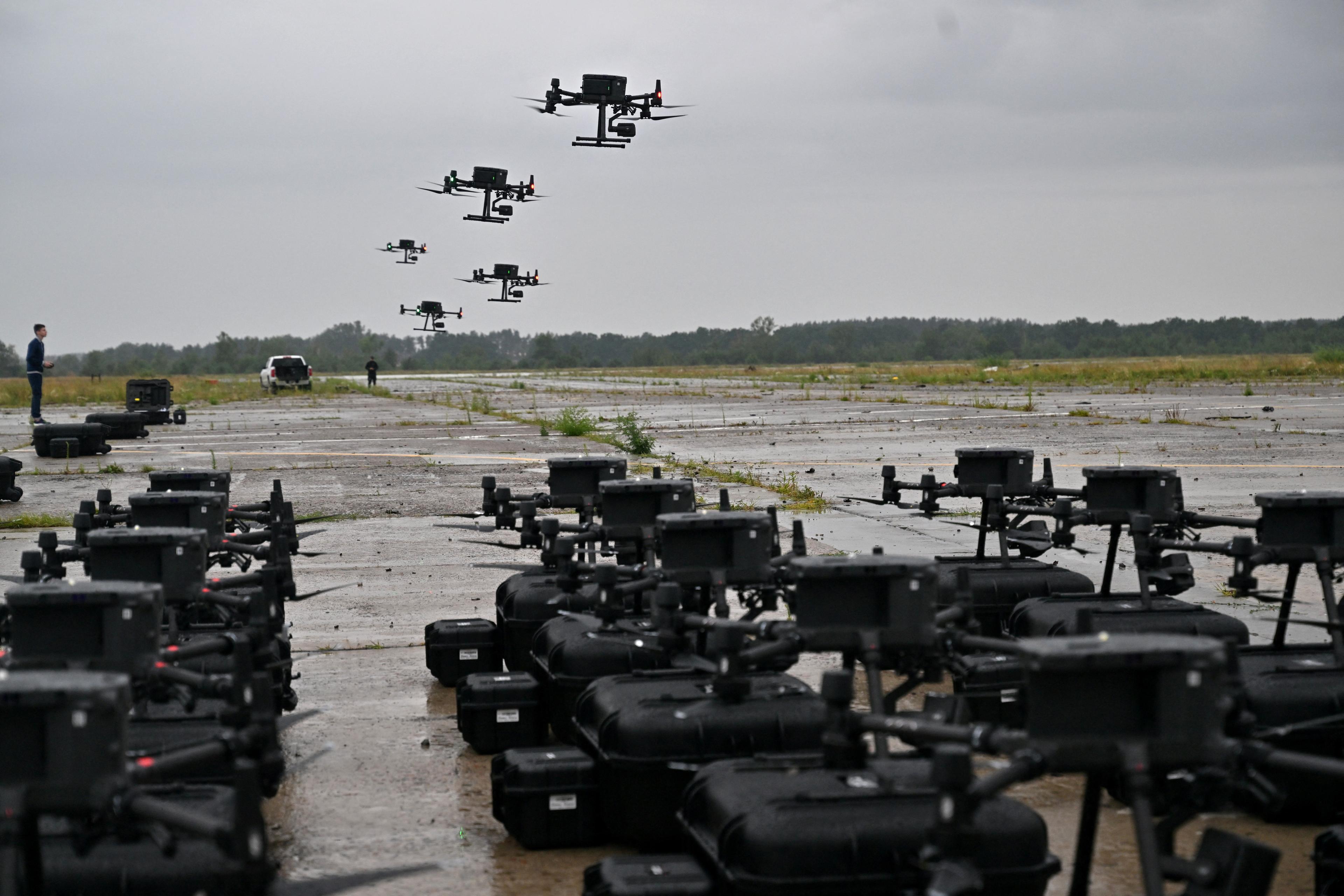
DJI Matrice 300 reconnaissance drones are seen during test flights prior to being sent to the front line, in the Kyiv region on Aug. 2, 2022. (Sergei Supinsky/AFP via Getty Images)
Cao noted that Beijing has poured money into drones and other unmanned systems, but NORINCO is less competitive in those areas. Traditional artillery, shells, and small arms are no longer where the growth is.
Meanwhile, Cao added, China’s weak economy and fiscal strain have a “decisive” impact on its defense industry as a whole. If Beijing has to make cuts, the PLA’s equipment programs are likely to shrink first.
“Beijing will try to keep officers’ and soldiers’ pay steady to preserve loyalty and morale, which means weapons procurement becomes the main place to find savings,” he said.
High Output, Weak Demand for Chinese Arms
The third drag on China’s arms companies is exports.
SIPRI data show that between 2019 and 2023, China was the world’s fourth-largest supplier of major weapons, accounting for about 5 to 6 percent of global exports. Most sales went to Asia, and well over half to a single customer, Pakistan.
On paper, China is still a major exporter, but in reality, Chinese weapons “are not very welcome” in many markets, Su Tzu-yun, director of Taiwan’s Institute for National Defense and Security Research, told The Epoch Times.
He said Russia’s poor performance in Ukraine has hurt the appeal of Russian-style systems across the developing world. Many Chinese designs follow older Russian lines, so when buyers see Russian tanks and missiles being destroyed, Chinese copies lose shine as well, he noted.
At the same time, South Korea has moved into markets once dominated by Russian and Chinese companies. Seoul has signed multibillion-dollar deals with Poland for K2 tanks, K9 howitzers, and FA-50 jets, giving Korean companies a strong foothold among NATO members and raising expectations on quality and delivery speed.
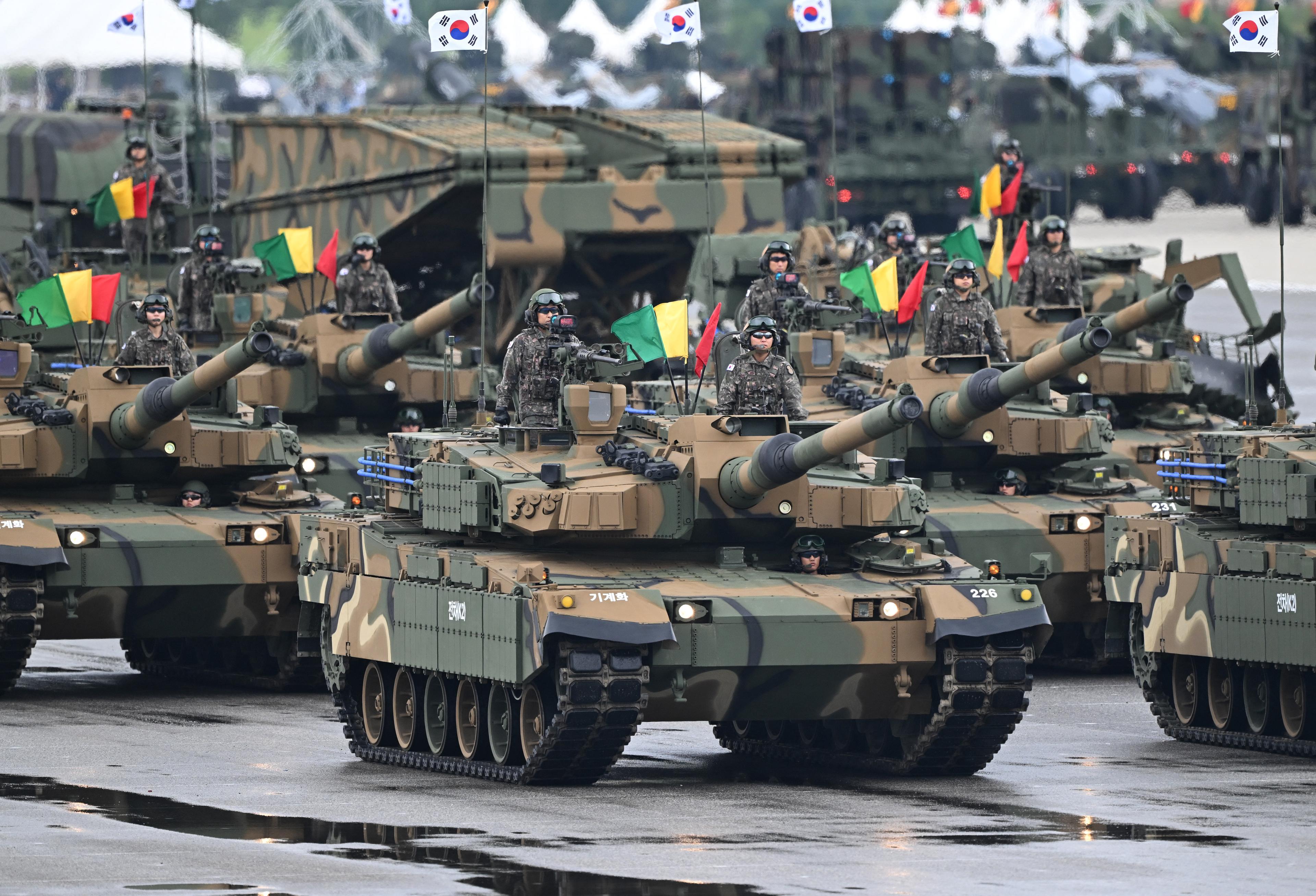
Visitors watch South Korea's K2 tank during a ceremony to mark the 76th anniversary of Korea Armed Forces Day at Seoul Air Base in Seongnam on Oct. 1, 2024. (Jung Yeon-je/AFP via Getty Images)
Su said another problem is that some Chinese weapons already delivered have had quality issues, including what he describes as “corner-cutting” in production. That has led some foreign customers to pause new purchases. Inside China, the removal of senior generals has also disrupted the command chain, and some systems’ real performance is now being reexamined.
He says that this mix of weak demand abroad and internal review at home is a key reason for the drop in overall revenues.
2027 Goals Face Delays, Not a Change of Course
The year 2027 marks the 100th anniversary of the PLA’s founding, and the Chinese Communist Party (CCP) has tied it to targets for building a “modern” fighting force. Some analysts fear that by that time, the CCP may want at least the option to use, or threaten to use, force to bring Taiwan under its control.
Cao said the CCP’s overall trajectory has not changed—its military budget continues to rise, and modernization remains a top political priority.
SIPRI’s latest figures show that China and the United States together account for almost half of global military spending, and China has already built the world’s largest navy by ship numbers and fielded new generations of missiles and drones.
“A few years of weaker revenue at some state firms will not undo those gains,” Cao said.
For Cao, none of this makes the CCP less dangerous. Economic stress and corruption scandals may make China’s buildup less efficient, he said, but they can also push the authorities to lean more on nationalism and external crises to divert attention from domestic problems.
He points to Russia’s invasion of Ukraine as an example of a regime under pressure choosing war rather than restraint.
“Dictators don’t care about their people’s lives,” he said. “That’s where the danger lies.”
Ning Haizhong and Luo Ya contributed to this report.