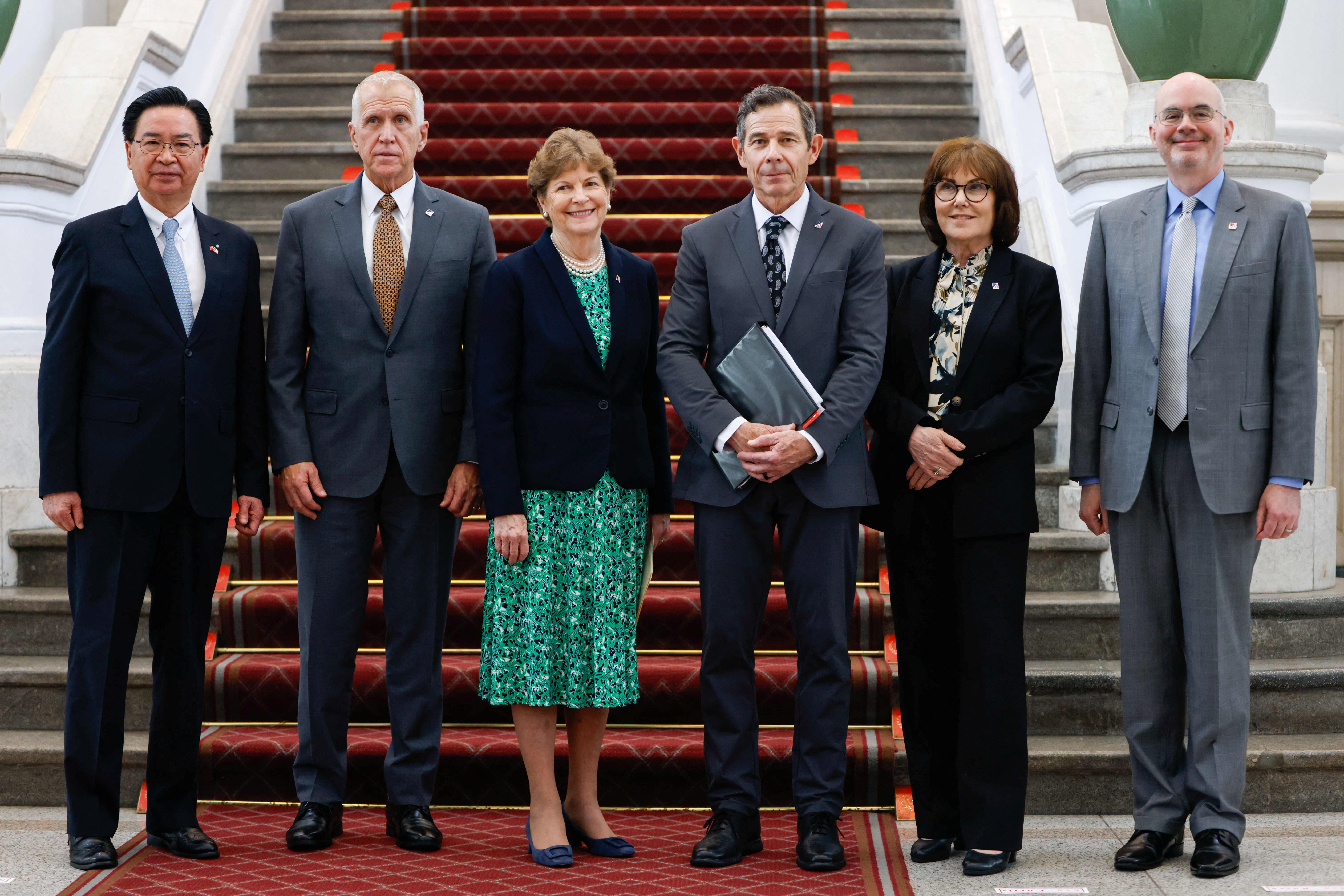

TAIPEI, Taiwan—A bipartisan group of U.S. senators met with Taiwanese President Lai Ching-te on March 30, amid a legislative deadlock over competing defense budget proposals as the island faces rising military pressure from China.
The U.S. delegation—headed by Sen. Jeanne Shaheen (D-N.H.), ranking member of the Senate Foreign Relations Committee, and Sen. John Curtis (R-Utah)—urged Taiwan’s parliament, the Legislative Yuan, to pass Lai’s proposal for extra defense spending of $40 billion.
“We’re here to enforce that message and demonstrate to the people here in Taiwan that we are together a very important part of the safety and the unity around this world,” Curtis said at a press conference in the presidential office in Taipei after meeting Lai.
“I'd like to personally endorse the special defence budget and tell you back in Washington, D.C., that my colleagues are watching, that this is important. We want to make sure that as we invest in this part of the world, that you are also investing and that we’re in this together.”
The U.S. delegation, which also included Sens. Thom Tillis (R-N.C.) and Jacky Rosen (D-Nev.), arrived in Taipei on March 30 for a two-day visit.
According to the American Institute in Taiwan, Washington’s de facto embassy on the island, senators will meet with senior Taiwanese leaders to discuss key issues, including bilateral relations, regional security, trade, and investment.
The senators’ visit comes as Lai’s ruling Democratic Progressive Party (DPP) and the opposition are mired in a rare political crisis. The opposition, which consisted of the Kuomintang party (KMT) and its much smaller ally, the Taiwan People’s Party, has used its majority in parliament to block or stymie key government proposals, including the budget.
Lai announced his special defense budget in November 2025. Since then, the KMT and the Taiwan People’s Party have put forward proposals at lower prices: NT$380 billion ($11.8 billion) and NT$400 billion ($12.4 billion), respectively.
Despite the legislative impasse, the Taiwanese parliament has cleared four U.S. arms deals totaling about $9 billion.
“We are concerned by the increased pressure from Beijing, including military activity around Taiwan that raises the risk of miscalculation,” Shaheen said after meeting Lai.
“The strong relationship between the US and Taiwan has spanned decades. Our clear and bipartisan message on this trip is that this relationship will be sustained for decades to come.”
Shaheen and Tillis were among a bipartisan group of 37 senators who sent a letter to leaders of Taiwan’s three parties in February, urging them to support the special defense budget.
Tillis pointed to the ongoing war in Ukraine, arguing that a shortfall in NATO’s defense spending over two decades “may be one of the reasons that [Russian President] Vladimir Putin felt safe in his incursion into Ukraine.”
“Taiwan must continue to invest in its own defense capabilities, as deterrence is essential to maintaining stability,” Rosen said.
“We know that Taiwan faces many threats, including the so-called gray zone tactics like cyber attacks, disinformation, and attacks on subsea cables.”
China’s cyberarmy carried out a daily average of 2.63 million cyberattacks on Taiwan’s critical infrastructure in 2025, according to the island’s National Security Bureau.
Before meeting with the senators, Lai told reporters at the presidential office that his defense budget plans were aimed at more than just purchasing U.S. military equipment and building a sophisticated, multi-layered missile defense system.
The plans also include investments in Taiwan’s indigenous defense industry and efforts to integrate collaboration between Taiwan and the United States in the artificial intelligence and defense sectors.
Lai called on the Legislative Yuan to support his plans across party lines.
“This will signal to the international community—especially the U.S. administration and Congress, who have so steadfastly supported Taiwan—that we are firmly committed and determined to advance our self-defense capabilities, and that we are undaunted by the threats we face,” Lai said, according to a translation.
In Beijing, Mao Ning, spokesperson for the Chinese regime’s foreign ministry, reiterated opposition to any form of official exchanges between Taiwan and the United States when asked about the U.S. delegation’s trip to Taiwan.
KMT Chairperson Cheng Li-wun is scheduled to travel to China next month to meet with Chinese leader Xi Jinping.
U.S. President Donald Trump will meet with Xi in China from May 14 to 15, their second bilateral meeting of Trump’s second term. Their first took place in South Korea in October 2025.
Reuters contributed to this report.