

The Trump administration has revoked the visa of a Chinese national working for Beijing’s state-run news agency Xinhua in the United States.
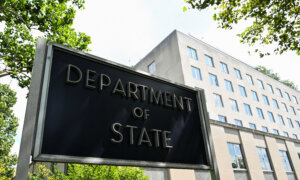
The State Department told The Epoch Times in a statement on June 1 that the administration “has the strongest commitment to the freedom of expression.”
“We will continue to insist on a relationship with China based on fairness and reciprocity, putting the American people first. We cannot accept the continued lack of reciprocity for U.S. media in China, nor any attempts by the Chinese authorities to silence U.S. media.”
The move comes months after Beijing expelled a New York Times reporter. In a recent article discussing China’s expulsion of China correspondent Vivian Wang in February, The New York Times said it didn’t request any U.S. government retaliation, but it did issue a statement on Friday calling for Wang to be reinstated as a credentialed journalist in China and urging both governments to “reverse this deterioration in journalist access.”
The State Department didn’t answer questions on whether the Chinese reporter’s visa cancellation was a tit-for-tat action.
Chinese officials told The New York Times that the decision to expel Wang was a response to Taiwan President Lai Ching-te’s video appearance at The New York Times’ DealBook summit in December last year, according to the paper, which noted that Wang “played no role in the event.”
At the DealBook summit, Lai said China’s military drills around Taiwan were becoming “increasingly frequent and intense,” while Beijing’s “united front” influence operations against the democratically governed island were becoming “more serious,” according to a transcript from Taiwan’s presidential office.
At a regular briefing on June 1, Lin Jian, spokesperson for the Chinese regime’s foreign ministry, accused the outlet of providing Taiwanese officials a platform to “peddle separatist rhetoric.” Lin also accused Wang of breaking a local law governing foreign media and foreign journalists.
The Chinese Communist Party (CCP), which claims Taiwan as a province of its own, has labeled Lai a “separatist” for his outspoken defense of the island’s sovereignty.
Lin also responded to the U.S. expulsion of the Xinhua reporter by accusing Washington of engaging in “political suppression” against Xinhua journalists.
The State Department also pointed to the disparity in conditions under which U.S. reporters work in China compared with Chinese journalists in the United States.
“China has long imposed onerous restrictions on foreign journalists operating in China, including those working at U.S. media organizations,” the department said. “Journalists routinely report harassment, monitoring, and intimidation, especially when reporting on topics that the Chinese Communist Party deems ‘sensitive.’”
In April, the Foreign Correspondents’ Club of China issued a statement criticizing the Chinese regime for a “spate of targeted attacks on press freedom,” citing incidents including temporary detention and visa revocations.
‘Information Vacuum’
In China, the U.S. media presence is thin. All foreign journalists in China are required to obtain accreditation from Beijing’s foreign ministry. The Chinese regime has used accreditation and the visa process to deny entry or expel foreign journalists whose work has upset the CCP or to punish what the regime considers unfavorable coverage of it.
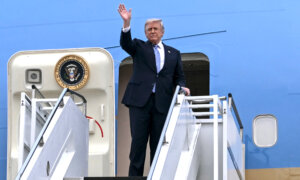
In May, at least 20 White House press members who planned to cover the summit between President Donald Trump and Chinese leader Xi Jinping, including staff members of The Epoch Times and its sister media outlet NTD, did not receive visa approval.
Xinhua was among 15 CCP-controlled media designated as foreign missions by the first Trump administration in 2020. At the time, a State Department spokesperson pointed out that Western and Chinese media are different, as the former are “beholden to the truth” while the latter are “beholden to the Chinese Communist Party.”
The designations underscored the broader principle of reciprocity that shaped the first Trump administration’s approach to the Chinese regime. Another example was the 2020 closure of the Chinese Consulate in Houston, carried out in response to espionage activities linked to the facility.
Theresa Fallon, director of the Center for Russia Europe Asia Studies, welcomed the Trump administration’s decision to revoke the Xinhua reporter’s visa.
“Finally—a US administration is using reciprocity,” Fallon wrote in an X post on May 30.
“Beijing denies many foreign media companies visas if they don’t like their reporting. This has led to an information vacuum in which the Chinese Communist Party actively shapes its own narrative, what many call propaganda.”
Trump’s National Security Strategy, released in December last year, stated that the administration aims to “rebalance America’s economic relationship with China, prioritizing reciprocity and fairness to restore American economic independence.”
During Trump’s talks with Xi earlier this month, the two leaders agreed that Iran must not obtain a nuclear weapon and emphasized the need for a relationship between the two countries based on “fairness and reciprocity.”
Peter Mattis, president of The Jamestown Foundation, suggested that the Trump administration should have taken a more “proportional response” instead.
“A narrowly reciprocal 1-to-1 response,” Mattis wrote on X on May 30. “A proportional response would have been to remove a corresponding percentage of state ‘journalists’ from US.”
The Congressional-Executive Commission on China on May 29 warned about the consequences of the CCP’s restricting freedom of the press.
“When foreign journalists are expelled and the free flow of news and information is restricted, it sets dangerous limits on what the world knows about China and what the Chinese people know about the world,” the commission wrote on X.
The Associated Press contributed to this report.