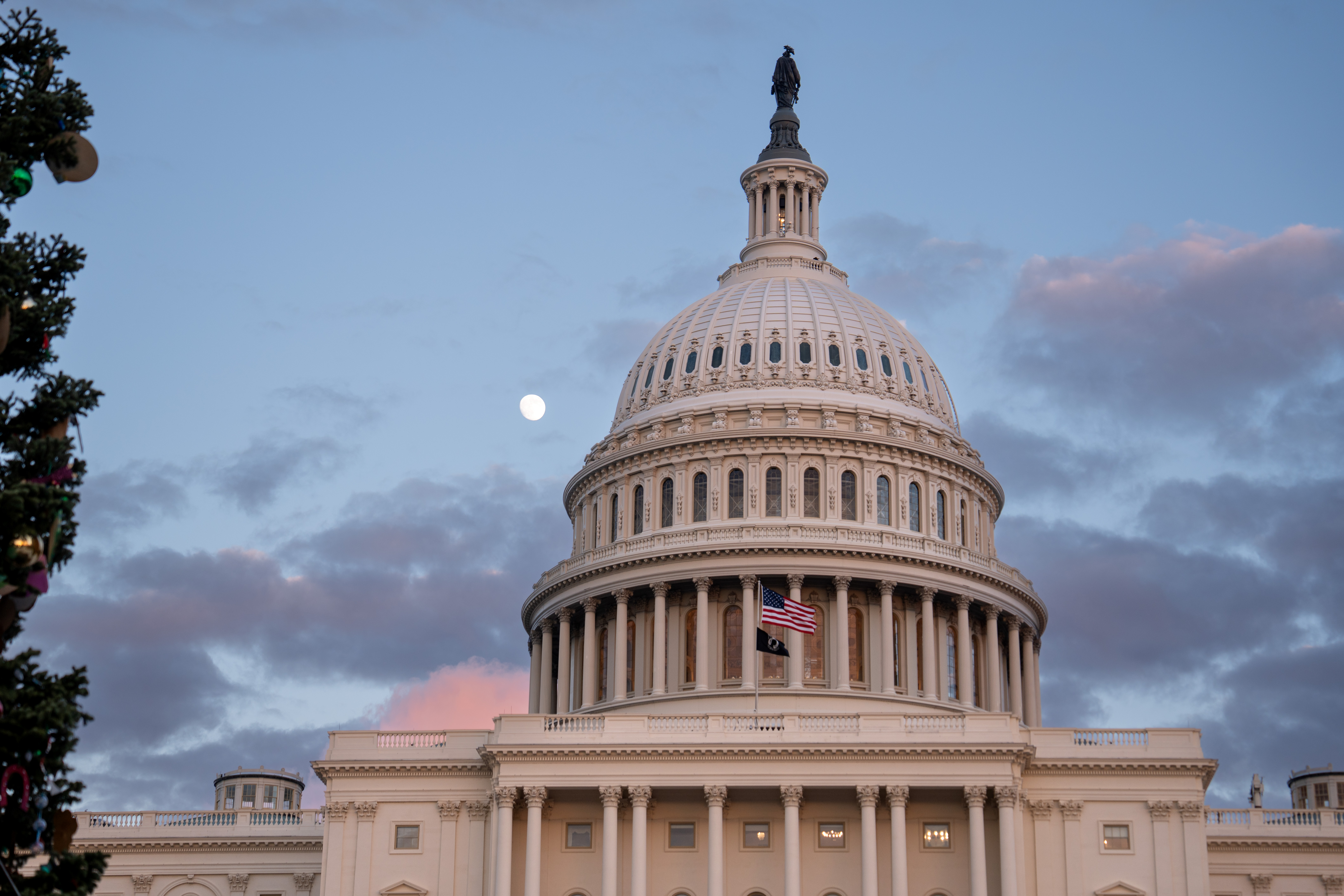
The House passed the fiscal year 2026 National Defense Authorization Act (NDAA) on Dec. 10, tying the defense bill to several provisions aimed at curbing the Chinese communist regime’s influence in key U.S. sectors or ending fiscal support for the regime’s human rights abuses by American consumers.
The Senate is set to take up the defense package next. Here are the China-related provisions included in Congress’s bill.
Restricting Investments in Chinese Tech
The Outbound Investment National Security Act included in the massive defense package aims to prevent U.S. dollars from funding “dual-use strategic technologies that benefit a foreign adversary’s military modernization efforts, surveillance states, and human rights abuses.”
It prohibits U.S. investment in Chinese entities that pursue advanced technology, such as Chinese AI companies, to be determined by relevant agencies.
The Select Committee on the Chinese Communist Party (CCP) has advanced similar legislation in the past, and committee chair Rep. John Moolenaar (R-Mich.) welcomed its inclusion.
“For too long, the hard-earned money of American retirees and investors has been used to build up China’s military and economy. This legislation will help bring that to an end,” he stated.
Derisking the Supply Chain
The bill will prohibit purchases of certain critical minerals—molybdenum, gallium, and germanium—from “non-allied foreign nations.” Exceptions will be made for certain magnets or if the materials are obtained from recycling scrap metal from approved countries.
U.S. lawmakers and officials have said that derisking the critical mineral supply chain from China will have to be done with partner countries and will require government support by way of price floors or other mechanisms.
The Pentagon will also be required to report the sourcing of castings and forgings, missiles and munitions, energy storage and batteries, microelectronics, and other strategic and critical materials, and ensure it has multiple sources for these critical sectors unless a waiver is granted.
The bill mandates prioritizing the establishment of production of sensitive military munitions.
No More Chinese Computers, Seafood
A provision in the NDAA would generally prohibit the Pentagon from buying and selling Chinese seafood, which lawmakers have said addresses the CCP’s known practice of forced labor.
In 2023, an Outlaw Ocean Project investigation revealed the systemic practice of using forced labor on Chinese fishing vessels, a practice that is ongoing, according to more recent investigations.
The Pentagon will also be prohibited from buying clothing, fabrics, 3D printers, and solar panels from China, Iran, North Korea, or Russia.
The Pentagon will have to phase out computers and printers involving Chinese-owned or controlled entities by 2029.
The NDAA also contains a provision prohibiting new or extended contracts with biotech “companies of concern” to be determined by the Office of Management and Budget, and requiring a risk assessment of U.S. data held by foreign adversary biotech companies. The section does not single out China, but lawmakers have in recent years raised concern over the United States’ reliance on Chinese biotech companies for generic medicines, new drug development, other critical processes in the biotechnology development cycle, and research sharing.
A separate section of the bill concerns Americans’ biodata and prohibits contracting with Chinese biotech companies that would access U.S. DNA or RNA. It also highlights the intelligence gap that has arisen in Chinese biotech investments and acquisitions in the United States and calls on the intelligence community, including the Pentagon, to release a report and strategy to counter this.
Another section would declassify information related to gain-of-function research done at the Wuhan Institute of Virology or any other Chinese research center.
The bill also includes a section prohibiting Pentagon funds from being used to support any entertainment projects with ties to the Chinese regime, including where the project has or is likely to comply with CCP demands to censor content.
The regime often requires films and TV programs to self-censor, even when the subject matter has nothing to do with China, and to release a regime-approved version to gain access to the Chinese market.
Indo-Pacific Deterrence and Support for Taiwan
The NDAA has a section on the Indo-Pacific that requires producing an assessment of Chinese activity in the region and increasing support for Taiwan.
The bill also calls for creating more Regional China Officer posts in foreign offices to monitor and report on malign activities conducted by the CCP around the world, the establishment of a unit to counter CCP influence in the Bureau of East Asian and Pacific Affairs, and the opening of a U.S. mission in Inner Mongolia.
The bill calls for “strengthening” the U.S.–Taiwan partnership in line with existing law governing the United States’ policy of “strategic ambiguity” in its Taiwan relations.
This involves increasing military drills and cooperation with allies in the region, a joint drone program with Taiwan, increasing arms sales to Taiwan if appropriate, and joint training between the U.S. and Taiwan Coast Guard.
It also refers to non-defense-related support for Taiwan, such as supporting its participation in the International Monetary Fund (IMF). Taiwan is the United States’ tenth-largest trading partner, and the bill notes that Taiwan holds about $741 billion in foreign exchange reserves, according to a 2020 U.S. Treasury report, more than that of India, South Korea, or Brazil.
U.S. policy states that the country will not deter or discourage Taiwan’s bid for membership in the IMF and will maintain support for Taiwan’s participation.
Reports on China
Several provisions are aimed at identifying the degree to which foreign manufacturing is involved in defense supply chains, with some explicitly naming China, and others requiring general reporting requirements, or assessments on the state of U.S.–China competition.
The secretary of war will be called on 90 days after the NDAA goes into effect to give a report on any “chokepoints” China, Russia, Iran, and North Korea have over the production of strategic and critical military materials.
After 180 days, he will be called on to report on the munition stockpiles of the United States, including in relation to those of China, Russia, Iran, and North Korea. The Pentagon will have to similarly report on drugs that the Pentagon purchases that are sourced from China.
The bill codifies the Pentagon’s involvement in an interagency panel meant to review foreign acquisitions to review and block purchases by entities acting at the direction of or on behalf of foreign adversary countries (China, Russia, Iran, and North Korea) to buy U.S. farmland.
The Pentagon and the Commerce Department will also need to study how the Russian and Chinese fishing industries are impacting each other.
As part of its report on military presence in Europe, the Pentagon will also have to assess the impact of transatlantic cooperation on deterring threats from the Chinese regime.
Various congressional committees want a report from the Pentagon on Chinese involvement in fentanyl trafficking to the United States, a plan to stop it, and identification of persons involved for sanctions. The lawmakers are also seeking information about the regime’s explicit involvement in the drug trafficking or money laundering in international synthetic opioid trafficking.
Lawmakers also want reports on the wealth of the CCP; investments the regime is making in Brazilian agriculture, which have increased in recent years as an alternative to trading with the United States and sometimes with poor environmental outcomes; entities that provide support to the Chinese military; the CCPs diplomatic posts; foreign adversary information manipulation and interference strategies; and China’s Arctic activities. The bill also includes a provision to promote the use of foreign language skills, especially Chinese and Russian, in posts that counter foreign adversary influence.
Congress also wants the Pentagon to evaluate equipment by router company TP-Link to see if it should be blacklisted.
Lawmakers have sounded the alarm over TP-Link, which, according to some estimates, covers the majority of the small and home office router market in the United States, citing issues that led to Chinese telecom giant Huawei being banned. The company’s links to China could subject it to intelligence sharing obligations under the regime’s national security laws.
Spokespersons for TP-Link have pointed to U.S.-based operations that serve the U.S. market and denied any links to the CCP.