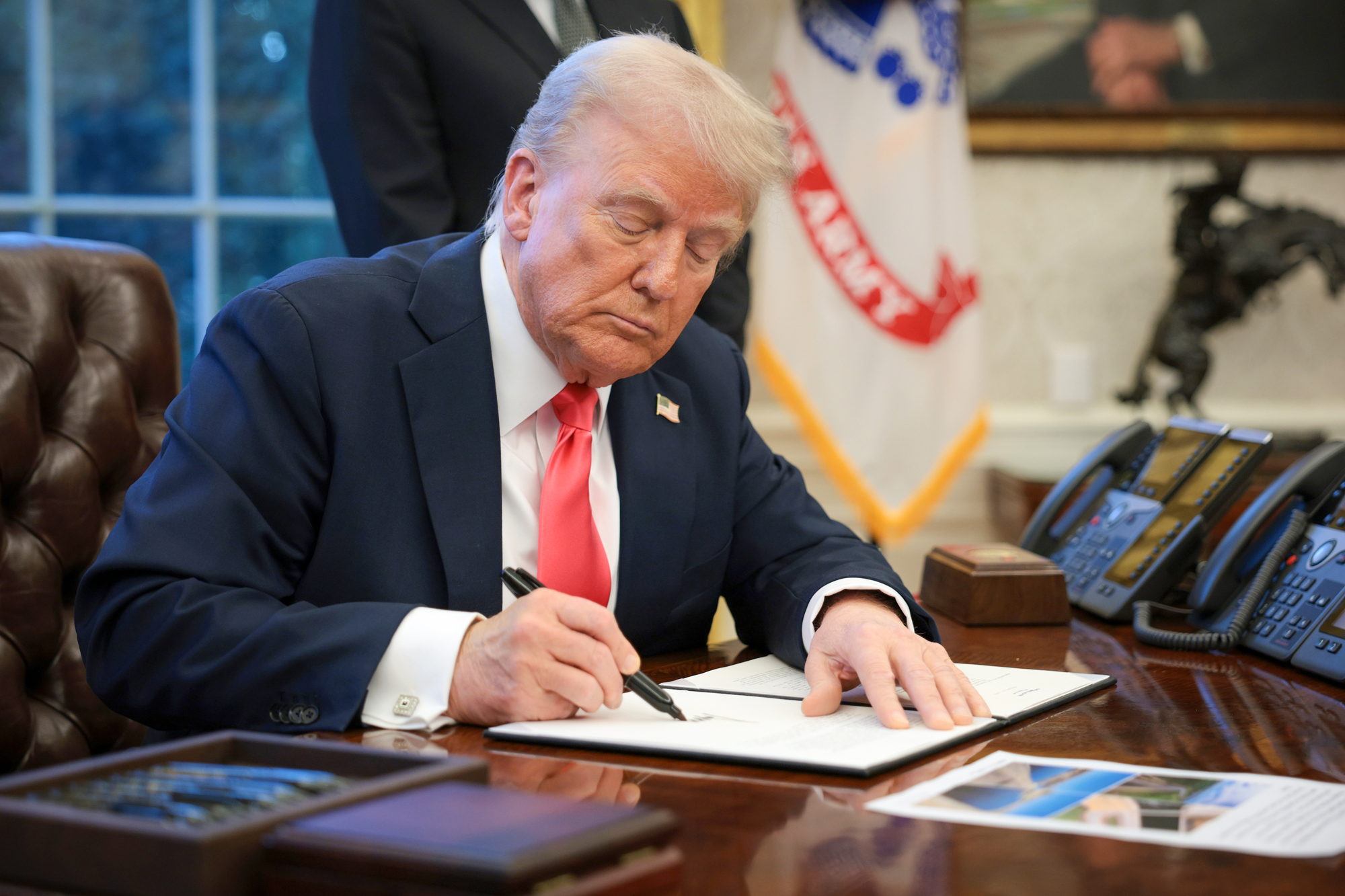

President Donald Trump signed an executive order on Feb. 18 declaring the United States’ supply of glyphosate, a controversial chemical used as a herbicide in commercial food production, a critical component of ensuring national and food security.
Trump’s order said there is no viable alternative to the chemical, and an adequate supply is crucial for domestic agricultural production, as the herbicide is instrumental in allowing American farmers to maintain high yields and low production costs. Meanwhile, the chemical has come under fire by the Make America Healthy Again (MAHA) movement, with thousands of lawsuits across the country claiming that exposure to it causes multiple types of cancer.
Glyphosate is a key ingredient in popular herbicide Roundup, produced by German-based agrochemical company Bayer’s subsidiary, Monsanto, and commonly used in U.S. food production.
“Lack of access to glyphosate-based herbicides would critically jeopardize agricultural productivity, adding pressure to the domestic food system, and may result in a transition of cropland to other uses due to low productivity,” the executive order reads.
“Glyphosate-based herbicides are a cornerstone of this Nation’s agricultural productivity and rural economy.”
A day before the president signed his executive order, Bayer announced that Monsanto submitted a proposal for a $7.25 billion class‑action settlement.
The company wishes to settle the thousands of lawsuits across the country in which plaintiffs allege that Roundup caused them to develop cancers.
Bayer issued a statement with its announcement of the proposal, stating that it is not an admission of wrongdoing or liability. Rather, it’s a decision to contain the litigation.
Trump’s executive order comes as the Supreme Court agreed to hear a Roundup case in April. The appeal, from Bayer, is against a $1.25 million award to a Missouri man who claims that Roundup caused him to develop blood cancer.
Bayer has maintained that Roundup is safe and is not carcinogenic, whereas MAHA advocates have singled out glyphosate as a contributing factor to long-term health effects in children.
Also as part of the Feb. 18 executive order, Trump aimed to secure the country’s elemental phosphorus supply, a key input used in all factions of the U.S. military. It’s used in smoke, illumination, and incendiary devices, as well as in the manufacturing of semiconductors for radar, solar cells, sensors, and lithium-ion batteries.
Elemental phosphorus is also used in the production of glyphosate-based herbicides.
“Indeed, there is only a single domestic producer of elemental phosphorus and glyphosate-based herbicides, and this producer does not meet our annual needs,” Trump said in his executive order.
Bayer’s Monsanto produces both elemental phosphorus and Roundup.
Yet, more than 6 million kilograms of elemental phosphorus are imported from other countries each year, Trump said in his order. Without an adequate supply of the mineral, the United States remains vulnerable to hostile foreign actors.
“I find that ensuring robust domestic elemental phosphorus mining and United States-based production of glyphosate-based herbicides is central to American economic and national security,” Trump wrote.
Trump directed Agriculture Secretary Brooke Rollins to ensure a continued, adequate supply of glyphosate-based herbicides and elemental phosphorus through contracts and allocation of materials, services, and facilities as necessary to promote national security.
Rollins will work with Secretary of War Pete Hegseth to determine nationwide priorities and the allocation of resources, according to the executive order.
As part of the president’s order, domestic producers of elemental phosphorus and glyphosate-based herbicides are ordered to comply.
Rollins is further instructed to ensure that any rule or regulation issued under the order doesn’t risk the viability of domestic producers.