
President Donald Trump said on Nov. 6 that the U.S. military carried out limited strikes targeting Iran’s “anti-aircraft device” after Iranian state media reported attacks near Qeshm Island.
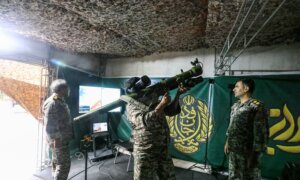
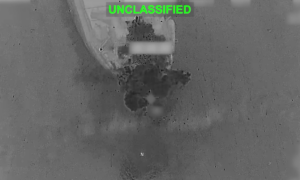
“We do minor strikes, but they knocked out. They built a little bit of an anti-aircraft device, and we knocked it out in about 15 minutes, maybe five,” Trump told reporters.
Iranian state news agency IRNA earlier reported that two missiles struck the Suza area of Qeshm Island in the Strait of Hormuz, though no further details were provided. The agency also reported on Nov. 7 that an MQ-9 drone had been shot down over the island, which Tehran claimed belonged to the U.S. military.
Trump hinted on Friday that his administration was in talks with Iran.
“We’re dealing with them now. They want to make a deal very badly,” he said, without providing any details. “We’ve made a lot of progress with Iran.”
Qatar’s Prime Minister Sheikh Mohammed bin Abdulrahman Al-Thani said on Saturday that mediation efforts between the United States and Iran remained ongoing.
“We cannot wait to reach a perfect agreement; we hope to reach a good agreement,” the Qatari leader said, noting that he believes a settlement between the two nations is possible.
Earlier this week, the U.S. military also struck an Iranian anti-aircraft facility in what Trump described as a minor attack. Iran’s state-run Islamic Republic News Agency reported several explosions on Qeshm Island on Nov. 2.
The U.S. military has acknowledged striking targets on the island in recent months. In September, explosions were reported on the island, as the U.S. military said it completed a wave of strikes against Iranian military targets.
The U.S. military also struck an Iranian military ground control station on Qeshm Island in June, following Iranian missile and drone launches toward regional partners.
The latest strikes marked the first since the U.S. midterm elections resulted in Republicans losing control of both chambers of Congress.
Trump said on Nov. 4 that he believed the war in Iran contributed to his party’s losses but defended the move as necessary to ensure Iran cannot acquire nuclear weapons.
“I did the right thing,” he told The Wall Street Journal on Nov. 4. “I would have done it again.”
U.S. Central Command announced on Nov. 6 a reward of up to $20 million and possible relocation for anyone who could provide information about Iran’s nuclear program, including its facilities, equipment, and personnel, such as scientists, or their movements.
Central Command also shared a link to the reward form, which cites a 2025 International Atomic Energy Agency report stating that Iran possesses uranium enriched to 60 percent purity, which is close to the 90 percent required for developing a nuclear weapon.
“Iran is the only non-nuclear-weapon state to produce uranium at such a high enrichment level. Experts estimate this quantity, if enriched further, could be enough for several nuclear weapons,” the form states.
Rachel Roberts and Evgenia Filimianova contributed to this report.