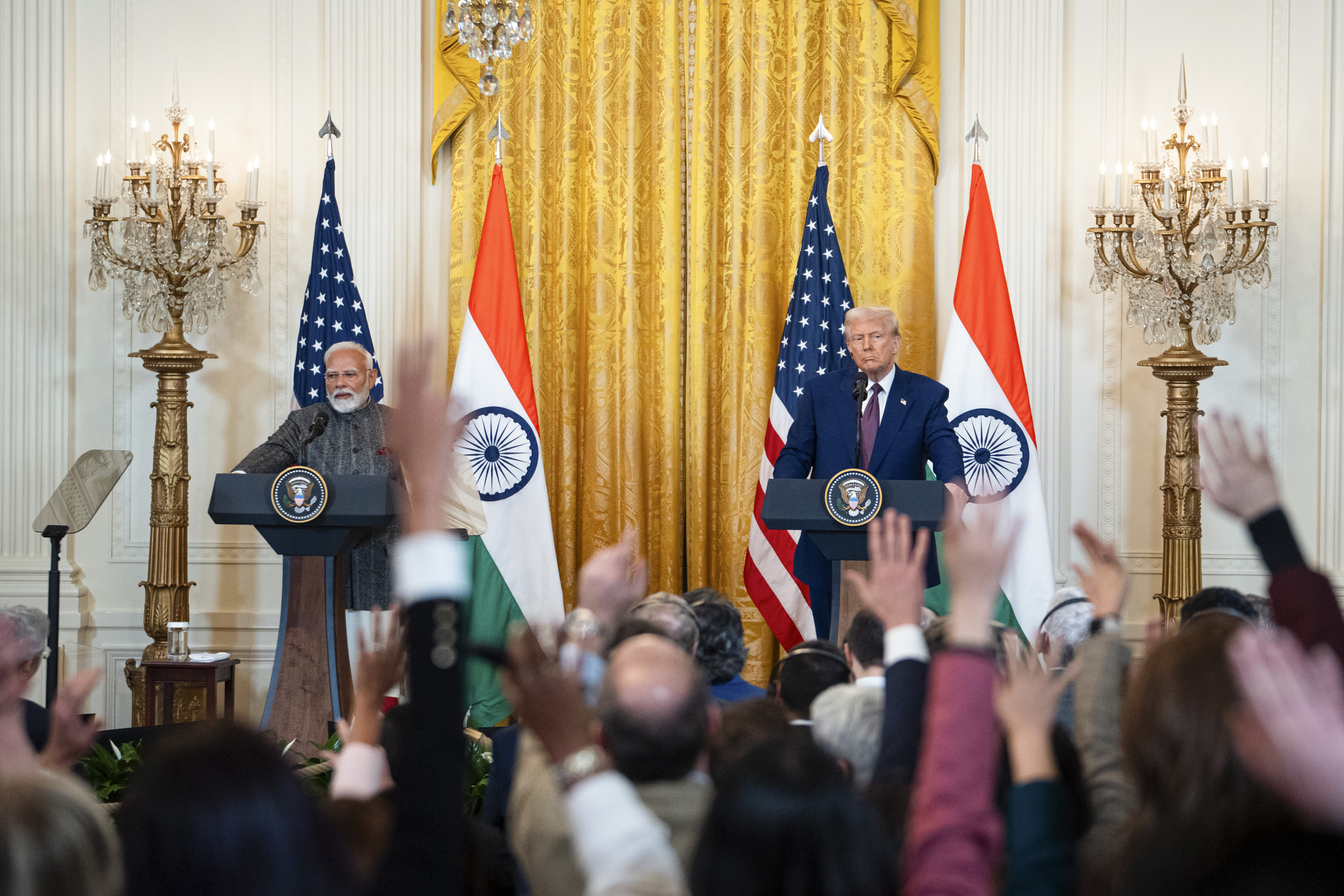

President Donald Trump is imposing an additional 25 percent tariff on India, lifting the total rate to 50 percent.
Trump, writing in an Aug. 6 executive order, said India’s government is “currently directly or indirectly importing Russian Federation oil.”
“Accordingly, and as consistent with applicable law, articles of India imported into the customs territory of the United States shall be subject to an additional ad valorem rate of duty of 25 percent,” the executive order states.
Last week, the president announced a 25 percent tariff against India, one of the largest U.S. trading partners. Additionally, India would face another penalty over its purchases of Russian energy and military equipment.
In an Aug. 5 interview with CNBC’s “Squawk Box,” he confirmed that he would increase the tariff on India “very substantially over the next 24 hours” because it is buying Russian crude oil that is “fueling the war machine.”
The new tariff rate on India is now the largest of the tariffs imposed on U.S. trading partners.
While Trump has called Indian Prime Minister Narendra Modi a “friend,” he has regularly expressed concerns about India’s trade imbalance, tariffs, and nontariff trade barriers.
Last year, the U.S. goods trade deficit with India was $45.8 billion, up 5.9 percent from 2023, according to the U.S. Trade Representative’s Office.
India has also been in the crosshairs of Trump’s targeting of the BRICS coalition, a group of emerging market countries headlined by Brazil, Russia, India, China, and South Africa.
“BRICS ... is basically a group of countries that are anti the United States, and India is a member of that, if you can believe it,” he said at a July 30 press conference.
“It’s an attack on the dollar, and we are not going to let anybody attack the dollar. So it’s partially BRICS and it’s partially the trade situation.”
Despite BRICS’ years-long campaign to dethrone the U.S. dollar and embrace bilateral trade settled in local currencies, the greenback remains the dominant currency in global trade. The dollar accounts for nearly half of international payments, SWIFT data for June show.
Pressure Campaign
Trump’s announcement follows through on his threats to ratchet up pressure to end the Russia–Ukraine conflict. One strategy the Trump administration has employed is targeting countries buying Russia’s petroleum products, threatening to implement secondary tariffs.
In an Aug. 4 Truth Social post, the president stated that India is also using the Russian oil it purchases to sell it “on the open market for big products.”
“They don’t care how many people in Ukraine are being killed by the Russian War Machine,” he said.
India has defended the transactions as a means to provide the population with affordable energy since conventional supplies were diverted to Europe following the war in Ukraine.
“In this background, the targeting of India is unjustified and unreasonable,” a spokesperson for India’s foreign ministry said, adding that the government will employ all necessary measures to protect its economic and national interests.
Officials also say India is engaged in long-term oil contracts with Russia, making it challenging to break those contracts overnight.
According to the United Nations COMTRADE database on international trade, India has accelerated its imports of Russian crude oil since 2022. Last year, India purchased almost $53 billion in oil, up from nearly $49 billion in 2023.
Last week, Trump reduced his original 50-day deadline for Russia to end the war, giving Moscow 10 to 12 days.
The Kremlin criticized the White House’s campaign to force countries to eliminate trade with Russia.
Dmitry Peskov, spokesperson for the Kremlin, says India and other countries should be allowed to select their own trading partners for trade and economic cooperation.
“We hear many statements that are in fact threats, attempts to force countries to cut trade relations with Russia. We do not consider such statements to be legal,” Peskov told reporters on Aug. 5.
U.S. special envoy Steve Witkoff is in Moscow on Aug. 6, just a few days before Trump’s deadline.
Reuters contributed to this report.