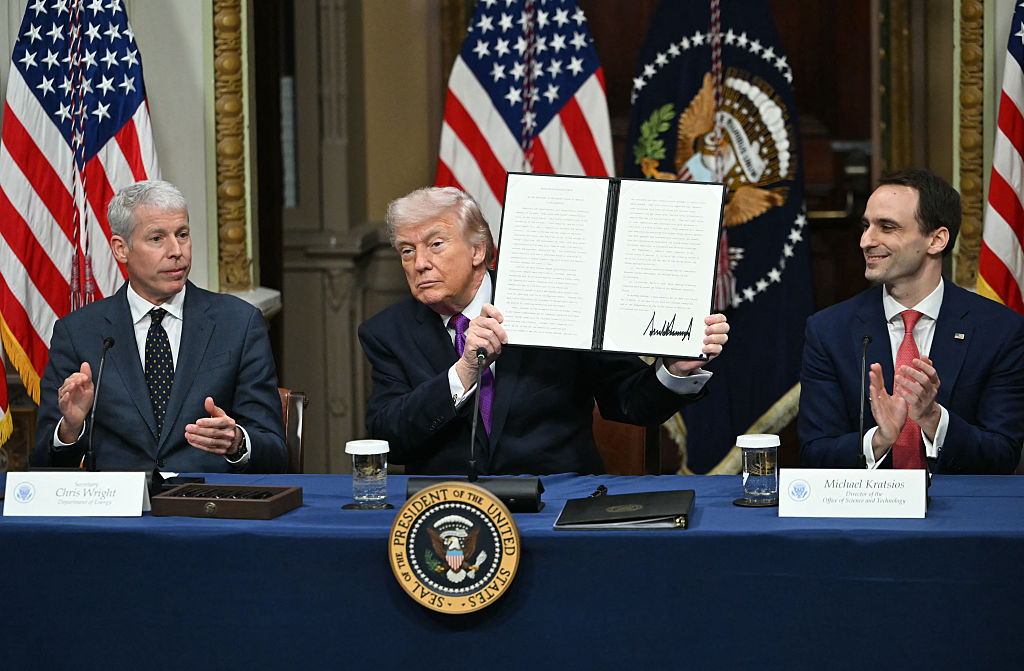

WASHINGTON—President Donald Trump held a roundtable meeting with artificial intelligence executives at the White House on March 4 for the signing of a ratepayer protection pledge, an initiative to reduce electricity costs.
“This is a historic win for countless American families and will also make our electricity grids stronger and more resilient than ever before,” Trump said during the gathering held in the Indian Treaty Room.
The five-step commitment was drafted to guide electricity production needed to run AI data centers while enhancing the nation’s power grid and protecting consumers.
Representatives from Amazon, Google, Meta, Microsoft, OpenAI, Oracle, and xAI signed the agreement.
“This is a pledge that is going to be a very important pledge to the country and their companies, also,” Trump said.
Participating companies agreed to pay for their own electricity generation infrastructure to power their data center operations, while providing additional capacity to bolster the public’s power supply.
“Basically, we’re building massive amounts of electricity, and you’re not paying for it at all,” Trump said. “And the companies want to do it; otherwise, they couldn’t build.”
Companies will absorb all costs for necessary power delivery upgrades to accommodate data centers.
Rate structure negotiations will occur voluntarily with states and public utilities, and companies agree to pay guaranteed rates, even if electricity is not used.
Investments are targeted to benefit local communities through hiring and skill-development programs.
“American workers will benefit from the data center boom at every step from construction to operation,” a White House official told reporters during a background call on March 4.
Additionally, the companies will work with local grid operators to enhance grid reliability and boost backup power supply.
“The road to a secure grid that’s not at risk when it’s under power stress is more demand development, more investment,” the officials said.
“That’s what this rate payer pledge and partnership with the hyperscalers is all about.”
Administration officials described the agreement as a realignment of federal energy policy to prioritize Americans, citing national statistics that show that power costs increased by 30 percent under President Joe Biden’s administration.
“The government has been in the way of things,” Energy Secretary Chris Wright said.
“This is a pivot, and this is a transformation.”
Critics of the fast rise in AI infrastructure and data centers caution that environmental effects and power usage will negatively affect the country.
A 2025 report titled “Big Data Centers, Big Problems” by the California-based nonprofit Frontier Group recommended restricting data centers to on-site renewable energy production, warning about rising energy prices if facilities are tied to public grids.
Officials discussed Americans’ concerns about data centers during the meeting.
“There’s a lot of misinformation out there about the rise in energy demand and what it’s going to mean for our community,” House Speaker Rep. Mike Johnson (R-La.) said.
The president suggested that energy concerns are unwarranted now that the pledge outlines a path to long-term energy sustainability.
He first announced the agreement during his State of the Union address on Feb. 24 after signing an executive order declaring a national energy emergency on his first day back in office.
Correction: A previous version of this article misstated the date of President Donald Trump’s State of the Union address. The Epoch Times regrets the error.