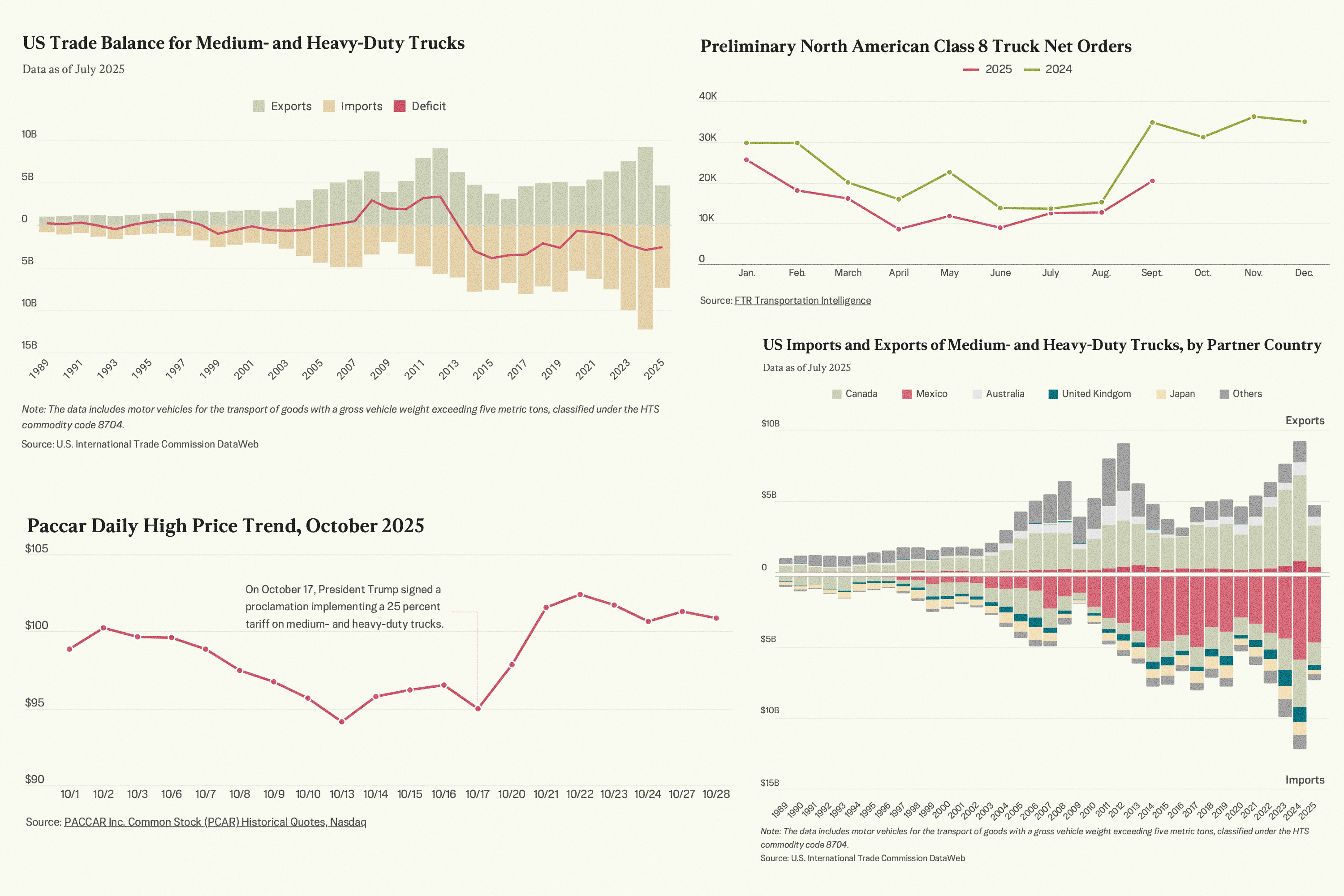

Starting on Nov. 1, the United States will impose a 25 percent tariff on imports of medium- and heavy-duty trucks, affecting billions of dollars in imports from Mexico and Canada.
Of the $12 billion in U.S. imports of medium- and heavy-duty trucks in 2024, Mexico ($5.9 billion) and Canada ($3.3 billion) led the way and accounted for 48 percent and 27 percent of total imports, respectively.
The UK and Japan each contributed 8 percent to the overall import share, according to official trade data.
Preston Feight, CEO of U.S. truck manufacturer Paccar, said at a recent earnings call, “[The new truck tariff is] good for Paccar’s customers, as it will reduce tariff costs and bring clarity to the market.”
“American-made heavy-duty trucks have been [at a] $10,000 or more per truck cost disadvantage compared to trucks assembled in Mexico,” Paccar said in a statement in May in response to a Commerce Department truck imports investigation.
“Mexican-built trucks that incorporate non-tariffed Chinese parts and foreign steel and aluminum can be imported into the U.S. tariff-free if they meet the [U.S.–Mexico–Canada Agreement] rules of origin for finished vehicles.”
Paccar, an American Fortune 150 company with a 120-year history, controls more than 30 percent of the U.S. heavy-duty truck market. The company manufactures more than 98 percent of its heavy-duty trucks for the United States in Ohio, Texas, and Washington state.
The United States posted a $2.7 billion truck trade surplus with Canada in 2024. In contrast, the truck trade deficit with Mexico surged past $5.1 billion, the largest gap recorded in the past 35 years. Nearly $3 billion of that deficit was attributed to Class 8 heavy-duty trucks, which typically weigh more than 33,000 pounds, according to an Epoch Times analysis of international trade data.
Under the new tariff, trucks traded under the U.S.–Mexico–Canada Agreement (USMCA) will incur a 25 percent tariff on non-U.S. components, according to a White House fact sheet released on Oct. 17. For medium- and heavy-duty trucks that do not qualify for preferential tariff treatment under the USMCA, the tariff will apply to the full value of the vehicle.
To boost domestic production, manufacturers assembling trucks in the United States with imported parts may offset tariffs by an amount equal to 3.75 percent of the total value of all trucks built domestically between 2025 and 2030.
The new truck tariffs are meant to boost the volume of Class 8 units assembled in the United States, according to Dan Moyer, senior analyst for commercial vehicles at FTR Transportation Intelligence.
“By targeting non-USMCA content and rewarding domestic assembly, they push [original equipment manufacturers] and suppliers toward more North American sourcing,” Moyer told The Epoch Times via email.
“The transition will take time, given current capital and labor limits.
“The policy also avoids stacking with other steel, aluminum, or reciprocal tariffs, preventing double penalties on U.S. producers.”
In August, the Commerce Department imposed 50 percent tariffs on hundreds of steel and aluminum derivative products imported to the United States.
“[Paccar’s third-quarter] margins were affected by the August steel and aluminum tariff increases and the tariff costs on trucks that were built in the United States,” Feight told analysts during the company’s earnings call on Oct. 21.

A truck exits U.S. truck manufacturer Paccar Inc.’s commercial truck plant in Sainte-Thérèse, Canada, on Oct. 22, 2025. After President Donald Trump signed a truck-tariff proclamation on Oct. 17, Paccar’s stock rose by 3 percent and kept climbing, reaching a monthly high in the following days. (Christinne Muschi/The Canadian Press)
Paccar’s chief financial officer, Brice J. Poplawski, also said he believes that the One Big Beautiful Bill Act, signed into law on July 4, will provide incentives for next quarter.
“We have programs around encouraging our customers to take advantage of that 100 percent bonus depreciation,“ he said. ”We think that will help spur some demand here in the fourth quarter.”
The 100 percent bonus depreciation is a tax benefit that allows businesses to immediately deduct the entire cost of qualifying property—that which has a useful life of 20 years or less, such as trucks—rather than spreading it over several years.
“I think it gives us a competitive leg up from where we’ve been,” Feight said.
After President Donald Trump signed the truck tariff proclamation on Oct. 17, Paccar’s stock rose by 3 percent and continued to climb, reaching a monthly high in the following days.
Truck Prices, Orders
The structured tariff design should limit broad inflationary effects, Moyer said.
“The tariff targets only the non-U.S. content of USMCA-compliant imports, reducing its overall price impact,” he said. “By avoiding overlap with other trade duties and offering offsets for U.S. assembly, it helps contain costs and limit inflationary pressure.”
While the specific impact will vary by original equipment manufacturer and supplier, the tariffs are broadly expected to drive an increase in overall Class 8 truck prices in the mid-single-digit percent range, according to Moyer.
“USMCA-compliant vehicles will see smaller increases, while noncompliant imports face higher costs,” he said.
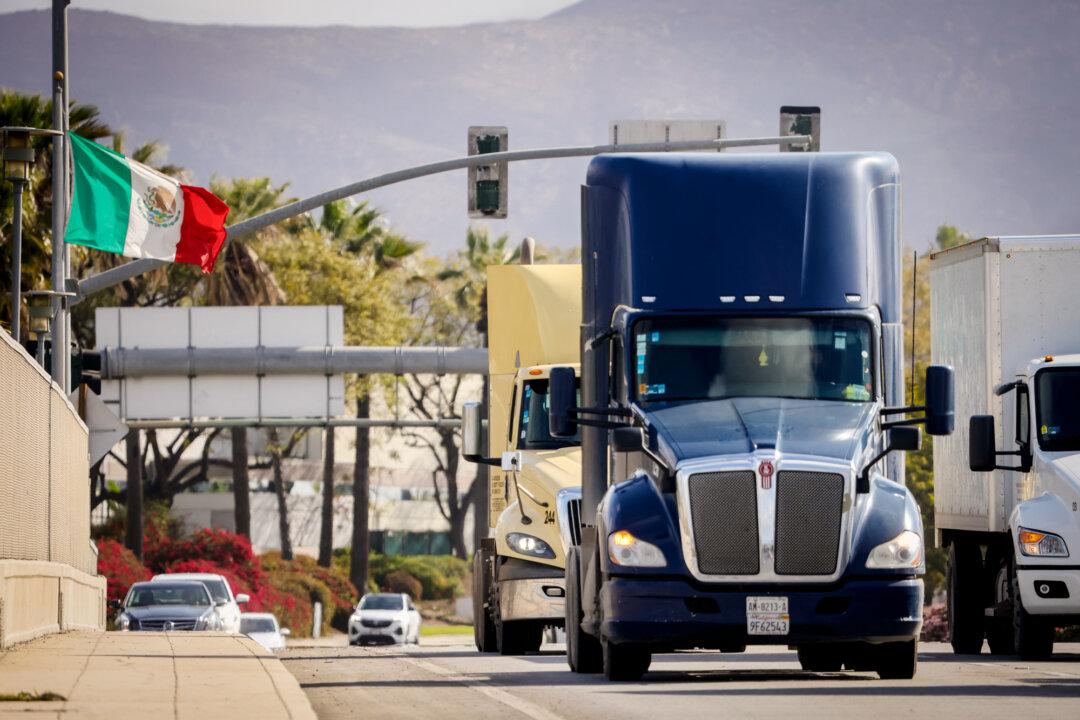
Trucks coming from Mexico enter the United States at an inspection station after crossing the border in Otay Mesa, Calif., on April 1, 2025. The United States posted a $5.1 billion truck trade deficit with Mexico in 2024. (Sandy Huffaker/AFP via Getty Images)
Offsets, related to parts tariffs, for U.S. assemblers will cushion some of the impact.
“Some fleets may delay purchases or shift to used trucks, tightening capacity,” Moyer said.
In September, North American Class 8 truck net orders were at 20,659 units, up by 62 percent from August but down by 41 percent from 2024, according to Moyer. He noted that retail sales totaled 20,627 units, down by 6 percent month over month and 27 percent year over year.
Class 8 truck orders have trended below previous-year levels since the start of 2025, according to FTR.
Moyer outlined several factors driving the decline in Class 8 truck orders throughout 2025.
“Weak freight demand, higher costs, and low carrier profits have dampened fleet confidence,“ he said. ”Tariff uncertainty and a soft economy are keeping most fleets focused on replacement rather than expansion.”
Despite this, Feight said, Paccar delivered “excellent performance and strong profits” in the third quarter.
The company’s profits for Q3 would have been worse if it were not for improved revenue at its parts and financial services divisions, according to industry site Transport Topics. Paccar’s parts division achieved record sales, and the financial services division benefited from an improved used truck market.
The decline in heavy truck sales could also be a warning sign for a broader economic slowdown.
“Falling Class 8 orders can signal weak freight volumes and reduced industrial activity, often early indicators of slower economic growth,” Moyer said.
Joseph Brusuelas, chief economist at RSM US, said: “One such bellwether on the real economy is the sale of heavy trucks, which move everything from food to basic materials to retail goods.
“Since 1979, when the data became available, a collapse in sales of heavy trucks has coincided with recessions. The recent downturn in heavy truck sales, which started in 2023, should be a concern for policymakers.”