
Check the Internet Movie Database website for plot summary, cast, reviews, and ratings.
In his own words, Texan pastor and author Max Lucado speaks to the hurting, guilt-ridden, lonely, and discouraged with “God loves you; let him.” He began his books as a sermon series in San Antonio, Texas, asking himself, “What can I say on Sunday that will still matter on Monday?”
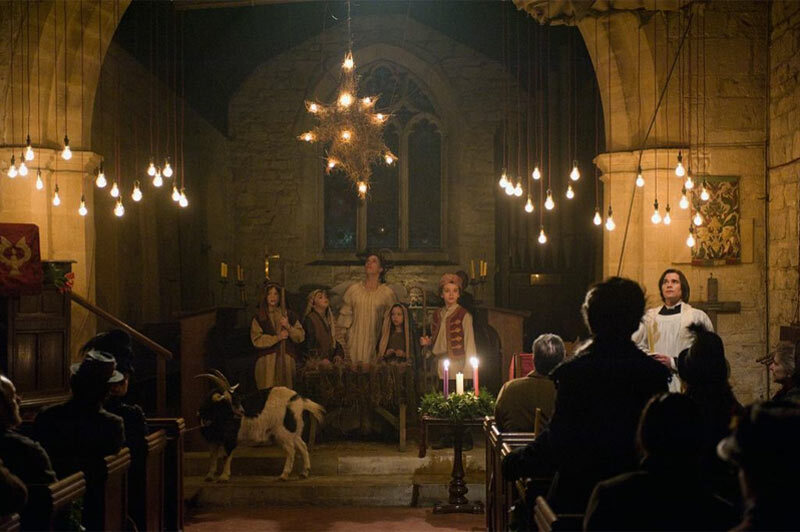
This film adapts Lucado’s novel about a 200-year-old legend. Every 25 years, an angel visits the British village of Gladbury, granting a miracle to the person who lights the Christmas Candle. The soft, angelic instruction is, “Light this and pray.”
Newcomer to late 19th-century Gladbury, Rev. David Richmond, whose faith is being tested by personal loss, believes in God but not in miracles. To him, good works matter more than faith. Technological prowess, embodied in the electric lamp and its sister inventions, ought to rebuff what he feels is outdated: faith.
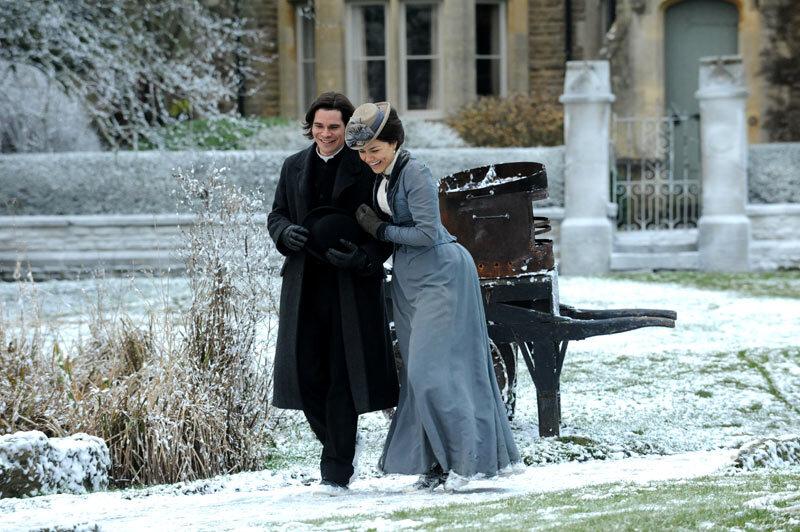
Hans Matheson (David Richmond) and Samantha Barks (Emily Barstow), in “The Christmas Candle.” (Pinewood Studios/MovieStillsDB)
Meanwhile, to the Haddingtons, the Hopewells, and Lady Camdon, faith isn’t the same as superstition. They believe that without faith good works are impossible, or at least short-lived. They believe that it’s not enough to light the candle; they must also pray.
A Simple Candle
The narrator asks a question that contemporary teens and young adults might ask themselves. With the surfeit of modern tech marvels, who needs light from a simple candle? In this film, as it turns out, everyone does.
Everyone wants miracles to spare them from disability, separation, starvation, sickness, death, or bereavement. Rev. Richmond’s solution? Instead of waiting for a miracle, why not “be” a miracle to others? To him, good deeds, like light, draw men to God, not faith.
Initially, that invitation proves infectious; people thrill at their invigorating sense of agency. Eventually, however, it’s inadequate.
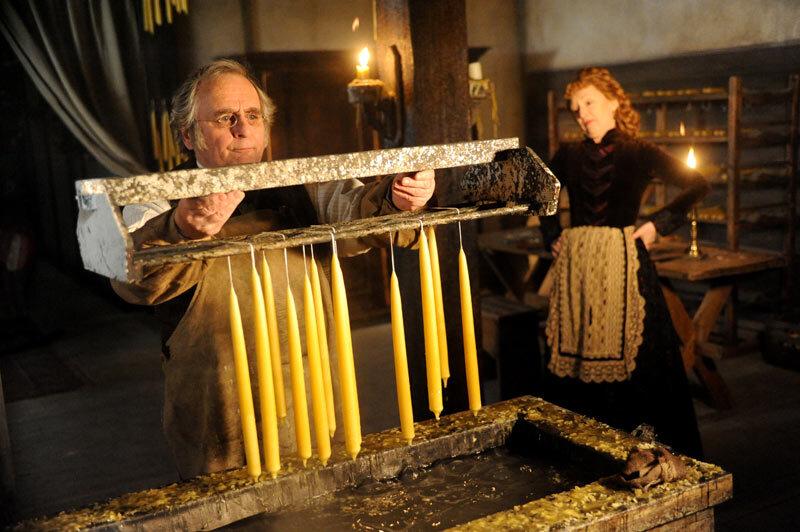
Edward Haddington (Sylvester McCoy) and Bea Haddington (Lesley Manville) make candles, in “The Christmas Candle.” (Pinewood Studios/MovieStillsDB)
The point of Richmond’s character arc isn’t that human actions are irrelevant and only God’s actions matter. Rather, there’s no good intent in man that God hasn’t put there. Forget about the heartbeat, breath, pulse, and blood powering man’s limbs. Man wouldn’t be able to execute a fraction of his good intent without God.
To Be Fully Human
It’s by rejoicing in God’s grace flowing in, with, and through man, that he is fully human. It’s through joyful union of both human and divine wills that miracles happen. Is that a contradiction? If God’s will is everything, how can humans have merit, or be distinct enough, to deserve merit in the first place?
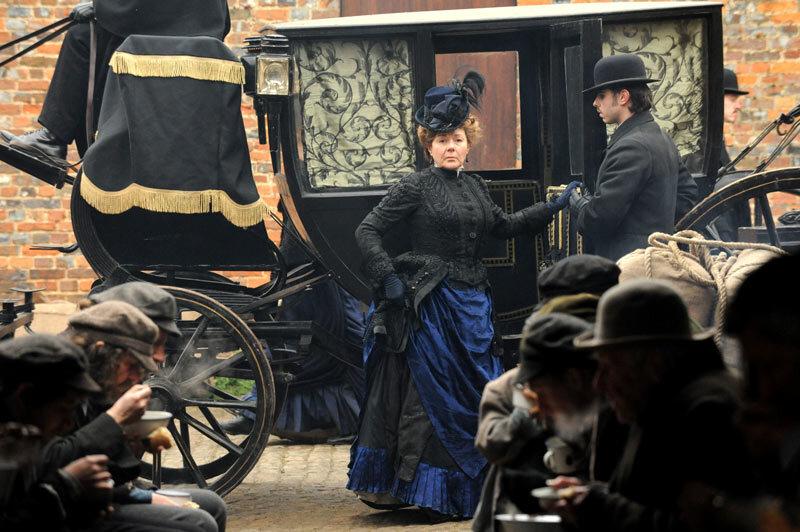
Lady Camdon (Barbara Flynn), in “The Christmas Candle.” (Pinewood Studios/MovieStillsDB)
Through his characters, Lucado explains that with God all things are possible, even for two ostensibly contradictory things to be true at once. His storytelling motif here is the divine spark and the human candle. Without that source spark, there is no flame, no miracle of heat to warm, and no miracle of light to brighten.
Equally, if the candle’s stem and wick, akin to a person’s mind and body, aren’t faithful to the divine spark, welcoming it and yielding to it, that allegorical human candle can sustain neither loving warmth nor caring brightness. Instead, it becomes no more than a stick of cold, dull, useless wax—in truth, not a candle at all.
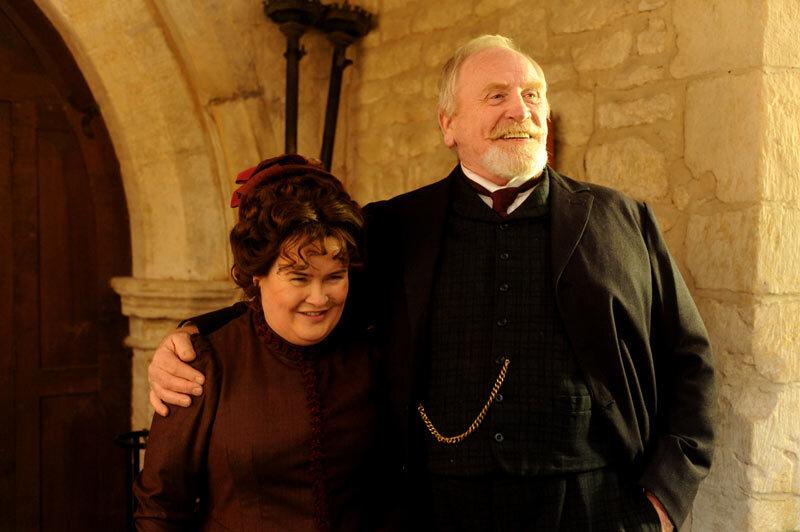
Lady Hopewell (Susan Boyle) and Herbert Hopewell (James Cosmo), in “The Christmas Candle.” (Pinewood Studios/MovieStillsDB)
Some candles may burn for as long as 25 minutes without needing a new spark. Here, it takes a fairytale-like 25 years for the village to require a refresher spark. Those like Rev. Richmond, experiencing loss or suffering, struggle to acknowledge miracles. Their flames of faith have been snuffed out by gusts of wind; they need a fresh spark to bounce back.
Whether it’s minutes or years, every now and then, a hand must share its spark for a new flame to come alive. No, there’s no contradiction in Richmond’s Bible-inspired prayer, “Lord I believe, help my unbelief.” Doubt can co-exist with faith. If anything, good works fortify the faithful so they can keep journeying from doubt toward faith, instead of using doubt as an excuse to give up faith altogether.
Director John Stephenson’s opening close-up likens the hand lighting a candle to God selflessly sharing himself, the divine spark, without which man is in darkness.
Once lit, however, it’s up to man to melt as it were, keeping that fire alive. Man needs to shed more and more of himself, gratefully mimicking divine self-giving, until his earthly candle is no more, until he too becomes like the divine spark that created him: eternal.
These reflective articles may interest parents, caretakers, or educators of teenagers and young adults, seeking great movies to watch together or recommend. They’re about films that, when viewed thoughtfully, nudge young people to be better versions of themselves.
You can watch “The Christmas Candle” on Prime Video, Roku, Hoopla, Kanopy, Pluto, and Plex.
What arts and culture topics would you like us to cover? Please email ideas or feedback to features@epochtimes.nyc