As British ships sailed up the Chesapeake Bay, Secretary of War John Armstrong was adamant that the Royal Navy were heading for Baltimore—the country’s third-largest city. He was certain they would not come to Washington. “What the devil will they do here?” Armstrong rhetorically asked the capital’s militia commander, Maj. Gen. John Van Ness. The answer arrived on Aug. 24, 1814.
Washington was captured, but only momentarily. The British decided to burn the city rather than occupy it. Armstrong had almost been correct. The next stop for the British was Baltimore.
When the Royal Navy ships reached the mouth of the Patapsco River, a small American packet ship waving a flag of truce floated toward them. On board was United States agent for prisoners of war, John Skinner, and a young lawyer and amateur poet Francis Scott Key. Their objective was to negotiate the release of Dr. William Beanes, who had helped throw several British soldiers in jail for the charge of disturbing the peace. The two boarded the HMS Tonnant, met with Adm. Alexander Cochrane and won Beanes’s freedom.
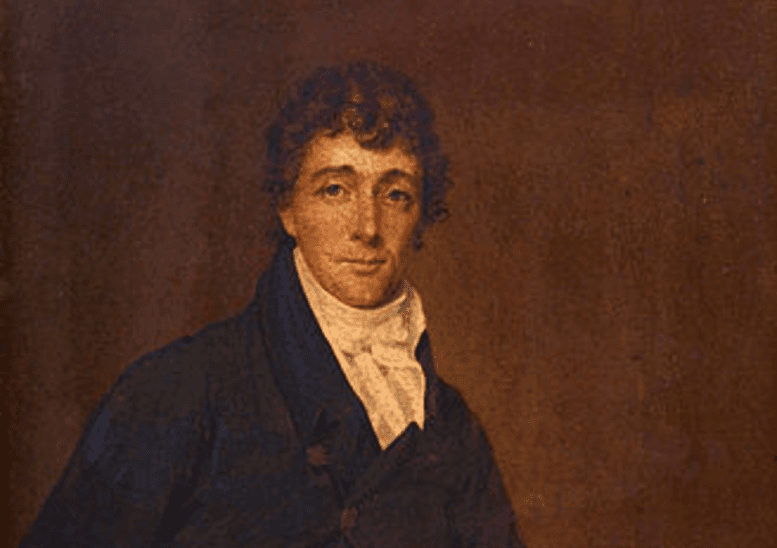
A portrait of Francis Scott Key by Joseph Wood. Best known as the author of the text of the American national anthem, "The Star-Spangled Banner." (Public Domain)
During this time, Key, Skinner, and Beanes had learned of the British plans to bombard Fort McHenry, located in the Baltimore harbor. Fearing the Americans would divulge their plans, Cochrane required they remain at sea during the bombardment. The Americans were escorted from the Tonnant to the HMS Surprise and then placed aboard their packet, which was tied to the Surprise.
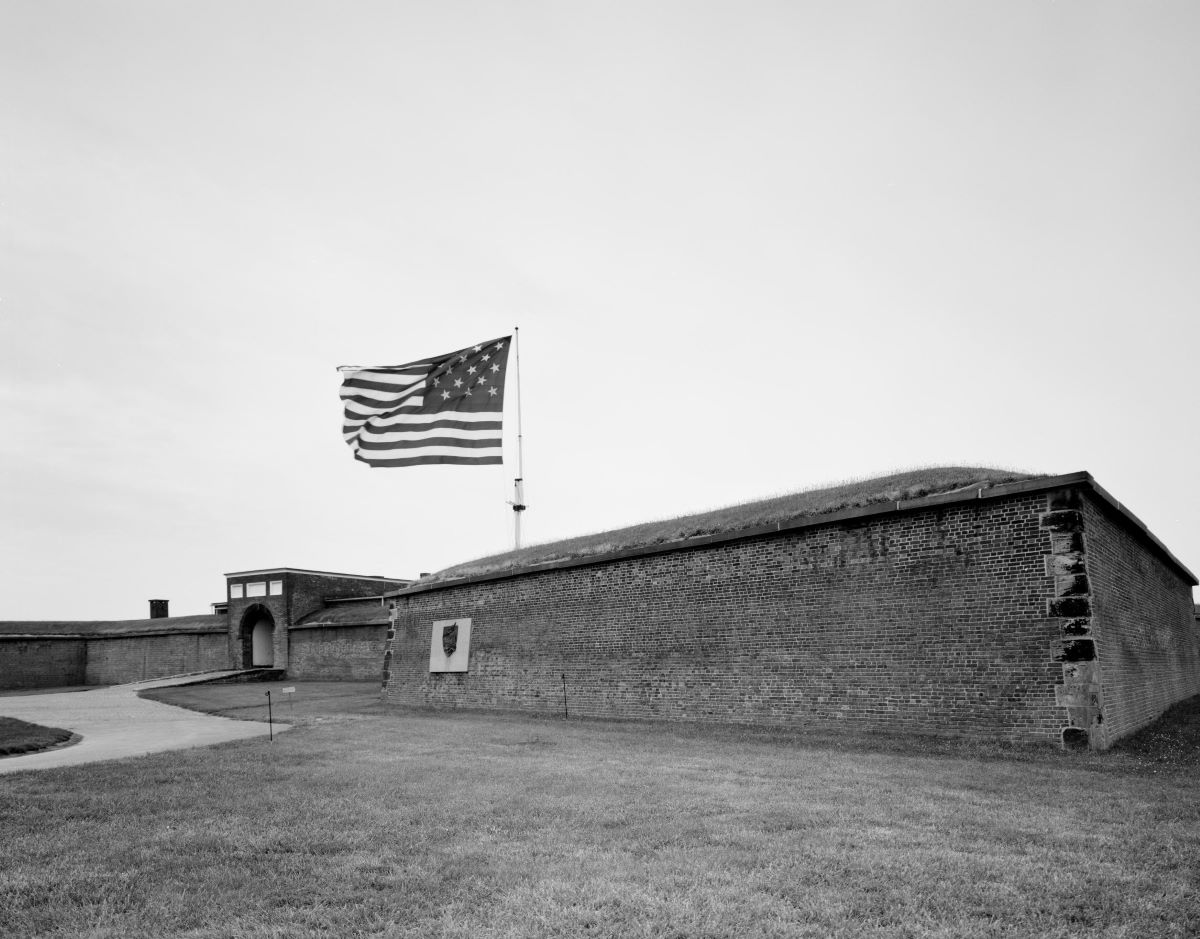
The British ships, with the Americans in tow, sailed along the Patapsco, anchoring out of range of the fort’s guns. Indeed, the British ships could only sail so far, as Maj. Gen. George Armistead, commander of Fort McHenry, had ordered the sinking of ships across the river. The sunken ships and the 1,000 militiamen along the walls of the star-shaped Fort McHenry ensured British land and naval forces maintained their distance.
Awaiting Attack
On Sept. 12, British soldiers had disembarked at North Point at the confluence of the Chesapeake and the Patapsco. The soldiers marched toward Baltimore, hoping to invade the city from the northeast. Skirmishes erupted throughout, leading to the death of British commander Maj. Gen. Robert Ross, who had overseen the burning of Washington. Marching along Philadelphia Road and with Baltimore in sight, the British could go no further. They faced approximately 10,000 American soldiers, as well as 100 cannon—triple what the British had. They would wait for the Royal Navy to attack the fort.
About eight miles east of Fort McHenry, Key, Skinner, and Beanes anxiously awaited the bombardment. Nearly 20 vessels—warships, bomb ships, and rocket ships—aimed to destroy the American stronghold. Shortly before 6:30 a.m. on Sept. 13, Adm. Cochrane gave the order to begin the bombing.
“I saw the flag of my country waving over a city—the strength and pride of my native State—a city devoted to plunder and desolation by its assailants,” Key recalled. “I witnessed the preparation for its assaults. I saw the array of its enemies as they advanced to the attack. I heard the sound of battle; the noise of the conflict fell upon my listening ear, and told me that ’the brave and the free' had met the invaders.”
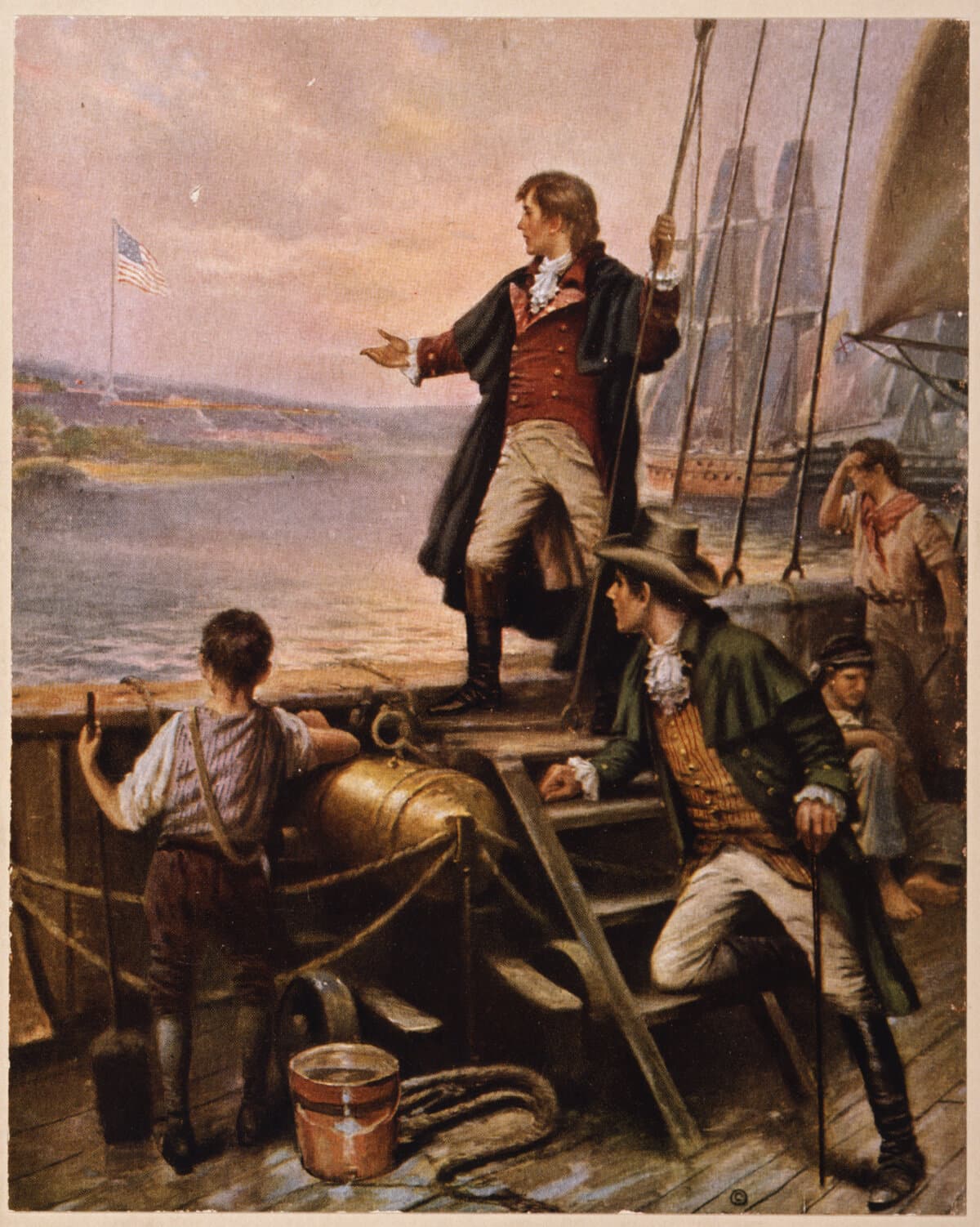
"The Star Spangled Banner," circa 1913, by Percy Moran illustrates Francis Scott Key standing on boat, with right arm stretched out toward the United States flag, with 15 stripes, flying over Fort McHenry, Baltimore, Md. Library of Congress. (Public Domain)
The noise of the conflict lasted 25 hours, as the Royal Navy fired more than 1,500 mortars, Congreve rockets, and cannonballs. The attack included a nighttime landing party of approximately 1,200 soldiers.
Raised in Defiance
Francis Scott Key feared the worst. The immense shelling on a single location seemed more than enough to force a surrender. On the morning of Sept. 14, Adm. Cochrane signaled the end of the bombardment. The day-long sound of cannonades subsided into the sounds of waves lapping against the ship hulls, the rhythmic creaking of wood beams and iron, and the chattering of sailors anticipating the hoisting of a white flag. Key stepped on deck to witness the American surrender. He pulled out his spyglass and surveyed the smoking fort.
The 17-foot by 25-foot storm flag, which had endured the long bombardment, as well as the heavy thunderstorm that drenched Baltimore, was lowered. The great question became what would replace it?
Armistead had long prepared that answer. More than a year before the attack, he had requested “a flag so large that the British will have no difficulty seeing it from a distance.” A Baltimore flagmaker by the name of Mary Pickersgill had sewn the large storm flag, as well as a flag that met Armistead’s requirements.
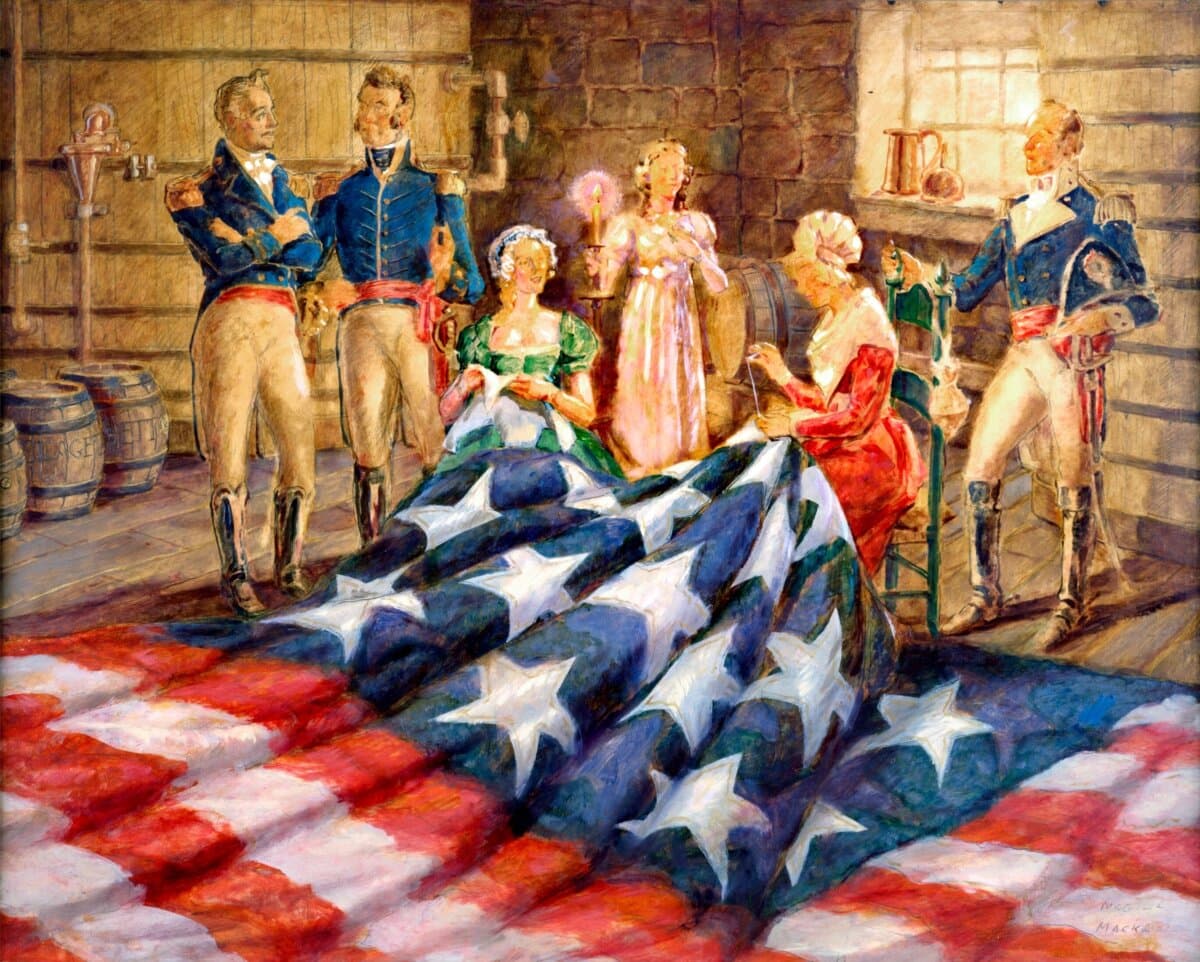
Mary Pickersgill and her nieces sewing the flag at Brown's Brewery. Artist's rendition by Robert McGill Mackall, 1962. (Public Domain)
Key watched as the Americans hoisted the specially designed 30-foot by 42-foot 15-star and 15-stripe flag. The message was clear. Fort McHenry had withstood the Royal Navy’s best shot. The British quit Baltimore; Key, Skinner, and Beanes were released; and the Royal Navy sailed for New Orleans where Maj. Gen. Andrew Jackson would deliver the British one of its greatest defeats.
Writing a Poem, Creating an Anthem
The defiance of the Americans and the raising of the enormous flag had left the young lawyer and poet inspired to write a poem. Since the original copy of his poem does not survive, there are conflicting stories of exactly how he came to put the poem to paper. Some suggest he wrote the poem on the back of a piece of paper or envelope aboard ship. Some say that he put the poem to memory and wrote it down only after he came ashore. Regardless of how or on what type of paper, the four-stanza, 32-line poem entitled “Defence of Fort M’Henry” was published on Sept. 20 in the Baltimore Patriot and Evening Advertiser newspaper.
Key was not only a poet, but also a lyricist, who went on to write numerous songs and hymns. The cadence with which Key wrote the poem was most likely assisted by a tune he had in mind called “To Anacreon in Heaven.” Soon, his poem evolved into a tune sung in taverns. Its popularity surged throughout the 19th century, becoming one of the nation’s primary patriotic songs.
In 1889, the United States Navy began playing the tune during its flag raisings. In 1916, President Woodrow Wilson declared it the official national anthem of the U.S. Armed Forces.
In 1929, John Linthicum felt strongly that America “needed a national song to give expression to its patriotism.” He believed Key’s “Star-Spangled Banner” was ideal. Fittingly, Linthicum was a member of the House of Representatives representing Baltimore. In 1930, he stood before the House Judiciary Committee imploring them to support his measure for the national anthem. More than just words, he presented letters and resolutions from numerous organizations, and a petition containing more than 5 million signatures.
Linthicum’s bill was presented during the era of Prohibition. There was public criticism that the national anthem should not be a famous drinking song. Congress, however, sided with Linthicum and the 5 million signatures.
On April 21, 1930, the House passed the bill, which was then passed by the Senate the following year. On March 2, 1931, President Herbert Hoover signed “An Act To make The Star-Spangled Banner the national anthem of the United States of America.”
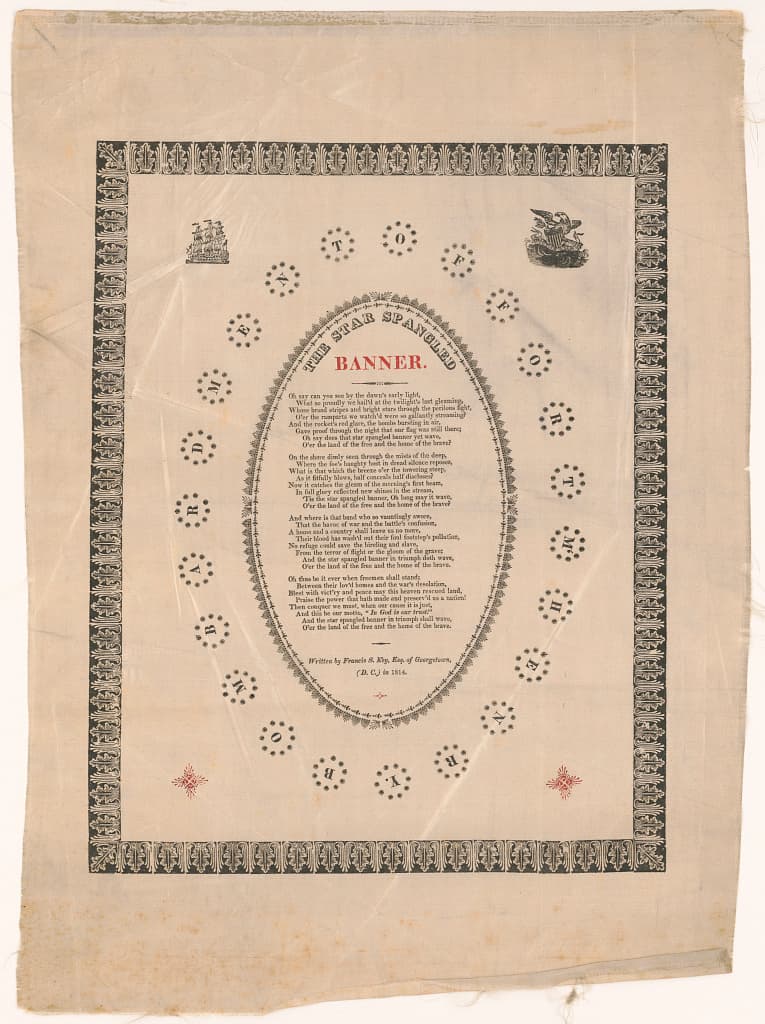
Print shows the text of the "The Star Spangled Banner" within an oval design at center, surrounded by circular star-bursts that contain letters spelling "Bombardment of Fort M'Henry" within a frame that has a ship in the upper left corner and the seal of the United States in the upper right corner. Library of Congress. (Public Domain)
What arts and culture topics would you like us to cover? Please email ideas or feedback to features@epochtimes.nyc.