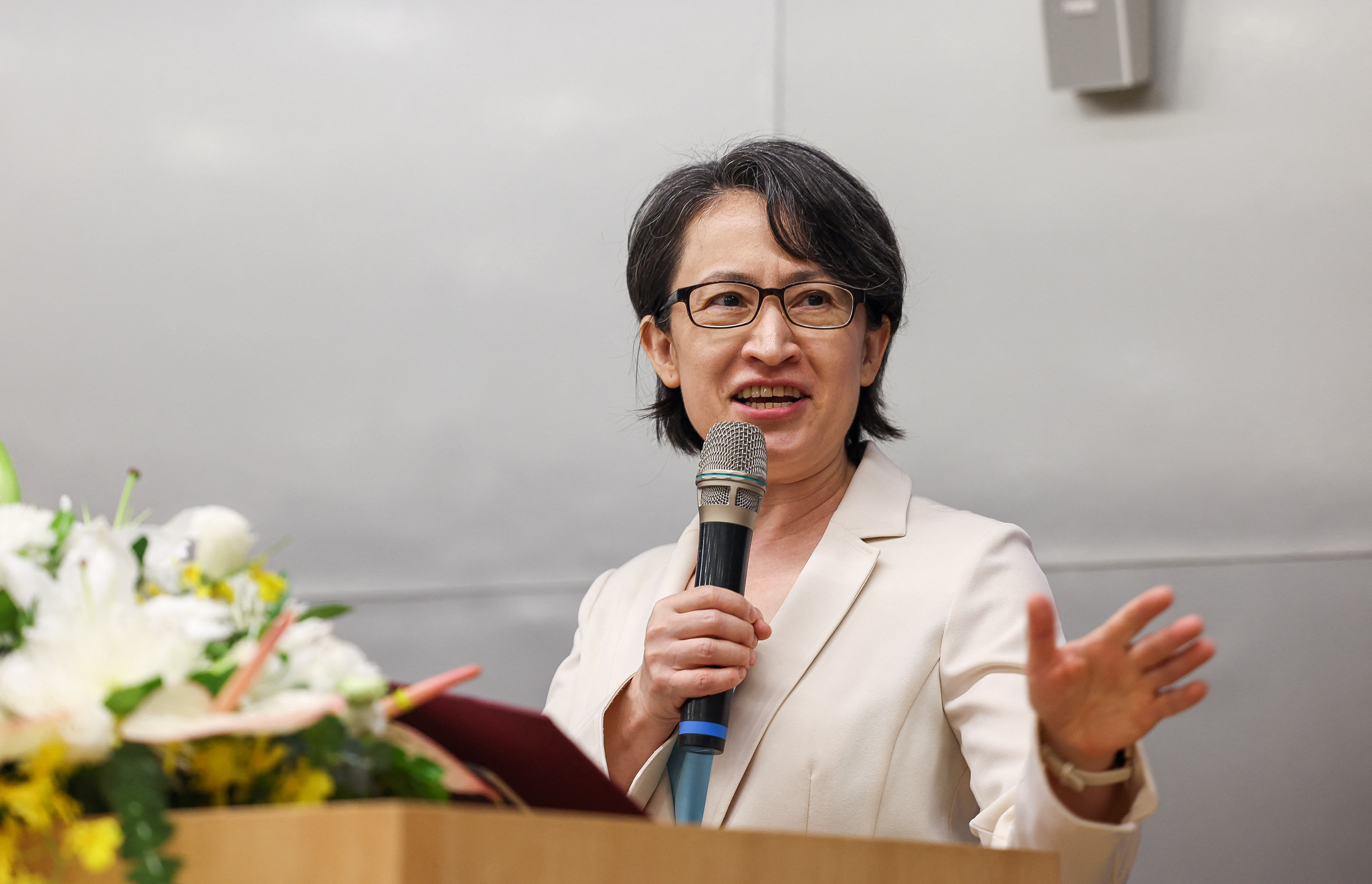

Taiwan and the United States are “indispensable, complementary partners” in advancing artificial intelligence, Vice President Hsiao Bi-khim said on March 24, highlighting shared democratic values and aligned technology strategies.
Hsiao delivered her remarks via recorded video at the Hill and Valley Forum. The one-day event in Washington brought together Silicon Valley executives and Washington policymakers, including Sens. Jim Banks (R-Ind.) and Rick Scott (R-Fla.), who both warned that the AI race is a high-stakes battle, with serious consequences if China takes the lead.
“The Taiwan government has launched 10 new AI infrastructure projects, which include AI robotics, ensuring that AI is not just confined to data centers, but embodied in physical, deployable systems, including future generations of unmanned systems,” Hsiao said.
Unveiled last year, Taiwan’s 10 AI projects focus on smart application development, key technologies, and digital infrastructure, including a national computer center as well as advances in silicon photonics, quantum computing, and robotics. The projects are aimed at generating more than NT$15 trillion ($500 billion) in economic value by 2040, along with 500,000 employment opportunities in the AI sector.
In April last year, Taiwanese President Lai Ching-te said he wanted to turn Taiwan into an “AI island.”
Taiwan’s AI projects “enable seamless alignment with U.S. industry,” Hsaio added, helping meet the “growing demand for secure components and systems at scale.”
Hsaio also referenced a U.S.–Taiwan chips deal announced in January, under which Taiwanese tech companies agreed to invest at least $250 billion to expand advanced semiconductor and AI innovation in the United States, while the Taiwan government agreed to guarantee $250 billion in credit for these companies.
“Taiwan contributes to every layer of the U.S. AI hardware stack. We are more than just essential. We are a trustworthy partner,” she said.
Taiwan also welcomes the chance to take part in Pax Silica—a U.S.-led initiative aimed at building secure supply chains for advanced technology, including AI and semiconductors—Hsiao added.
“Taiwan and the U.S. are not just competitors; we are indispensable, complementary partners. Together, we will safeguard our technological advantage, fuel the next wave of innovation, and ensure a world that is not only prosperous, but free,” Hsaio said.
Banks, who spoke during the forum’s session titled “Scale, Security, and Sovereignty: Competing with China’s Defense-Industrial Model,” warned that the AI race is about more than technological dominance.
“This isn’t just a technological race, a fight over who’s going to get the best technology and win the AI race first. This is a moral fight,” Banks said. “We know that the PRC is going to lie, steal, and cheat,” he added, referring to China’s official name, the People’s Republic of China.
Banks applauded the Trump administration for releasing the AI action plan in 2025, which calls for tighter AI compute export controls and closing semiconductor loopholes to block adversaries’ access to U.S. technology.
Addressing export concerns, Banks pointed to his bipartisan Guaranteeing Access and Innovation for National Artificial Intelligence (GAIN AI) Act. The legislation would require U.S. companies to obtain a license to export advanced AI chips to China and other “countries of concern,” certifying that American companies have priority access before any foreign sales.
The Senate included the GAIN AI Act in its version of the Fiscal Year 2026 National Defense Authorization Act when it passed the bill in October 2025.
During a separate session at the forum, titled “The Operating System for Institutions: Money, Workflows, and AI,” Scott spoke about the purpose of his bill, the No Adversarial AI Act, which was introduced in both chambers of Congress last year.
“We are competing against China. The government of China wants to destroy our way of life,” Scott said. “When they wake up every day, [they think,] ‘how can the American way of life be destroyed?’”
“My goal is [that] we got to put ourselves in a position that we can outcompete, especially China, with regard to AI,” Scott added.
Under Scott’s legislation, the Federal Acquisition Security Council would maintain a list of AI technologies developed by companies linked to foreign adversaries, and government agencies would be prohibited from using any AI tools on that list.