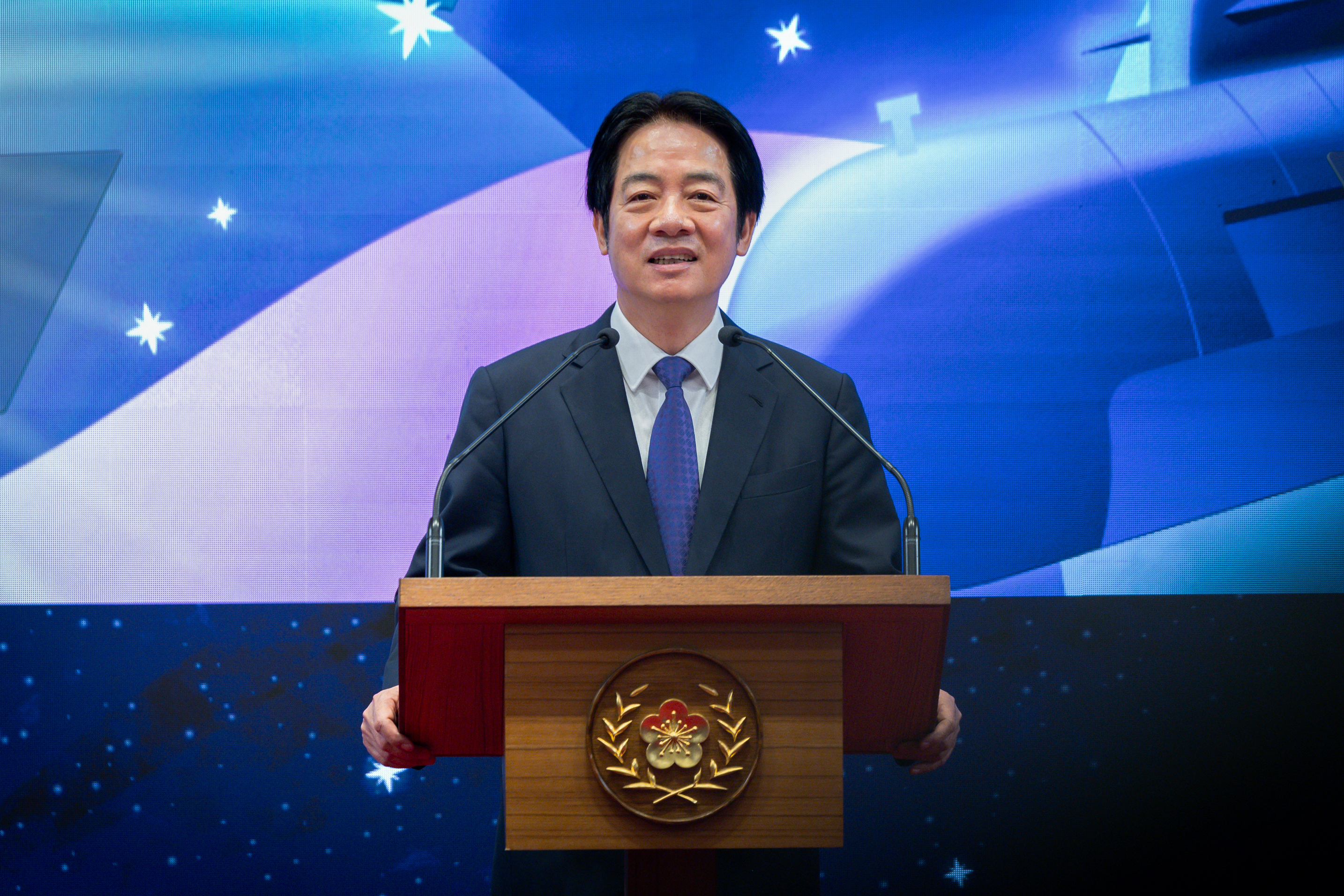

TAIPEI, Taiwan—President Lai Ching-te pledged to strengthen Taiwan’s defenses and protect sovereignty on Jan. 1, calling for unity at home after China conducted large-scale war games around the island earlier this week.
Lai made the remarks during a New Year’s address, amid a political rift that has prevented his special $40 billion budget for arms purchases, including a proposed air defense system called the Taiwan Dome, from being discussed in the legislature.
“As president, my position has always been clear: to staunchly defend national sovereignty, strengthen national defense, and enhance whole-of-society defense and resilience, and to comprehensively establish robust deterrence and democratic defense mechanisms,” Lai said in Mandarin, according to a translation provided by the presidential office.
On Monday and Tuesday, China deployed destroyers, frigates, fighters, bombers, unmanned aerial vehicles, amphibious assault ships, and coast guard vessels for drills encircling Taiwan and fired 27 rockets into the island’s nearby waters. According to Taiwan’s defense ministry, more than 200 Chinese military aircraft flew near the island during the 48 hours through 6 a.m. local time on Wednesday.
China’s foreign ministry said on Monday the drills were intended as “punitive and deterrent action” against what it called “separatists” who seek “Taiwan independence” through military buildup. The Chinese communist regime has never ruled Taiwan but considers the island its own territory. The regime has escalated pressure on Taiwan since 2016, when the Democratic Progressive Party (DPP) began the first of three consecutive four-year presidential terms.
Lai said his administration had announced new national security measures to counter Chinese infiltration and would accelerate revisions to local laws to strengthen national security. He also pointed to his $40 billion special defense budget, which he said would “comprehensively upgrade” Taiwan’s combat capabilities and defense industry.
“Facing China’s alarming military ambitions, Taiwan has no time to wait and certainly no time to consume ourselves with internal strife,” Lai said.
“We may hold different views on many issues, but without strong and resilient national defense, there will be no country, nor will there be space allowed for us to debate,” Lai continued. “This should be a national consensus across party lines.”
Lai expressed hope that the DPP and the opposition parties can “work together to swiftly pass this crucial national defense budget.”
The opposition, which consists of the Kuomintang (KMT) and its much smaller ally, the Taiwan People’s Party (TPP), blocked the legislative review of the special defense budget for the fifth time on Dec. 30.
In late November, after Lai announced the special defense budget, Raymond Greene, director of the American Institute in Taiwan—the U.S. de facto embassy on the island—applauded the president’s decision, saying at the time that doing so was “a major step towards maintaining peace and stability across the Taiwan Strait by strengthening deterrence.”
KMT Chair Cheng Li-wun has voiced opposition. In a press release dated Nov. 26, Cheng said that the special defense budget, combined with other proposed spending for 2026, would push government borrowing beyond the legal limit of NT$500 billion (about $16 billion).
Sen. Roger Wicker (R-Miss.), chairman of the Senate Armed Services Committee, expressed support for Lai’s proposed special defense budget in a post on X on Dec. 29, responding to China’s military drills.
“Our Taiwanese allies must set aside partisan differences to fully fund President Lai’s proposed Special Defense Budget now,” Wicker wrote. “There is no time to waste.”
Lai said he “will take action to promote cooperation between the ruling and opposition parties.”
“Democracy gives us the right to debate and the right to disagree. But without a nation, freedoms and rights like these would not exist,” Lai said.
“As a president elected by the people, I shoulder the mandate of all the people of Taiwan. Thus, I will spare no effort to defend the nation and protect our hard-earned free and democratic way of life,” Lai continued. “We will not be held back by political deadlocks.”
Chinese leader Xi Jinping reiterated his ambition to annex Taiwan in his New Year’s Eve address on Wednesday, saying that “reunification” is “unstoppable.”
The Pentagon, in its annual report on China’s military developments released on Dec. 23, stated that “China expects to be able to fight and win a war on Taiwan by the end of 2027.”